
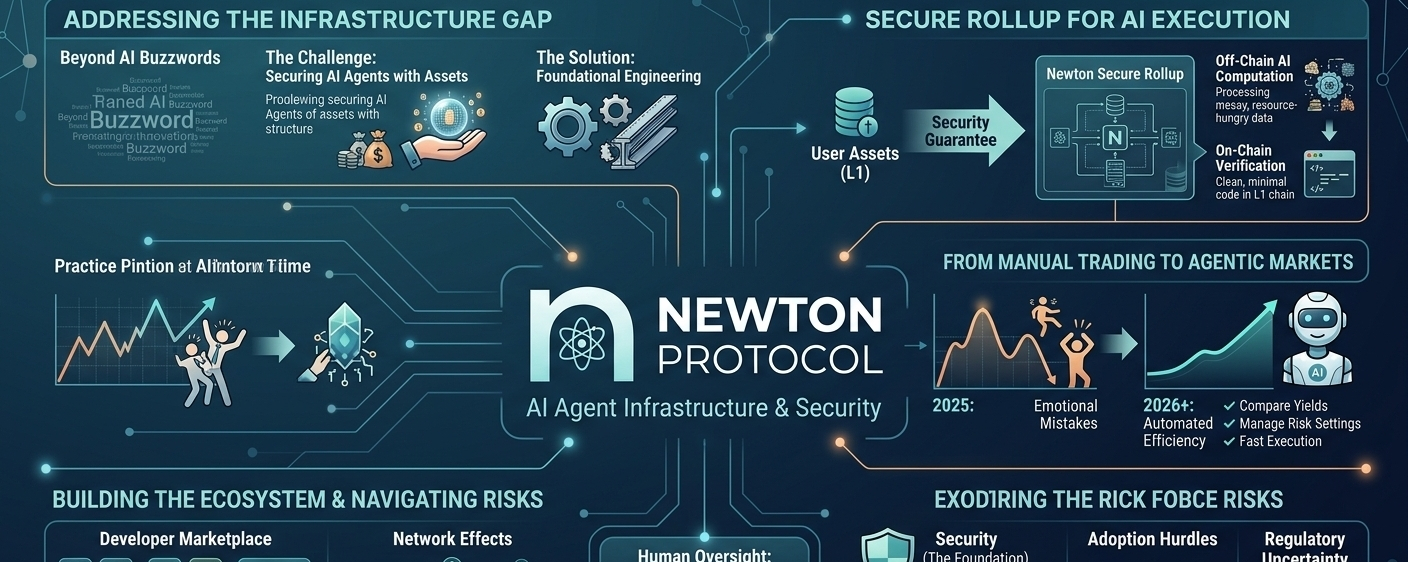

I've spent way too much time digging through AI projects over the last year, and honestly, most of them blur together after a while. Every other project says it's building "AI for Web3," every whitepaper throws around the same buzzwords, and after reading ten of them you start feeling like you're reading the exact same paragraph with different logos pasted on top. Then I came across Newton Protocol, and my first reaction wasn't excitement. It was skepticism. A lot of it. Because AI and crypto together have become one of those combinations that instantly makes me think, "Okay... what's the catch?" But the more I looked into it, the more I realized the team isn't trying to sell an AI chatbot with a token attached. They're actually trying to solve a problem that's been sitting in plain sight for years.
Let's be honest here... everyone talks about AI agents now. X is full of people saying AI will manage wallets, trade automatically, rebalance portfolios, negotiate on-chain, and basically become your digital employee. Sounds cool. But almost nobody spends time talking about the infrastructure those agents actually need. If an AI controls assets worth thousands or even millions of dollars, where does that logic run? How do you verify what it did? How do you stop it from making a catastrophic mistake? That's the boring part nobody wants to tweet about, but it's probably the most important part.
Newton Protocol seems obsessed with that layer instead of chasing flashy demos. I actually like that. It feels less like marketing and more like engineering.
Actually, wait... I almost forgot something that really stood out to me. The project is centered around a secure rollup instead of pretending every AI task should happen directly on a blockchain. That makes way more sense than forcing expensive computation onto Layer 1 networks. AI models aren't lightweight. They're messy, resource-hungry, and constantly processing huge amounts of information. Trying to squeeze all of that directly on-chain sounds clunky from day one. A rollup gives them breathing room while still keeping security connected to blockchain verification. It's not glamorous, but honestly, that's usually where the best infrastructure projects live.
Another thing I keep thinking about is automated trading. People hear that phrase and immediately imagine guaranteed profits. That's probably the biggest misunderstanding in crypto right now. AI doesn't magically print money. Markets don't care how smart your model is. Black swan events still happen. Liquidity disappears. Narratives flip overnight. Anyone who was active during some of the crazy market swings in 2025 knows exactly what I'm talking about. AI isn't replacing judgment. It's replacing repetitive work. There's a huge difference.
That's where Newton starts making sense to me. Instead of expecting users to stare at charts twenty-four hours a day, an AI agent could monitor dozens of protocols, compare yields, react to predefined risk settings, and execute transactions far faster than any human could. Does that mean it'll always outperform? No. Absolutely not. But it might remove a lot of emotional mistakes, and if you've been in crypto long enough, you know emotions destroy more portfolios than bad technology ever did.
I also keep circling back to the developer marketplace idea because I think people are underestimating it. Everybody talks about tokens, TVL, and trading volume, but ecosystems don't become valuable because of those numbers alone. They become valuable because talented builders keep showing up. If Newton can become the place where developers publish AI agents the same way developers publish software libraries today, that's interesting. Really interesting. Suddenly you're not just betting on one team. You're betting on hundreds or thousands of independent developers creating tools nobody even imagined when the protocol launched.
Anyway, that's obviously easier said than done. Building marketplaces is hard. Really hard. Network effects aren't something you can manufacture with incentives forever. At some point people stay because the product is actually useful, or they leave because it isn't. We've watched enough crypto ecosystems learn that lesson the expensive way.
Something else that's been stuck in my head lately is how people keep arguing that AI will completely replace traders. I don't buy it. Maybe that's a hot take in January 2026, but I think human oversight is still going to matter for a long time. AI can process information faster than we can. It doesn't panic. It doesn't get greedy after three green candles. But it also doesn't truly understand context the way experienced investors sometimes do. It sees probabilities. Humans sometimes see things that haven't shown up in historical data yet. The sweet spot probably isn't AI replacing humans. It's AI handling everything repetitive while humans decide when the assumptions themselves need to change.
Security is another rabbit hole I ended up spending way too much time thinking about. If an AI agent has permission to move assets, that's a massive responsibility. One bug could become incredibly expensive. One exploit could wipe out months of gains. That's why I actually appreciate projects that spend more time discussing permissions, verification, execution environments, and audits than promising impossible returns. The flashy announcements get attention, but security is what people suddenly care about after something goes wrong.
I almost forgot to mention the timing because timing matters more than people admit. AI infrastructure has become one of the hottest conversations across tech, while Layer 2 ecosystems keep getting faster and cheaper. Those trends aren't slowing down. They're colliding. Whether Newton becomes the dominant protocol or not is impossible to predict, but it's definitely building in a part of the market that feels increasingly relevant instead of chasing yesterday's narrative.
Of course, there are things that still worry me. Adoption isn't automatic. Developers have countless ecosystems competing for their attention. Users don't switch platforms just because someone says "AI" a hundred times. The protocol needs real performance, reliable tooling, documentation people can actually understand, and enough trust that serious capital is willing to interact with autonomous agents. That's a very high bar. Crypto communities can be incredibly patient until they aren't.
Then there's regulation. Nobody really knows where everything settles yet. Different countries keep moving at different speeds, and projects combining AI with decentralized finance are basically sitting right in the middle of two industries that regulators already struggle to categorize. That uncertainty isn't unique to Newton, but pretending it doesn't exist would be naive.
Still, I keep coming back to one simple thought. Infrastructure usually looks boring before it looks obvious. People laughed at cloud computing until everyone depended on it. Layer 2 scaling sounded unnecessary until blockchain activity exploded. Maybe secure AI execution ends up being another one of those things where nobody cares until suddenly everyone needs it. If AI agents are genuinely going to manage assets, execute trades, interact across protocols, and perform meaningful economic activity, then the question isn't whether infrastructure matters. It's whether anyone built the right infrastructure early enough, and that's probably the part of Newton Protocol I can't stop thinking about.
