
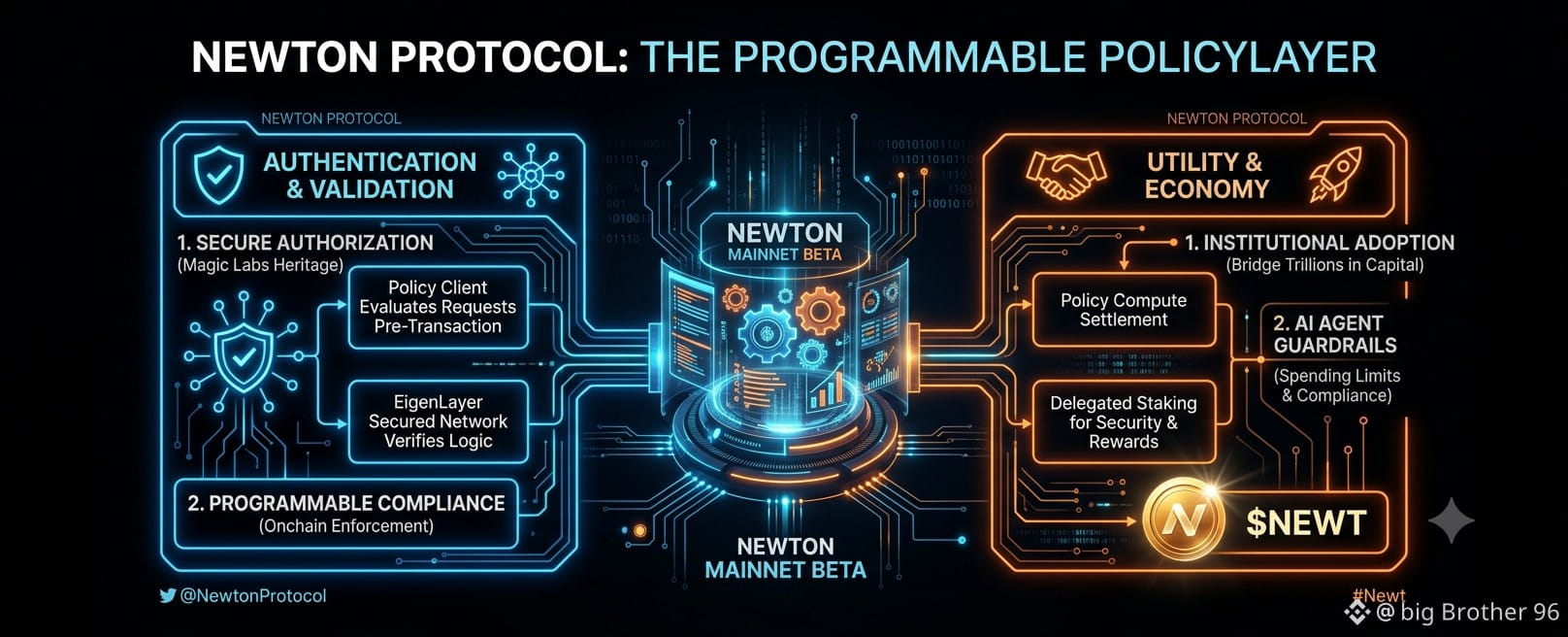
As the blockchain landscape matures, the focus of global decentralized development is shifting from a pure race for transactional speed to a much more complex and critical frontier, which is the challenge of secure authorization and programmable compliance. While the early years of decentralized finance were dominated by the sheer mechanics of transaction execution, ensuring that an asset could move smoothly from point A to point B, the actual institutional and real-world adoption of this technology requires a layer of intelligence that sits right before execution takes place. Today, standard smart contracts execute rules precisely as written, but they remain functionally blind to external, real-world context, jurisdiction limits, identity parameters, and complex risk matrices. This architectural gap has historically kept trillions of dollars in traditional institutional capital sitting cautiously on the sidelines. To bridge this divide, a paradigm-shifting approach is emerging through the efforts of @NewtonProtocol, which has introduced a dedicated, decentralized policy layer designed to turn compliance and rule enforcement into verifiable onchain code.
To understand why this evolution is so revolutionary, one must examine the daily friction points that enterprise users, stablecoin issuers, and autonomous AI agents face when attempting to navigate the Web3 space. In traditional finance, every transaction undergoes a silent but highly sophisticated sequence of checks before it clears, evaluating whether the sender is sanctioned, whether the transaction violates geographic regulations, or if it triggers fraud prevention thresholds. Blockchains, by default, lack an elegant mechanism to handle these checks pre-transaction without completely centralizing the protocol or introducing immense latency. By building an infrastructure specifically optimized for pre-transaction policy evaluation, Newton Protocol changes the fundamental equation of decentralized trust. It allows developers to define exact rules for how digital assets are allowed to move, verifying identity and safety metrics via cryptographic proofs before a single block is permanently written.
This ambitious architecture is moving rapidly from an impressive theoretical framework into a tangible reality with the launch of the Newton Mainnet Beta. This release marks a foundational milestone for the ecosystem, providing a live environment where decentralized applications, institutions, and builders can actively deploy and test programmable permissions. Unlike typical infrastructure projects that attempt to build entirely in isolation, this protocol leverages deep technical lineage and strategic collaboration. Spearheaded by the visionary team at Magic Labs, who originally pioneered the concept of embedded wallets used by millions of mainstream consumers across apps like Polymarket and Mattel, the protocol is built on a pedigree of making Web3 frictionless and accessible. By collaborating closely with Polygon Labs and integrating deeply with the AggLayer, the network establishes a structure where liquidity remains unified across chains while enforcement layers remain perfectly consistent, avoiding the fragmented user experiences that plague contemporary cross-chain solutions.
At the core of this network architecture is a sophisticated engine that leverages the Open Policy Agent standard, utilizing modular policy language to make complex jurisdictional rules entirely composable. When a transaction is initiated, the policy client intercepts the action to perform real-time verification against the specific rules established by the protocol or dApp. This evaluation is not performed by a central server, which would introduce a single point of failure, but rather by a highly secure, decentralized Actively Validated Service network that is secured through EigenLayer restaking. This dual reliance on crypto-economic security and programmable code ensures credible neutrality, meaning that businesses and global regulators alike can trust that the rules are being enforced exactly as coded, transparently and without human bias.
The economic engine driving this entire verification framework is the native utility token, $NEWT. Within the ecosystem, the token serves several critical, non-speculative functions that are tied directly to the volume of compliance and policy compute happening on the network. Every time a smart contract or an AI wallet requests a policy check to verify a transaction's safety, the underlying compute fees are settled using the token. Furthermore, the operators who dedicate computational resources to validate these policies and generate cryptographic proofs must stake the token as collateral, ensuring they have skin in the game and are penalized if they provide inaccurate verifications. For ordinary participants and long-term supporters, a delegated proof-of-stake mechanism allows token holders to allocate their assets to trusted operators, earning a share of network rewards while directly hardening the overall security profile of the system.
Looking forward, the implications of this technology extend far beyond standard institutional finance into the rapidly accelerating domain of autonomous AI agents. As AI models are increasingly granted economic agency, equipped with embedded crypto wallets to buy data, rent compute, and execute transactions independently, they will require strict, unalterable guardrails to prevent them from operating outside of authorized parameters. A company deploying a fleet of AI agents cannot afford to have a model inadvertently interact with a sanctioned address or drain its entire treasury due to an algorithmic loop. By utilizing the protocol's pre-transaction enforcement, developers can bake spending limits, whitelist domains, and risk-management rules directly into the transaction path of the AI agent, making it virtually impossible for the machine to break its operational bounds.
Ultimately, the transition toward a decentralized economy that can safely accommodate both global enterprises and autonomous software agents depends entirely on the creation of robust, neutral infrastructure. The Newton Mainnet Beta represents a vital step toward this future, proving that compliance does not have to mean a sacrifice of user privacy or decentralized values. Instead, by encoding authorization logic into the very fabric of the blockchain ledger, the network turns regulatory and operational risks into verifiable mathematical truths. For investors, developers, and blockchain enthusiasts tracking the long-term utility of digital infrastructure, watching the growth of the network and the utility accumulation of #Newt will be essential as the industry leaves behind the era of unchecked execution and enters the era of programmable onchain trust.
