

Smart contracts are deterministic machines. Feed them garbage, they'll execute garbage perfectly every single time.
The Lie We Keep Telling Ourselves
The blockchain works. The code is audited. The math is sound. Then a flash crash happens because someone's oracle reported $0.01 ETH, and $50 million evaporates in six seconds. The contract did exactly what it was told. The problem was the truth it was told to execute.
This is the dirty secret of DeFi: every liquidation, every synthetic mint, every algorithmic rebalance, every insurance payout is only as legitimate as the data that triggered it. The blockchain doesn't verify reality it verifies consensus. And if consensus is fed a lie, the lie becomes law.
APRO isn't fixing smart contracts. It's fixing the data layer that makes them useful or catastrophic.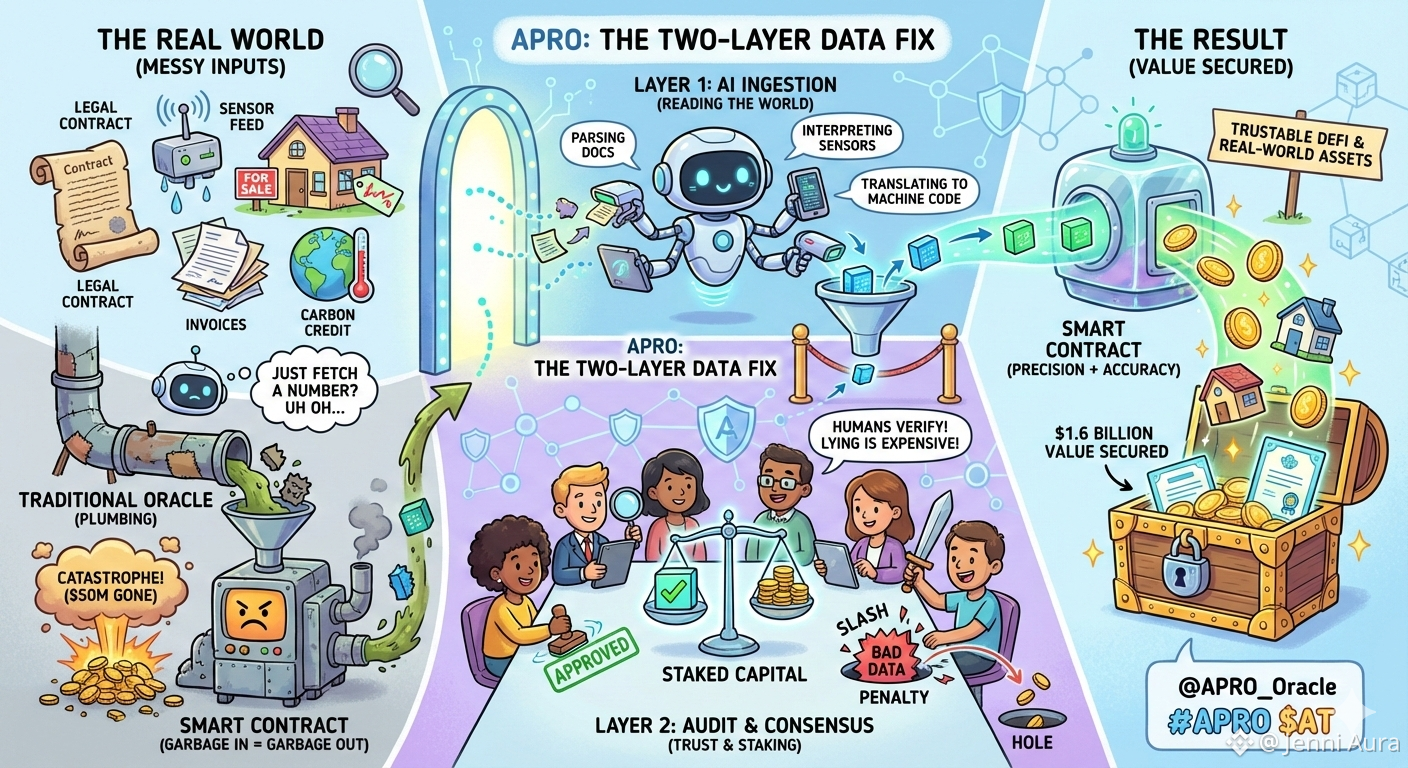
Why Most Oracles Are Just Expensive Vulnerabilities
Traditional oracles treat data delivery like plumbing: fetch a number, broadcast it, call it done. That works fine for liquid assets with deep order books. It falls apart the moment you need to verify something that doesn't have a ticker.
What's the fair value of a tokenized invoice? What's the occupancy rate of a real estate property backing a yield product? What's the attestation status of a carbon credit? These aren't questions you can answer by scraping Binance.
APRO's design acknowledges this: not all data is created equal, and the messier the input, the more you need verification infrastructure that can handle ambiguity without breaking trust.
The Two-Layer Architecture That Changes the Game
Here's where APRO stops being another price feed and starts being different: its RWA oracle uses a two-layer system.
Layer 1: AI Ingestion
Machines read unstructured real-world inputs documents, webpages, legal contracts, sensor feeds. This is where raw information gets parsed, interpreted, and translated into machine-readable form.
Layer 2: Audit and Consensus
Humans and incentives validate what the machines found. This is where challenge mechanisms, slashing, and staked capital enforce accuracy. If a node reports bad data, it loses money. If a report gets challenged and proven wrong, the node gets slashed.
The separation matters. Layer 1 is about reading the world. Layer 2 is about deciding what the chain should trust. Mixing those responsibilities is how you get AI hallucinations treated as gospel.
APRO separated them because it's not betting on AI being perfect—it's betting on adversarial validation catching imperfections before they blow up a protocol.
Why Staking-as-Margin Is the Unlock
Most oracles ask nodes to stake, but slashing is theoretical or governance-gated. APRO built slashing as a first-class execution mechanism: if your data deviates from consensus or fails a challenge, you lose capital automatically.
This isn't reputation it's economics. Nodes don't report accurately because they're virtuous. They report accurately because lying is expensive and getting caught is inevitable. That's how you build trust in a trustless system: make truth profitable and lies costly.
The result is an oracle that doesn't just broadcast data it stakes its reputation and capital on every data point it submits. That's not marketing. That's skin in the game.
The Metric That Actually Matters: Value Secured
People ask about TVL, but oracles don't lock funds like lending protocols. The real number is value secured: how much capital depends on the oracle being right.
APRO reports $1.6 billion in assets secured. That's $1.6 billion in positions, collateral, settlements, and liquidations that rely on APRO's data being accurate. If the oracle fails, that value is at risk. If the oracle holds, that value stays safe.
That's the only TVL metric that matters for infrastructure: how much would break if you disappeared?
Multi-Chain as Operational Reality, Not Marketing
APRO supports 161 price feeds across 15 blockchain networks. That's not a vanity stat it's operational surface area. Every chain has different latency, different execution quirks, different failure modes.
Multi-chain coverage expands addressable market, but it also expands attack vectors. The trade-off is clear: grow the network or minimize complexity. APRO chose growth, which means they're betting on operational discipline at scale over security through simplicity.
That's a bet every infrastructure project eventually makes. The winners are the ones who scale without breaking.
Why Real-World Assets Make This Critical
DeFi started with crypto-native collateral: ETH, BTC, stablecoins. Clean data, liquid markets, easy oracles. But the next trillion in onchain value isn't coming from more leverage on the same five assets. It's coming from tokenized bonds, real estate, commodities, supply chains assets with legal documents, audit trails, and no Coinbase ticker.
Those assets need oracles that can handle complexity: multi-jurisdiction compliance, off-chain verification, human-readable contracts translated into machine-executable logic. APRO's two-layer architecture is designed for exactly that use case.
This is where most price-feed oracles hit a wall. They're built for tickers, not title deeds. APRO is built for both.
The Unsexy Truth About Infrastructure
APRO won't moon because of a viral tweet. It won't 100x because of hype. It will succeed or fail based on one metric: does the data hold up when volatility spikes, adversaries attack, and billions are at stake?
That's not exciting. That's just infrastructure. The best kind doesn't get noticed until it's not there.
Smart contracts execute with mathematical precision. But precision without accuracy is just automated catastrophe. APRO is betting that the market will eventually pay for the intelligence layer that makes execution meaningful not flashy, just correct.
And in a world where one bad data point can liquidate millions, correct might be the most valuable product nobody's pricing in yet.

