
So I hpave been stAring at dead order books for days and somehow fell into reading about @NewtonProtocol Not because anything exciting happened in the markets, just that weired itch you get when nothing moves. A few forums kept whispering about their zkPermissions thing and how it could make bots actually independent on-chain. You know how it goes.
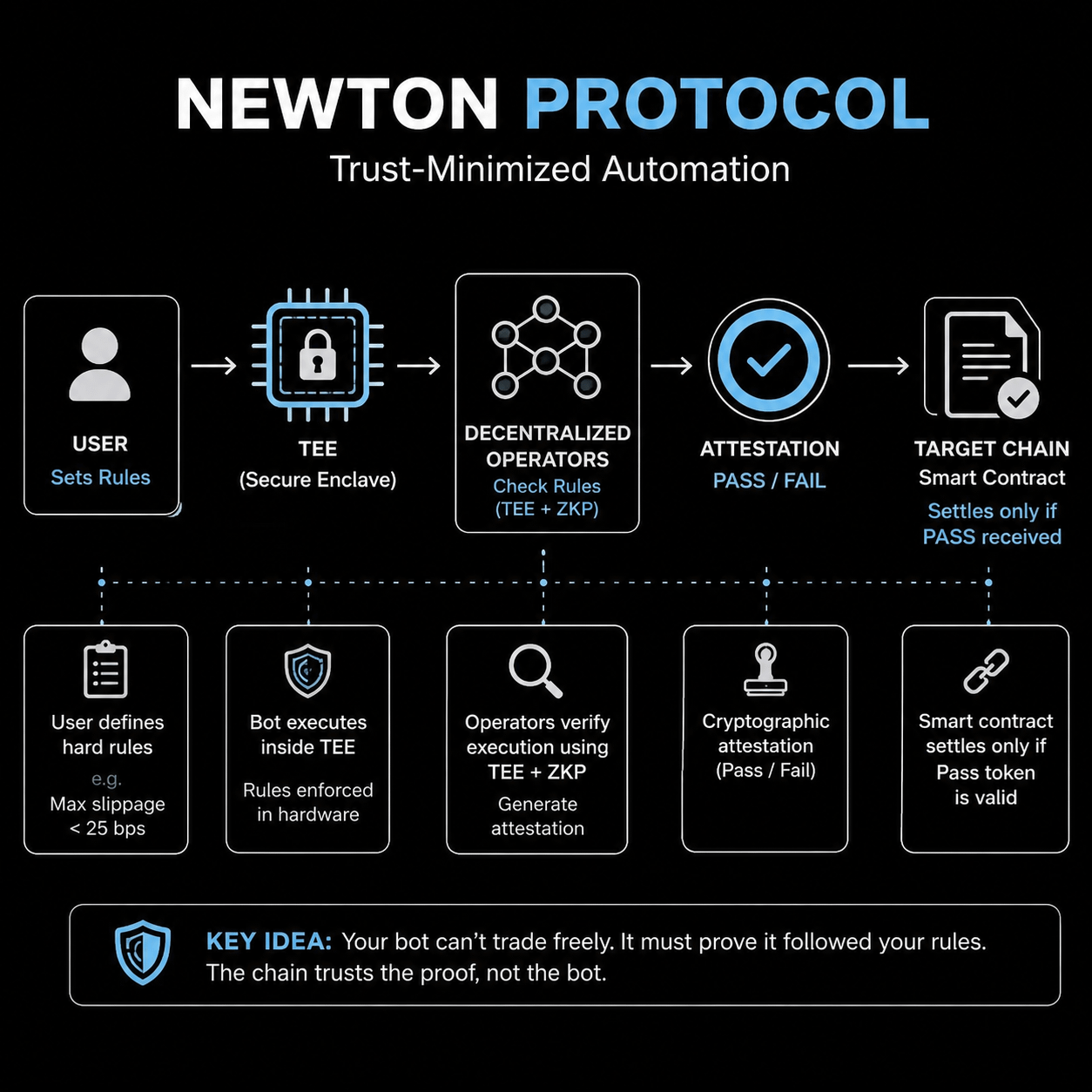
The basic idea newton pushes is simple enough. You got boring tasks like rebalancing your portfolio or making scheduled payments. Instead of doing it yourself, you let a bot handle it. But here's the part that caught my eye. With Newton, you don't just hand over your keys like some maniac. You set hard rules first. Lik telling the bot "stop everything if you lose more than 25 basis points on slippage." The bot then has to show proof it stayed inside those lines. Sounds clean right?
Well I kept reading Newton's docs deeper and found something that bugged me.
The fancy diagrams skip over how execution actually flows. Your bot doesn't fire trades directly at some blockchain. It runs inside a TEE which is basically a locked hardware safe, and instead of executing straight away, it sends a transaction "intent" to Newton's decentralized operators. These operators check your rules using TEE plus ZKP and generate a cryptographic attestation, basically a Pass or Fail stamp. The target chain's smart contract won't settle anything unless it sees that Pass token from Newton.
I originally thought the proof would block bad stuff in real-time before it hit any mempool. That was dumb of me. The attestation is still generated after the fact inside that enclave, and the target chain blindly trusts whatever stamp comes out. Newton's design banks on physical silcon enforcing your rules first, and the math proof is just the chain checking a receipt before letting settlement happen.
This changes how i look at Newton's whole pitch now.
They talk big about trust-minimized automation riding on zero-knowledge like it erases needing to trust anyone. But you're still betting that TEE chip has no bugs. That the secure compartment never leaks secrets. That the chip maker actually built real physical protection. Zk proofs are great at saying "this result followed these rules." What they absolutely can't do is stop the agent from doing shady stuff inside that enclave before any atestation even starts forming. And if the enclave is compromised, it can just generate a fake Pass stamp that the target chain will happily accept. The real trust ain't in clean math, it's in hardware being solid. And silicon has way more security fails than number theory ever did. Side-channel attacks pulling secrets out of enclaves aren't theory anymore, they've hit way bigger targets than some defi bot.
Newton probably isn't broken and i doubt the builders ignored this stuff. Layering TEE with ZKP is a deliberate bet where each piece covers what the other misses. Still the word "verifiable" in Newton's docs feels heavy in a way that i think people confuse with "unbreakable" and those two things aren't even neighbors. Verifiable just means you can spot the mess after it happened. Not that the mess was impossible.
Where this gets scary isn't some guy doing weekly bitcoin buys. It's DAOs handing treasury control to bots or anyone building complex chains where one trigger feeds another. The more complicatd the rules get inside Newton's execution setup, the bigger the gap between what really happened inside that enclave and what the proof claims. Attack surface just grows.
Markets still flatlining. Maybe i'll grab coffee and watch more sidways candles.
