
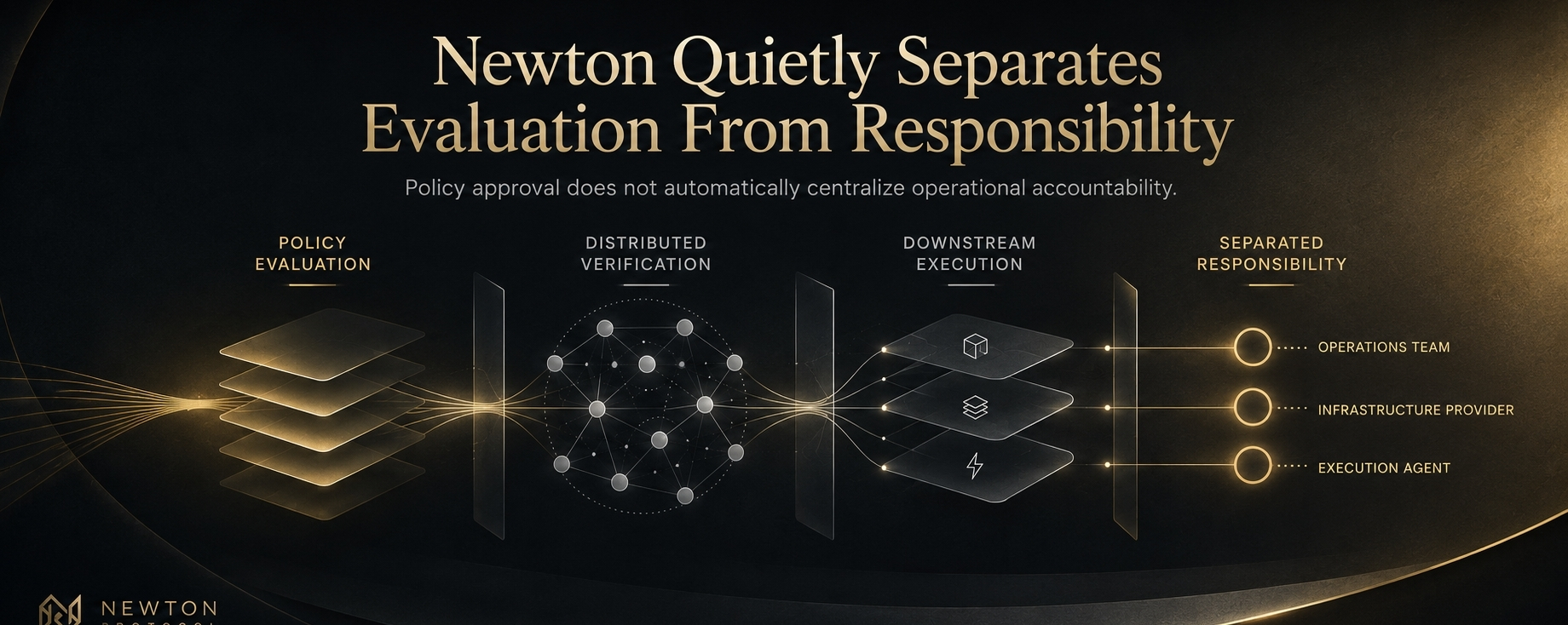
I spent some time thinking about what @NewtonProtocol operators are actually responsible for once a policy task moves through the network.
At first, the answer looked straightforward.
Operators evaluate the policy.
They verify the required conditions.
They contribute signatures toward the final proof.
Simple.
But the more I looked at Newton’s execution flow, the harder it became to treat policy approval and operational responsibility as the same thing.
Because Newton’s architecture appears to separate them very carefully.
A policy task can pass evaluation.
The downstream action can still fail.
That distinction matters much more than I first realized.
Newton’s documented flow separates policy evaluation from transaction execution across multiple components. Operators retrieve the required data, evaluate the Rego policy, and contribute BLS signatures toward an aggregated proof confirming that the evaluated conditions were satisfied.
A PolicyClient can then verify that aggregated proof before allowing the protected transaction or operation to proceed.
At first glance, it is easy to mentally compress that entire flow into one idea:
“The network approved the action.”
But that framing quietly hides an important boundary.
The operator network evaluates whether the defined policy conditions were satisfied at evaluation time.
It does not automatically assume responsibility for everything that happens afterward.
That sounds obvious until you follow the execution lifecycle more closely.
A downstream contract can still revert.
An external dependency can still fail.
A transaction can still run out of gas.
A required service can still become temporarily unavailable.
The policy evaluation may remain valid while the operational outcome still breaks somewhere later in the execution path.
What stood out was not the existence of failure.
Distributed systems always contain failure boundaries.
What stood out was where Newton appears to place responsibility for those failures.
The policy network proves that operators evaluated the defined rule set and collectively agreed on the evaluation outcome.
But operational responsibility still partially remains with the surrounding application environment, PolicyClient implementation, downstream contracts, infrastructure dependencies, execution assumptions, and the logic connecting them together.
That creates a cleaner separation than I initially expected.
Collective evaluation does not automatically centralize operational liability.
I keep coming back to that distinction.
Because modern infrastructure systems often blur those boundaries together.
Users see an approved action and assume the complete workflow itself has become trustworthy end-to-end.
But Newton’s architecture seems more careful than that.
The evaluation layer proves that the defined policy conditions were satisfied during evaluation.
It does not guarantee that every downstream dependency, execution environment, or external system will continue behaving correctly afterward.
Those are different security questions.
And honestly, separating them may be healthier for infrastructure systems long term.
Because once policy evaluation, execution environments, external dependencies, and application logic all begin interacting continuously, pretending they share identical responsibility boundaries may create even more confusion.
Especially once adaptive systems begin coordinating actions faster than humans can manually inspect each operational step in real time.
A valid policy outcome may still enter an unhealthy execution environment.
A correctly evaluated task may still depend on unreliable downstream infrastructure.
An approved operation may still fail because surrounding conditions changed after evaluation occurred.
The network can validate conditions.
It cannot freeze reality around them.
That feels like one of the more important distinctions hiding inside Newton’s architecture.
And it also changes how responsibility may need to be communicated to users building on top of these systems.
Because operator consensus may prove that a policy was evaluated correctly.
It does not automatically explain where operational responsibility moves once execution leaves the evaluation boundary and enters the wider application lifecycle.
That is not necessarily a flaw.
In many ways, it may be a more honest infrastructure model.
Distributed policy evaluation can reduce trust assumptions around authorization decisions without pretending that cryptographic agreement magically removes operational risk from the rest of the system.
Still, the separation creates important infrastructure questions.
If a downstream dependency fails after policy approval, how should applications communicate that distinction to users?
Where should retry responsibility live?
How much operational trust still sits outside the evaluated policy boundary?
And once autonomous financial systems begin coordinating actions continuously across multiple environments, will users clearly understand which layer actually failed?
Newton’s architecture appears to answer one question very carefully:
whether policy conditions were collectively evaluated and verified.
The harder question may begin afterward.
Where does operational responsibility actually move once verified execution enters the real world?