
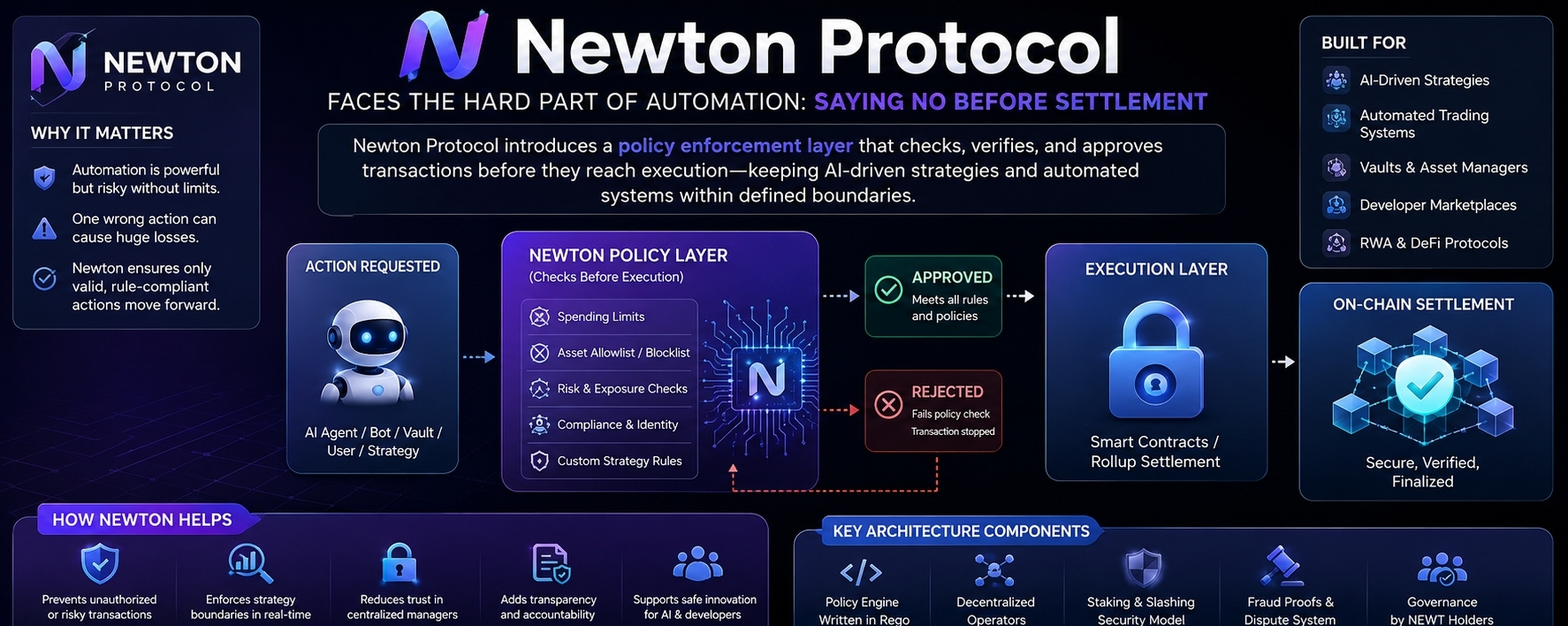

Newton Protocol is one of those projects I don’t want to judge too quickly, mostly because I’ve seen this part of the cycle before. A new AI angle appears, the market grabs it, traders flatten the idea into a ticker, and within a few weeks the real design work gets buried under noise. That is usually where good analysis has to slow down. Not because the market is patient. It is not. But because the first story around a project is often the laziest one.
With Newton, the lazy story is simple: AI strategies, automated trading, marketplace for developers, secure rollup, new token. Fine. That is the surface. I’m more interested in the uncomfortable part underneath it. Newton is not just asking whether AI can trade onchain. Everyone is asking that. Most of it sounds recycled already. Newton is asking whether automated systems can be forced to stay inside rules before they touch capital.
That is a better question.
Crypto has spent years making execution easier. Faster swaps. Cheaper transactions. More abstracted wallets. More automation. More vaults. More bots. More ways for money to move while the user is asleep, distracted, or pretending they understood the risk screen. The industry rarely admits that execution is not the hard part anymore. Restraint is the hard part. Stopping a transaction before it becomes damage is the hard part.
Newton Protocol seems to be building around that gap. The project is trying to place a verification layer between intention and execution. A user, vault, agent, or automated system may want to perform an action, but the action does not simply pass through because something signed it. It gets checked against rules first. If the action fits, it moves forward. If it does not, it should fail before funds move.
That sounds dry. It is dry. But dry infrastructure is often where the useful stuff lives.
The AI angle only makes sense if you look at it through that lens. I don’t care much for the fantasy of fully autonomous agents printing money while everyone else watches. That story has been dressed up in different clothes for years. Bots already failed. Quant vaults already failed. Copy-trading systems already failed. “AI agent” is often just the newest label slapped onto the same old promise: let the machine handle it.
The machine still needs limits.
An AI strategy can misread data. It can follow an instruction too literally. It can interact with a bad contract. It can chase a move after the edge is gone. It can be manipulated by inputs the developer did not think about. None of this is exotic. It is normal software failure, only now attached to wallets and liquidity. Newton’s role, if it works, is not to make every AI strategy intelligent. That would be a ridiculous claim. Its role is to make sure an automated system cannot wander too far outside its allowed lane.
That is where the project has a real reason to exist.
A trading agent with no hard boundary is not innovation. It is just risk with better branding. A vault manager with broad permission and weak oversight is not efficient. It is a future post-mortem waiting for the right market shock. A marketplace full of AI strategies means very little if users cannot tell what those strategies are allowed to do once money is involved. Newton is trying to make those permissions enforceable rather than decorative.
This is the part I keep coming back to. Crypto has too many promises written in docs and too few promises enforced before execution. A strategy can say it has limits. A manager can say they follow a mandate. A developer can say the agent only performs certain actions. Nice. I’ve read enough of that. The question is whether the system itself refuses the transaction when those words stop being true.
Newton wants to move that refusal into infrastructure.
There is something practical in that. Not glamorous, but practical. The protocol can be useful wherever automation meets capital. Vaults need limits. Treasury systems need limits. AI agents need limits. Strategy marketplaces definitely need limits, because once third-party developers start offering automated logic to users, the trust problem becomes ugly fast. Performance charts are not enough. Backtests are not enough. A clean interface is not enough. Users need to know what the thing can actually do with their funds.
And more importantly, what it cannot do.
That is probably Newton’s strongest angle. It treats automation as something that needs supervision, not worship. The market loves to talk about removing humans from the loop, but after enough failures you start to ask a different question: which humans, which loop, and what replaces their judgment when the system hits an edge case? If the answer is “the agent decides,” I get nervous. If the answer is “the agent acts only inside rules that are checked before execution,” then there is at least something to analyze.
Still, I’m not giving the project a free pass. Rule-based systems have their own grind. A bad rule can be worse than no rule because it gives everyone confidence while quietly allowing the wrong thing. A rule that is too loose becomes theater. A rule that is too strict turns into friction at the worst possible time. Markets move violently. Liquidity disappears. Prices gap. Contracts behave strangely under stress. The real test is not whether Newton can enforce a neat policy during normal conditions. I’m looking for the moment this actually breaks.
Because something always breaks.
Maybe a policy blocks a needed rebalance. Maybe an automated strategy gets trapped because the rule set cannot adapt quickly enough. Maybe a developer writes a rule that looks safe but misses a basic attack path. Maybe users don’t understand the permission structure and assume the protocol is protecting them from risks it never claimed to cover. Maybe the system adds just enough delay or complexity that builders decide to skip it.
That last one matters more than people admit. Developers hate friction unless the payoff is obvious. Crypto users hate friction even more. A project can have a sensible design and still fail because nobody wants to integrate another layer, another check, another dependency, another thing to explain. Newton has to prove that pre-execution control is worth the extra mental weight. For high-value systems, it might be. For casual applications, maybe not.
That creates an uneven adoption path. Newton’s best early users are unlikely to be people chasing small trades from a phone. The better fit is where one wrong action can cause serious damage: managed vaults, automated strategies with real balances, treasury flows, agent wallets, and developer marketplaces where users delegate some level of control. Those are not always the loudest markets. They are slower. More cautious. More annoying to sell into. But they also care about risk in a way retail narratives usually do not.
The secure rollup idea fits into this broader design, but I would not reduce the project to that phrase. “Secure rollup” can become another label people repeat without asking what is actually being secured. In Newton’s case, the more important piece is the transaction approval path. Can the system verify that a proposed action follows the rules? Can it do that reliably? Can it keep the process transparent enough that users and developers know what happened when something gets approved or blocked? That is where the project either earns its place or becomes another technical stack with no real gravity.
The marketplace side is interesting, but also messy. A marketplace for AI developers sounds good until you remember how marketplaces usually behave. They attract useful builders, yes. They also attract noise. Low-effort strategies. Overfitted systems. Shiny dashboards. Copycats. People selling confidence they did not earn. If Newton wants to support a marketplace for AI-driven strategies, the control layer cannot be an afterthought. It has to become part of how trust is formed. Not “this strategy claims to be safe,” but “this strategy is restricted in these specific ways, and those restrictions are enforced.”
That is a much harder product to build than a token page.
The token itself should be treated carefully. NEWT has a role inside the protocol, especially around participation, security, fees, and governance. That gives it a cleaner explanation than many tokens. But a clean explanation is not the same as demand. I’ve seen plenty of infrastructure tokens with beautiful diagrams and almost no real usage. The market trades them anyway, for a while. Then unlocks arrive, liquidity thins, attention rotates, and everyone starts pretending they were always “long-term” while checking the chart every ten minutes.
For NEWT, the question is simple and uncomfortable: does the protocol generate enough real activity to make the token matter beyond the AI label? If builders actually use Newton to check automated transactions, the token has something to stand on. If not, it becomes another asset leaning on narrative, exchange access, and timing.
Governance is another place where I’m cautious. Any protocol that helps decide whether transactions can proceed is not neutral in the casual sense. It may be useful. It may be necessary. But it is not invisible. Someone has to define policies. Someone has to update them. Someone has to decide how disputes work. Someone has to handle bad rules, stale rules, or rules that become politically sensitive. These are not small details. They are the difference between a safety layer and a quiet control point.
That tension will follow Newton if it grows. Users want protection, but they do not want to feel trapped by hidden permissions. Developers want flexibility, but they do not want unlimited liability. Automated systems need boundaries, but the people setting those boundaries need accountability too. There is no clean answer here. Just trade-offs. Crypto people hate admitting that, but most real infrastructure is just trade-offs with better documentation.
I do think Newton is looking at the right problem. That is not praise so much as recognition. The market is tired of projects that treat AI as a magic word and automation as an automatic good. More automation means more surface area for failure. More delegated control means more ways for users to misunderstand what they gave away. More strategy marketplaces mean more garbage mixed in with whatever is actually useful. Newton’s focus on permission, verification, and pre-execution checks at least starts from the mess as it exists, not from the clean fantasy people sell in launch posts.
But the grind is ahead. Not behind.
The project still has to prove that builders will care enough to integrate it. It has to prove that policy checks can be reliable without becoming heavy. It has to prove that users can understand the protections without being sold fake certainty. It has to prove that its marketplace does not become another pile of automated strategies nobody should trust with real money. It has to prove that the token is connected to usage, not just attention.
Newton Protocol is not interesting because it says AI can trade. That sentence is already worn out. It is interesting because it tries to answer the less comfortable question: when AI, bots, vaults, and automated systems start moving money, who gets to stop them before the mistake settles?