
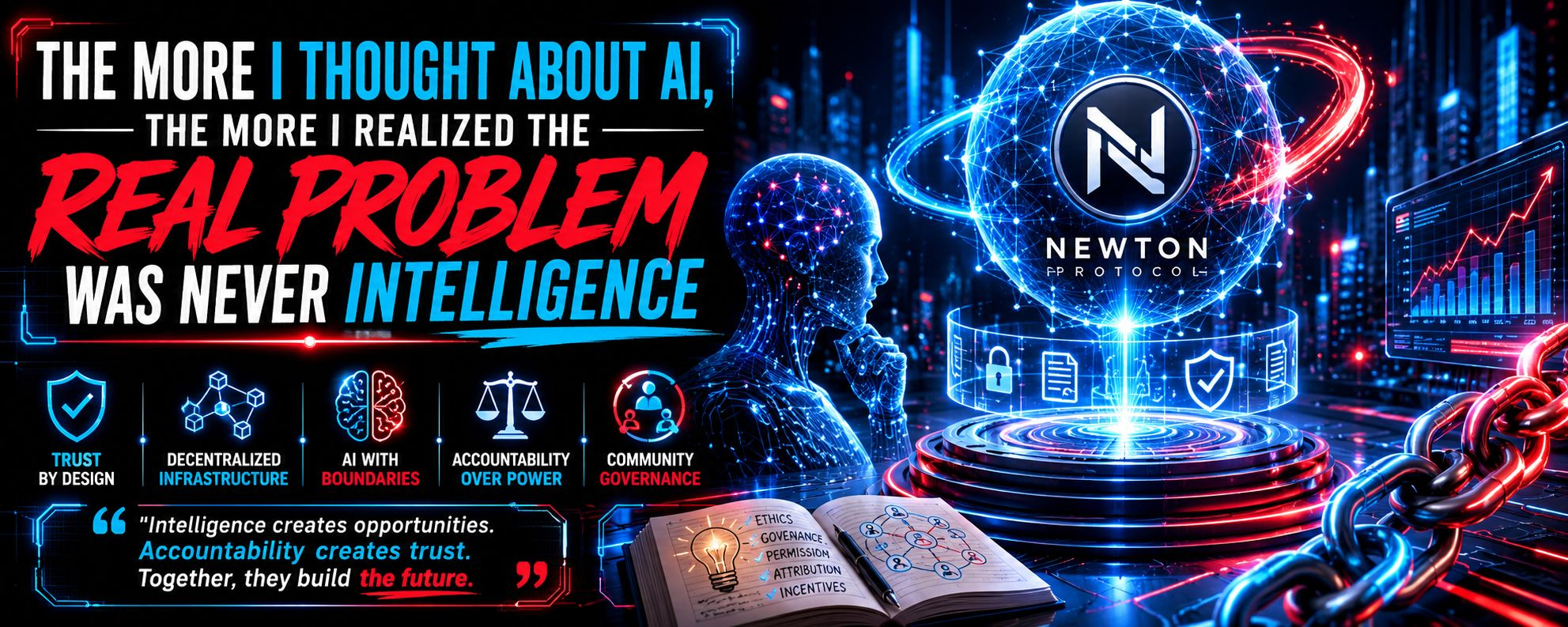
I'll be honest, Newton Protocol wasn't a project I expected to spend much time thinking about. At first glance, it looked like another attempt to combine artificial intelligence with blockchain, and if I'm being truthful, that combination has become so common that I instinctively approach it with skepticism. Every few weeks there's another protocol promising autonomous agents, smarter trading, decentralized intelligence, or a marketplace where AI somehow transforms finance. After hearing the same story enough times, you stop asking whether the technology is interesting and start asking whether anyone is actually solving a problem that couldn't already be solved with simpler tools.
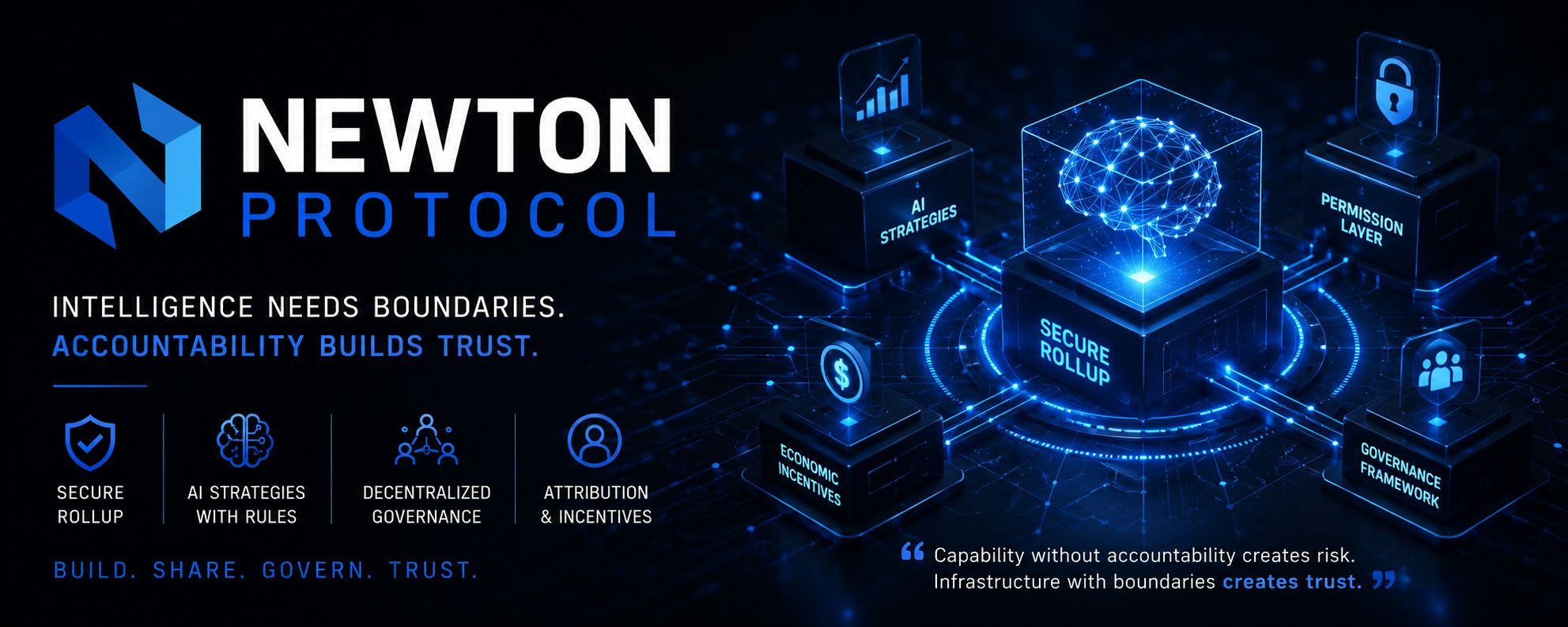
That was my mindset until I stopped looking at Newton Protocol as an AI project and started looking at it as an attempt to answer a much older question. Not how machines become more intelligent, but how increasingly intelligent systems fit inside environments where trust has always been limited.
It's easy to assume that intelligence naturally deserves authority. Humans make that mistake constantly. We admire competence so much that we often forget competence and accountability are completely different things. AI is beginning to expose that misunderstanding on a much larger scale. Models are improving at an astonishing pace. They can analyze markets, recognize patterns, generate strategies, write software, and make decisions faster than any individual ever could. Yet none of those abilities automatically make them trustworthy. In fact, greater capability often increases the cost of failure rather than reducing it.
That's the part I think many conversations quietly ignore. We spend enormous amounts of energy discussing what AI will be able to do while spending surprisingly little time discussing what AI should never be allowed to do.
The more I read about Newton Protocol, the more I felt that this was the question sitting beneath everything else.
Instead of imagining AI as something that should simply be given access to wallets, assets, and financial infrastructure, the protocol seems built around the opposite assumption. Intelligence should operate inside boundaries rather than replacing them. The goal isn't to remove human judgment but to translate it into rules that remain enforceable even when humans are no longer watching every individual transaction.
I find that idea more interesting than the AI itself.
For years, blockchain has largely been about reducing the need to trust people. Smart contracts replaced intermediaries because code could enforce agreements more consistently than institutions often could. Newton appears to extend that same philosophy toward artificial intelligence. Rather than trusting an AI because it appears capable, it asks whether capability should ever be enough on its own.
That feels like a surprisingly mature place to begin.
The secure rollup at the center of the protocol makes more sense when viewed through that lens. Initially, I wondered why AI needed specialized infrastructure instead of simply operating on existing blockchains. The answer, at least as I understand it, isn't that existing chains are incapable. It's that autonomous systems introduce an entirely different category of risk.
Traditional software follows instructions. AI interprets them.
That distinction sounds small until money becomes involved.
Interpretation introduces uncertainty. Uncertainty introduces responsibility. Responsibility eventually demands governance.
By separating the intelligence that generates decisions from the infrastructure that authorizes them, Newton seems to acknowledge that execution and reasoning should not necessarily belong to the same system. An AI may identify opportunities, optimize strategies, or recommend actions, but the surrounding architecture determines whether those actions are actually permitted.
The more I thought about that separation, the more it reminded me of constitutional systems rather than software engineering. Democracies don't function because leaders are assumed to be perfectly wise. They function because power exists within rules that remain valid even when wisdom fails.
Perhaps AI requires something similar.
Another aspect that kept pulling my attention was the idea of creating an ecosystem where developers can build and share AI strategies within an economic framework that recognizes contribution. That sounds straightforward until you consider how difficult contribution becomes to define once intelligence itself becomes collaborative.
An AI model rarely exists in isolation. It depends on researchers, infrastructure providers, datasets, validators, developers, users, and countless invisible contributors whose work overlaps in ways that are difficult to separate. Traditional ownership starts becoming blurry because outputs no longer belong entirely to one creator.
This isn't simply a technical problem.
It's an economic one.
People build where incentives exist. They share knowledge when recognition feels possible. They invest time when value doesn't disappear into platforms controlled by someone else. Attribution, in that sense, isn't merely about fairness. It's about determining whether decentralized innovation remains sustainable as AI becomes increasingly interconnected.
Newton seems to recognize that reality, although recognizing a problem is very different from solving it.
In fact, one of the reasons I found myself taking the protocol more seriously is because I kept noticing how many unresolved questions still exist.
Governance, for example, feels far more complicated than white papers often admit. Every decentralized protocol eventually reaches moments where technical decisions become political decisions. Participants disagree about incentives, security assumptions evolve, influential stakeholders accumulate leverage, and governance mechanisms that once appeared elegant begin encountering the messy unpredictability of human coordination.
Introducing AI into that environment doesn't reduce complexity.
It probably multiplies it.
The pace of machine learning development already exceeds the pace at which most governance systems can comfortably adapt. Rules that seem sensible today may become outdated surprisingly quickly. Permission structures may require constant revision. Economic incentives that initially appear balanced may slowly drift toward concentration as ecosystems mature.
I don't think Newton escapes those realities.
If anything, it embraces them by attempting to build infrastructure capable of evolving rather than pretending permanent solutions already exist.
There's something refreshing about that.
Crypto sometimes behaves as though every protocol is trying to solve history's greatest problems once and forever. Reality rarely works that way. Infrastructure is usually imperfect. Institutions evolve through iteration rather than flawless design. Systems survive because they adapt, not because they begin without weaknesses.
Perhaps that's the perspective I appreciated most.
Newton didn't leave me believing decentralized AI has finally been solved.
It left me thinking more carefully about what the actual challenge might be.
Maybe the future won't depend entirely on building more intelligent models. Maybe it will depend on designing environments where intelligence, regardless of how powerful it becomes, remains accountable to rules that people collectively understand and accept.
That feels like a much harder problem than simply making algorithms smarter.
And perhaps a much more important one.
I still don't know whether Newton Protocol will ultimately become the architecture that many hope it can be. Markets are unpredictable, governance is fragile, and technological assumptions have a habit of aging faster than anyone expects. Those uncertainties don't disappear simply because the underlying philosophy is thoughtful.
But I do think projects like this quietly shift the conversation in a healthier direction. They remind us that intelligence alone has never been enough to build durable systems. Every civilization eventually discovers that capability without accountability creates instability, no matter how impressive the capability appears at first.
As AI gradually becomes part of our economic infrastructure rather than merely another software tool, questions about ownership, permission, coordination, attribution, and trust will probably matter just as much as advances in the models themselves. Newton Protocol doesn't offer definitive answers to those questions, and perhaps no protocol can. What it does offer is a different place to begin asking them, and sometimes the quality of the questions matters more than the confidence of the answers.
