
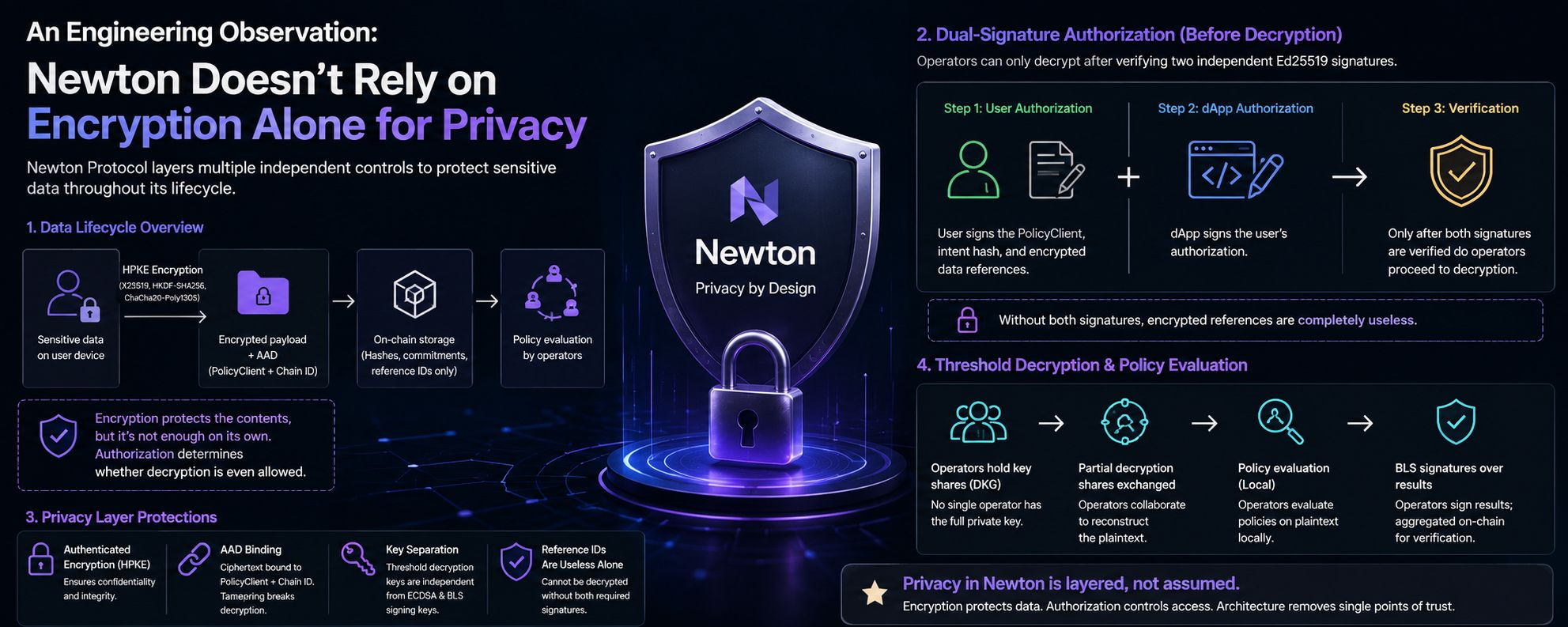

While reading Newton Protocol's Privacy Layer documentation, one implementation detail stood out. Most privacy-focused systems emphasize strong encryption to protect sensitive information, but Newton adds another requirement before protected data can even be accessed during policy evaluation.
According to the documentation, sensitive information such as identity documents, financial records, credentials, and proprietary parameters is encrypted on the client side using HPKE before it is uploaded. The encrypted data is never written to the blockchain in plaintext. Instead, only hashes, commitments, and reference IDs are used on-chain.
The interesting architectural decision appears during task execution.
Newton requires dual-signature authorization before operators are allowed to decrypt any encrypted data. Two independent Ed25519 signatures are required:
The end user authorizes the specific request by signing the policy client, intent hash, and encrypted data references.
The dApp then signs the user's authorization.
Only after both signatures are successfully verified will operators begin the threshold decryption process.
This creates an additional authorization layer that is separate from encryption itself.
The documentation also explains that decryption is performed through threshold decryption. Instead of a single operator possessing the complete private key, operators each hold distributed key shares generated through Distributed Key Generation (DKG). During policy evaluation, operators exchange partial decryption shares, reconstruct the plaintext locally, evaluate the policy, and then produce BLS signatures over the evaluation result.
An important consequence of this design is that encryption alone is not considered sufficient protection. Even if someone obtained an encrypted data reference, the documentation states that it cannot be decrypted without both required authorization signatures. The reference ID by itself is intentionally useless.
The Privacy Layer also introduces additional protections around encrypted data. The documentation describes authenticated encryption using HPKE with X25519, HKDF-SHA256, and ChaCha20-Poly1305. Additional Authenticated Data (AAD) binds every ciphertext to both the target PolicyClient and the chain ID. If either value is modified, decryption fails, preventing encrypted payloads from being reused in different execution contexts.
Another notable engineering decision is key separation. Newton explains that the threshold decryption keys are cryptographically independent from operators' ECDSA and BLS signing keys. This reduces the impact of compromising one cryptographic subsystem because it does not automatically expose another.
Taken together, these mechanisms show that Newton treats privacy as more than confidential storage. Encryption protects the contents, dual-signature authorization controls when decryption is permitted, threshold decryption removes single-party trust, and context binding helps prevent ciphertext reuse across contracts or chains.
Rather than relying on a single privacy primitive, the protocol layers multiple independent controls around the same sensitive information. That layered approach is one of the more interesting engineering choices documented in Newton Protocol's Privacy Layer.
Question for builders: Which design contributes more to Newton's privacy guarantees—the threshold decryption architecture, or the dual-signature authorization that determines whether decryption is allowed in the first place?@NewtonProtocol #Newt $NEWT