
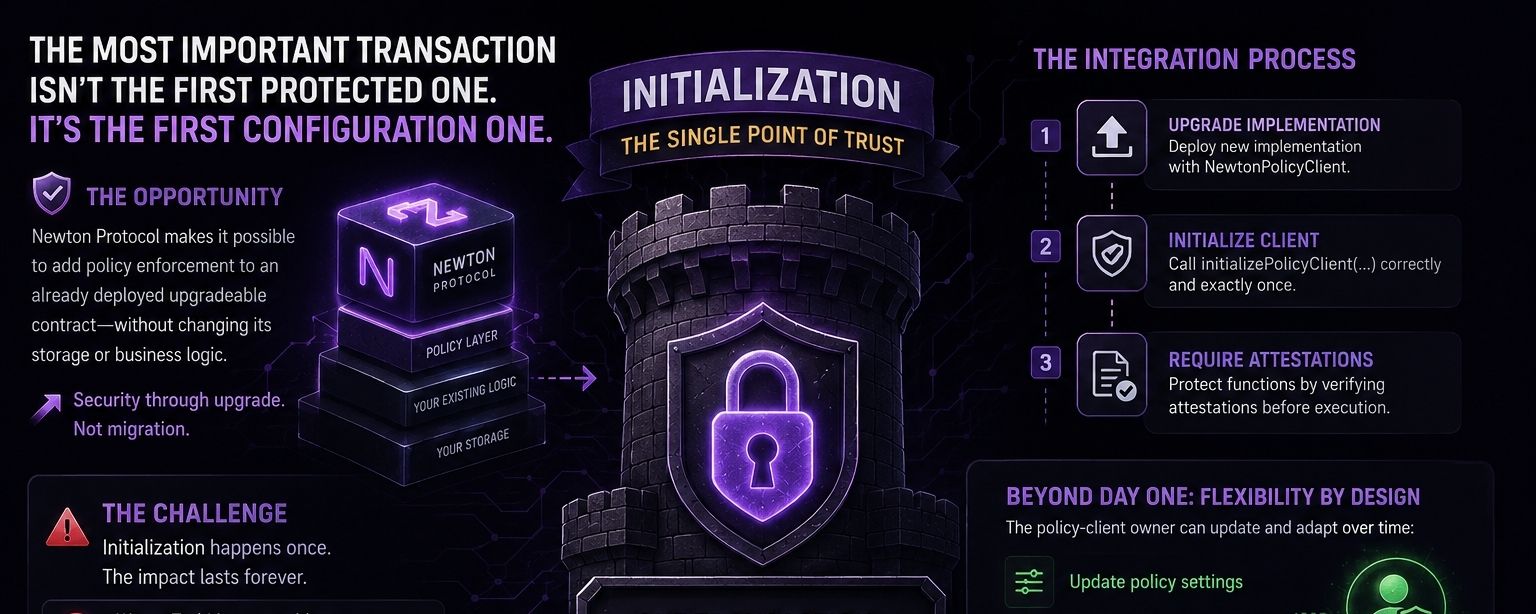
Newton's architecture makes it possible to add policy enforcement to an already deployed upgradeable contract without replacing its existing storage or business logic. For protocols that already manage live assets and users, that's a practical approach. Security can be introduced through a proxy upgrade instead of a complete migration.
At first glance, the process seems straightforward.
Upgrade the implementation, inherit NewtonPolicyClient, initialize the client, and begin requiring verified attestations before protected functions execute.
But the deeper I looked, the more I realized the upgrade itself isn't the hardest part.
Initialization is.
Newton's guide emphasizes preserving storage layout by appending new variables instead of modifying existing ones. It also introduces a dedicated _newtonPolicyClientInitialized flag to ensure the initialization function can only be executed once.
That one-time guard is an important protection.
However, it only prevents the contract from being initialized again. It cannot verify that the first initialization was performed with the correct configuration.
If the wrong TaskManager address is supplied, attestation verification may fail. If the wrong policy-client owner is assigned, control over policy management ends up in the wrong place. The initialization guard prevents repetition, but it cannot correct an incorrect first decision.
What I also found interesting is that initialization doesn't permanently lock the protocol's configuration.
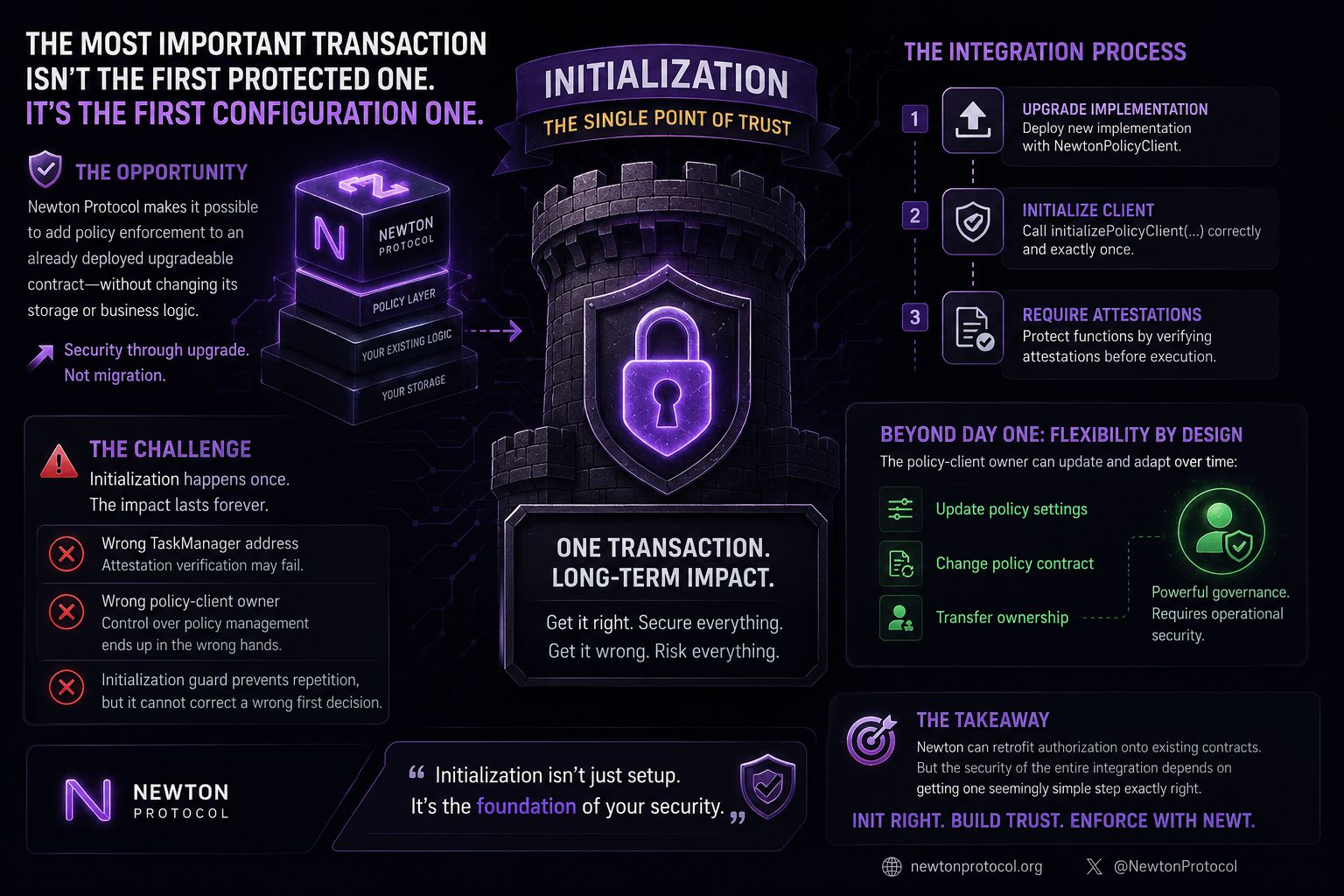
The policy-client owner can later update policy settings, change the policy contract, and transfer ownership through the functions exposed by NewtonPolicyClient. That flexibility is valuable for long-term governance, but it also means operational security extends well beyond deployment day.
My biggest takeaway wasn't simply that Newton can retrofit authorization onto existing contracts.
It was that the security of the entire integration depends on getting one seemingly simple step exactly right.
Sometimes the most important transaction isn't the first protected transaction.
It's the very first configuration transaction.