
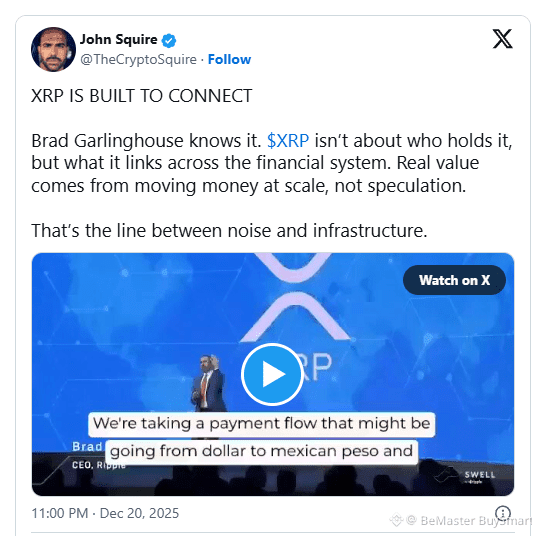
$XRP Rather than centering on price action or market cycles, crypto proponent John Squire has directed attention to what he sees as the core purpose of XRP: its function as a connector within the global financial system.
His latest commentary argues that the true importance of the digital asset does not lie in who holds it, but in how effectively it links currencies, institutions, and payment corridors. In this framing, value is measured by utility at scale, not by speculative interest.
Squire’s message presents XRP as part of the financial infrastructure rather than a vehicle for short-term trading. He draws a clear distinction between market noise and systems designed to move money efficiently across borders, positioning XRP on the side of real-world application.
✨Connecting Liquidity Across Borders
At the center of Squire’s remarks is the idea that XRP is designed to enable seamless movement of liquidity between different fiat currencies. The emphasis is on speed, efficiency, and the ability to operate across jurisdictions where traditional correspondent banking often introduces delays and added costs.
This perspective aligns XRP with use cases that involve bridging currencies in real-time, particularly in scenarios where institutions need to move value from one currency to another without relying on multiple intermediaries. Squire frames this role as essential for modernizing cross-border payments, arguing that the asset’s relevance comes from its capacity to function within payment flows that operate continuously and at scale.
✨Garlinghouse on Real-Time Payment Flows
In a video captioned in the post, Ripple CEO Brad Garlinghouse elaborates on how such a process works in practice. He describes a transaction path in which a participant holding U.S. dollars sells those dollars to acquire XRP, transfers the XRP across the XRP Ledger, and then converts it into Mexican pesos on the receiving side. According to Garlinghouse, this sequence enables liquidity to move from the US Dollar to the Peso in real time.
He explains that this approach changes how value is transferred within correspondent banking by enabling funds to be settled quickly rather than passing through a chain of pre-funded accounts. Garlinghouse notes that the ability to move liquidity on demand can alter how institutions manage cross-border payment flows, particularly in corridors where speed and certainty are critical.
✨Solving a Problem at Scale
Garlinghouse also contrasts this payment-focused approach with what he characterizes as a broader environment of hype, experimentation, and speculation in digital assets.
Within that context, he states that XRP stands out as being positioned to address a concrete global payments problem at scale. His remarks underline a belief that the asset’s primary role is tied to infrastructure rather than market narratives.
Squire’s commentary reflects this viewpoint by supporting the idea that long-term relevance will depend on practical deployment in financial systems. The message is not about future promises, but about an existing design aimed at linking currencies and institutions through efficient settlement.
✨Infrastructure Over Speculation
Taken together, Squire’s post and Garlinghouse’s explanation present XRP as a tool intended to support the mechanics of global finance. The focus remains on its capacity to move money across borders in real-time, offering an alternative to legacy processes that can be slow and capital-intensive.
By highlighting infrastructure over speculation, Squire frames XRP as part of a broader effort to modernize global value transfer. In his view, that functional role, rather than market sentiment, defines its real value significance.
🚀🚀🚀 FOLLOW BE_MASTER BUY_SMART 💰💰💰
Appreciate the work. 😍 Thank You. 👍 FOLLOW BeMaster BuySmart 🚀 TO FIND OUT MORE $$$$$ 🤩 BE MASTER BUY SMART 💰🤩
🚀🚀🚀 PLEASE CLICK FOLLOW BE MASTER BUY SMART - Thank You.
