
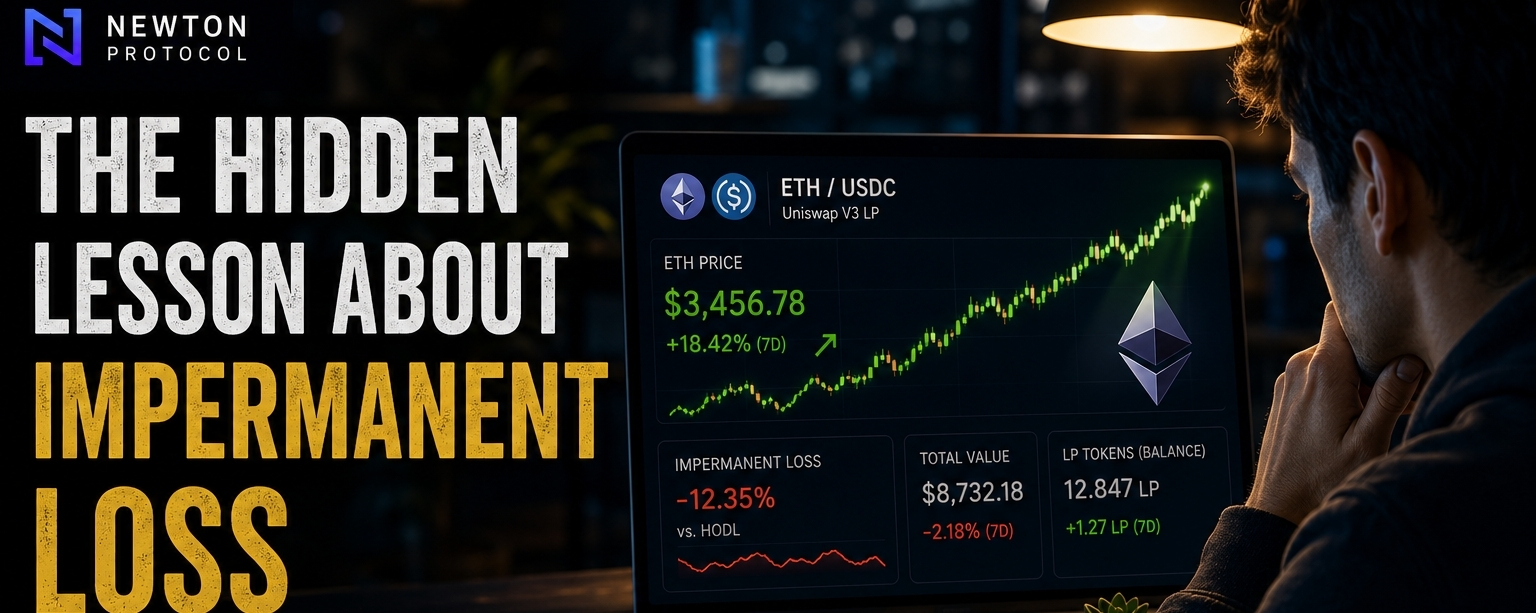

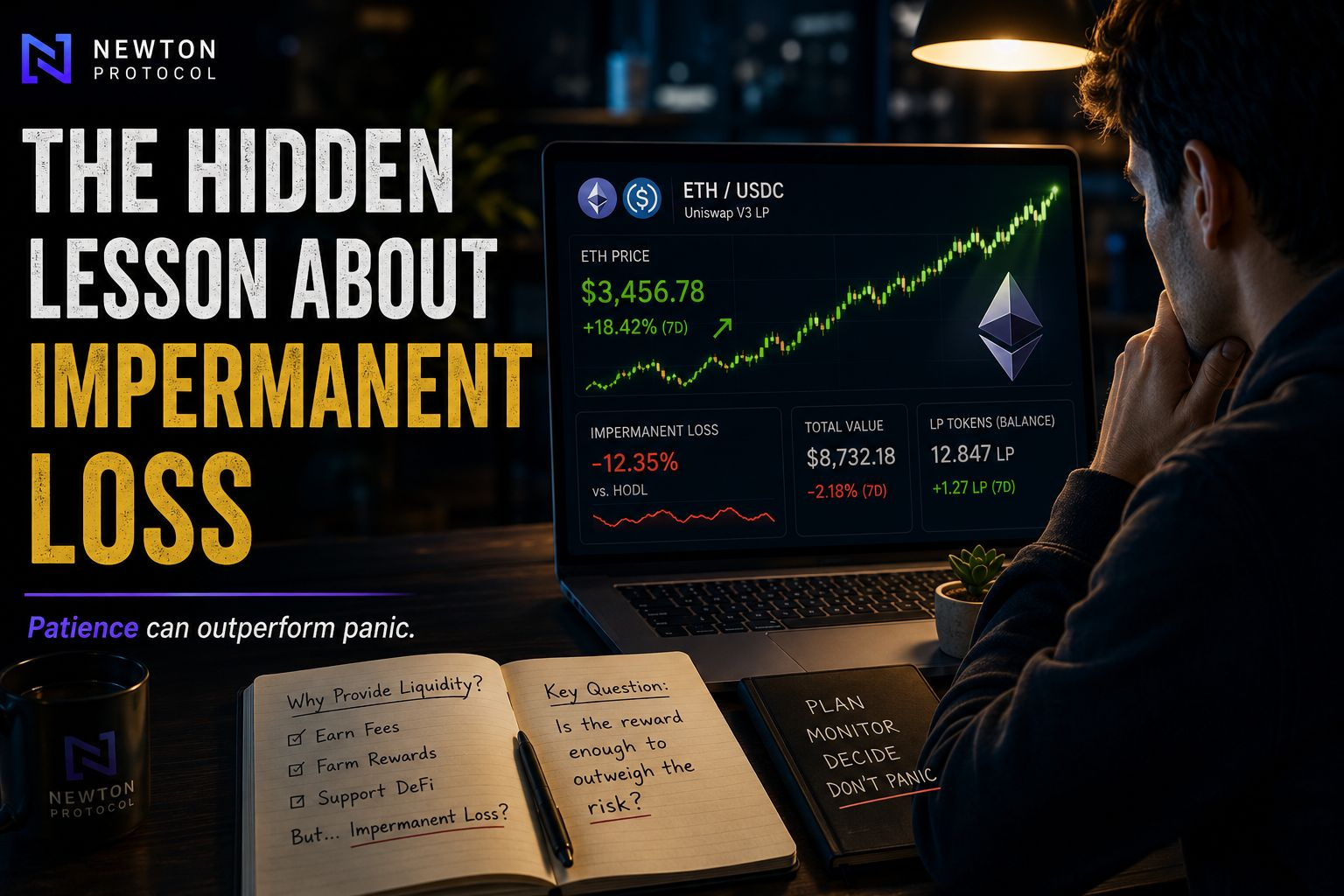
 @NewtonProtocol i used to think of impermanent loss as a simple math problem.
You provide liquidity, one token in the pair moons, the ratio shifts, and suddenly you have less of the winner than if you'd just held.
The loss is "impermanent" only if the ratio returns, but in a volatile market it rarely does.
So why would anyone willingly farm LP tokens, especially on a small-cap DEX, unless the reward completely outweighs the risk?
that's the question I kept asking myself..
until I watched Newton Protocol quietly rewrite my answer, not with marketing copy, but with pure, mechanical patience.
i deposited an ETH-stablecoin LP into a Newton vault about four months ago, right before a sharp leg up in ETH.
Within a week, the pool ratio had diverged significantly.
I opened the dashboard expecting the usual sinking feeling..
I'd missed some upside, and the yield would take months to compensate.
Instead, I saw that the auto-compounder had been harvesting and redepositing rewards the entire time, steadily increasing my LP token count.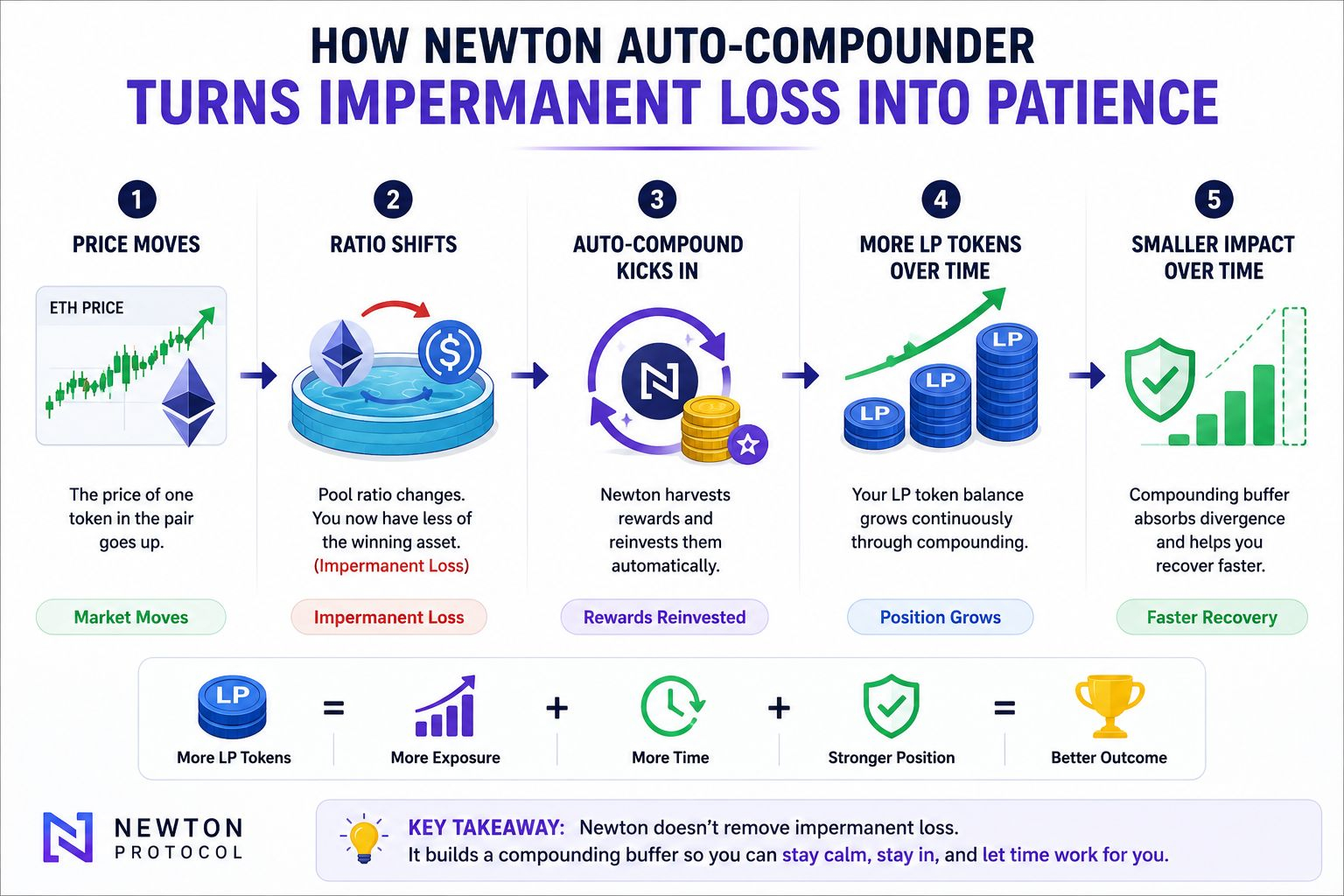
The base pool still carried an impermanent loss relative to just holding ETH, but the total position value had barely dipped compared to what a non-compounded LP would have shown.
Newton Protocol hadn't eliminated impermanent loss.
No vault can.
But it had reshaped the timeline..
By converting the farm rewards into more LP tokens continuously, it added a compounding buffer that absorbed part of the divergence.
My underlying LP tokens multiplied, so while each token represented a less favorable ratio, the sheer volume of tokens meant my overall exposure to the recovering leg was stronger.
When ETH eventually consolidated sideways, the compounded rewards started closing the gap much faster than static farming ever could.
that's when the real lesson hit:
auto-compounders don't just save you time..
They change the emotional texture of holding volatile LP positions.
Without Newton, I'd check the pool daily, do anxious mental calculations, and probably withdraw early out of fear, crystallizing the loss.
With Newton, the protocol's relentless reinvestment created a psychological distance.
I wasn't watching a losing trade.
I was watching a slow accumulation engine.
The dashboard showed a green number most days, even when the raw impermanent loss was still in the red.
That subtle reframing stopped me from making the stupid, emotional exits that had cost me money in the past.
i'm not romanticizing this.
The flip side is dangerous.
If you stop monitoring the underlying pair entirely and the weaker token nosedives, no amount of compounding can save you.
Newton's buffer is real..
but it's a cushion, not a shield.
I still track the asset ratios manually, and I still set mental stop-loss points.
The difference now is that the protocol handles the routine work while I focus on the strategic decisions the ones a smart contract can't make for me.
that's the angle I never hear anyone talk about.
Impermanent loss isn't just a mathematical friction..
it's a psychological battleground.
Newton Protocol gave me a way to step off that battlefield without abandoning my position.
It didn't solve the problem.
It gave me the patience to wait for the solution to unfold.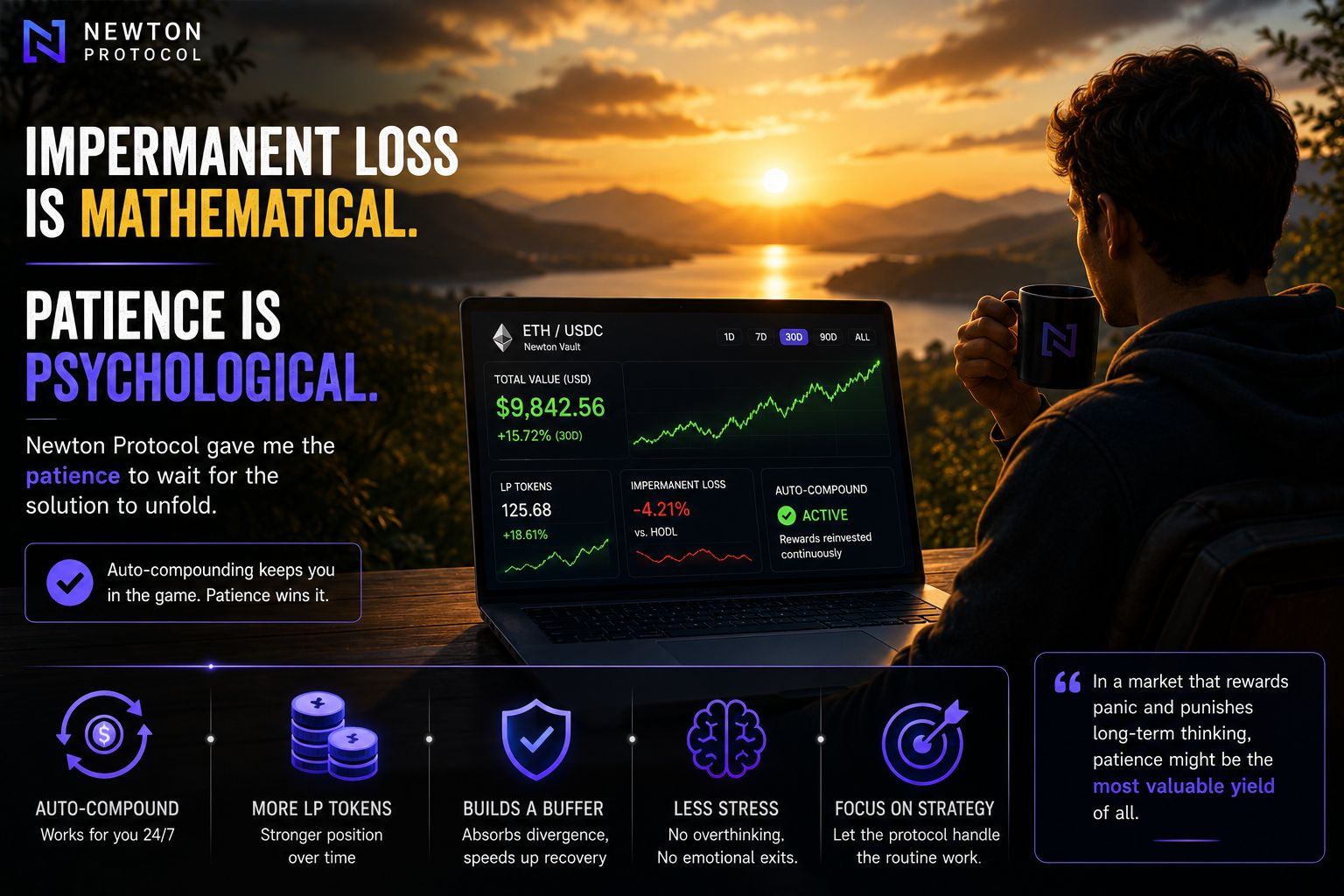
In a market that rewards panic and punishes long-term thinking, that might be the most valuable yield of all.