

When I look at the evolution of blockchain, we spent years obsessed with throughput how many transactions we could cram into a second. But as we move deeper into 2026, the conversation has fundamentally changed. We don’t just need fast chains; we need "smart" chains. This is why I’ve been closely watching Vanar’s transition from a high-performance gaming ecosystem into a fully realized Cognitive Chain. It is a quiet evolution that represents a total re-engineering of the blockchain’s DNA, moving from a passive ledger to an active, reasoning digital brain.
The core of my thesis is that for decentralized AI to actually work, it needs more than just a place to store data; it needs a way to process that data with context. Most L1s today suffer from what I call "AI Amnesia." They can execute a command, but they can’t "remember" or "reason" over vast amounts of historical data without it costing a fortune. Vanar is solving this by integrating intelligence directly into the protocol layer.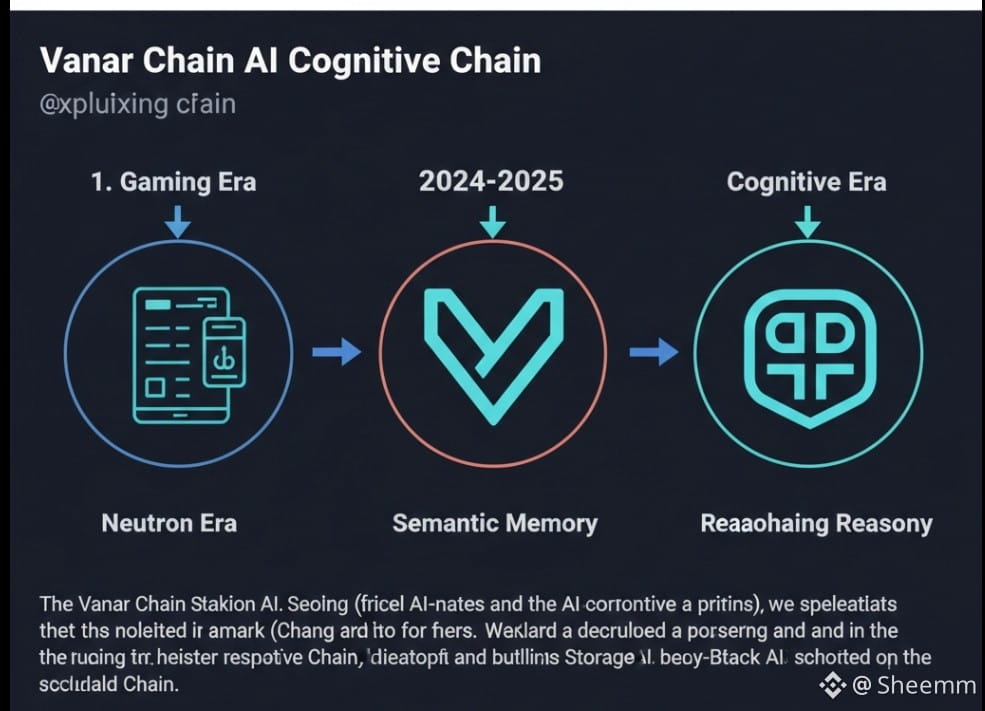
One of the most impressive technical feats I’ve seen in this roadmap is the introduction of Neutron. It serves as the network's "Semantic Memory." By using a 500:1 compression ratio, Vanar allows massive datasets to be condensed into queryable "Seeds" that live on-chain. This means that an AI agent doesn't have to scan an entire database to find an answer; it can recall information with the same efficiency as a human brain. When you pair this with Kayon the Reasoning Engine you get smart contracts that don't just follow "if/then" rules but actually weigh variables and make autonomous decisions.
This architecture is built on a bedrock of decentralized storage principles that prioritize the user over the platform. To understand why this matters for the long-term scale of Web3, we have to look at how data is actually handled within the ecosystem.
WHY THE INFRASTRUCTURE MATTRES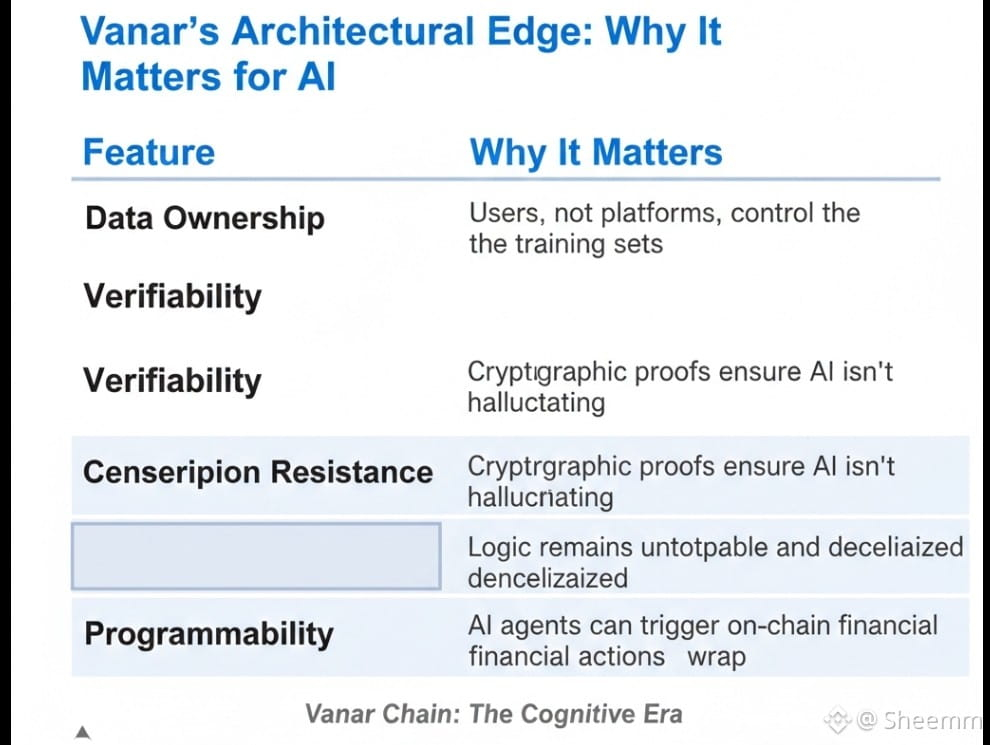
What truly bridges the gap for me is the economic shift. In the past, we judged a token’s value by simple gas usage. But in a Cognitive Chain, the $VANRY token evolves into the fuel for a global intelligence economy. We are seeing a move toward a subscription-based utility model, where the value of the network is tied to the intelligence it provides. The new buy-back and burn mechanics mean that as more enterprises use Vanar for their AI processing, the scarcity of the token increases. It’s a sustainable flywheel that moves away from speculative hype and toward real-world utility.
THE TOKENOMICS FLYWHEEL 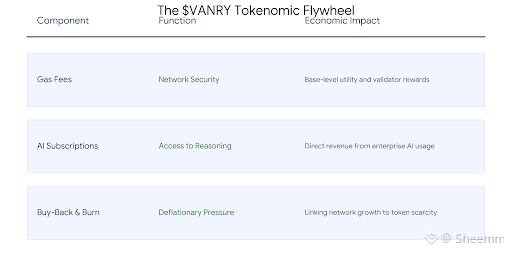
Ultimately, I see Vanar as more than just another Layer 1. It is becoming the connective tissue for a world where humans, AI agents, and decentralized applications coexist. By solving for memory, reasoning, and sustainable economics, they aren't just building a playground for gamers anymore—they are building the operating system for the next generation of digital intelligence. The shift from "Gaming" to "Cognitive" isn't just a change in branding; it's a recognition that in the 2026 economy, intelligence is the most valuable commodity on the planet.
THE COMPETITIVE LANDSCAPE 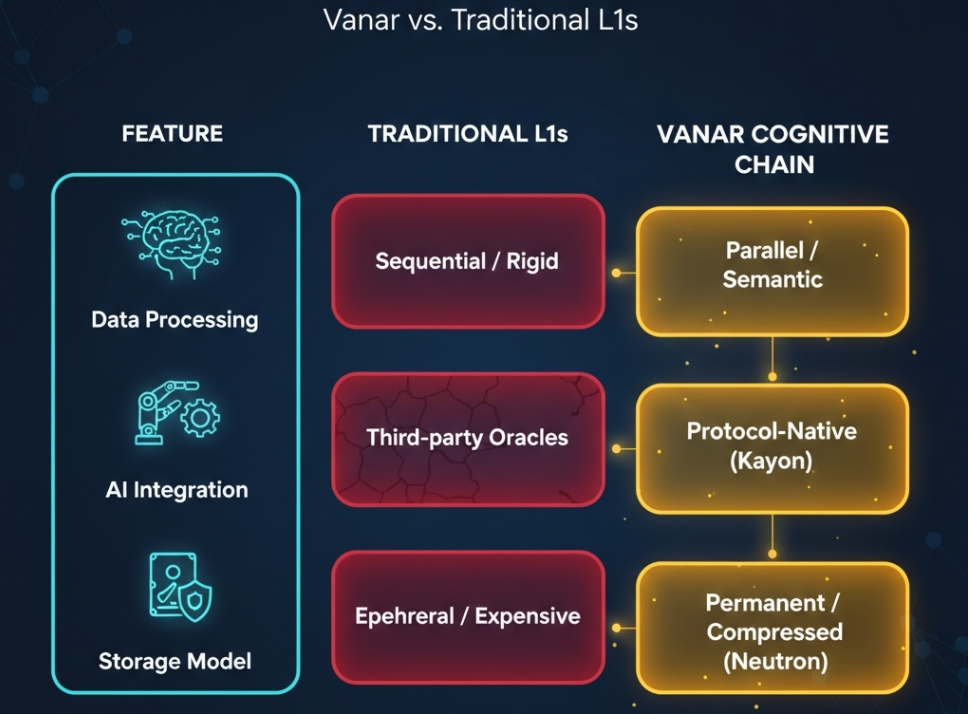
This transition is why I believe we are standing at the threshold of a new era. We've spent a decade building the pipes; now, Vanar is finally giving the network a brain. #Vanar