

How Mira Network Is Building the Verification Layer for Autonomous AI
Artificial intelligence is rapidly entering hospitals, financial institutions, legal systems, and government infrastructures. It can analyze scans faster than radiologists, detect fraud patterns in milliseconds, and draft legal documents in seconds.
But here’s the uncomfortable truth:
AI can be confidently wrong.
It can hallucinate.
It can fabricate sources.
It can reflect bias from its training data.
And in critical sectors like healthcare, a single wrong answer isn’t just inconvenient — it’s dangerous.
This is the fundamental problem that Mira Network is trying to solve.
The Problem: AI Is Powerful — But Not Reliable
Imagine an AI diagnosing a patient.
A woman walks into a clinic. She inputs her symptoms into an AI diagnostic system. Within seconds, it suggests a treatment plan.
But what if:
The AI misunderstood a symptom?
It hallucinated a medical reference?
It relied on biased or incomplete training data?
It overconfidently recommended the wrong medication?
Today’s AI systems are probabilistic. They predict the most likely answer based on patterns. They do not “know” truth — they estimate it.
That works fine for:
Writing blog posts
Generating images
Drafting emails
But it becomes risky when AI is used for:
Diagnosing cancer
Approving loans
Managing investment portfolios
Operating autonomous vehicles
Governing public infrastructure
The future isn’t about stopping AI. It’s about verifying it.
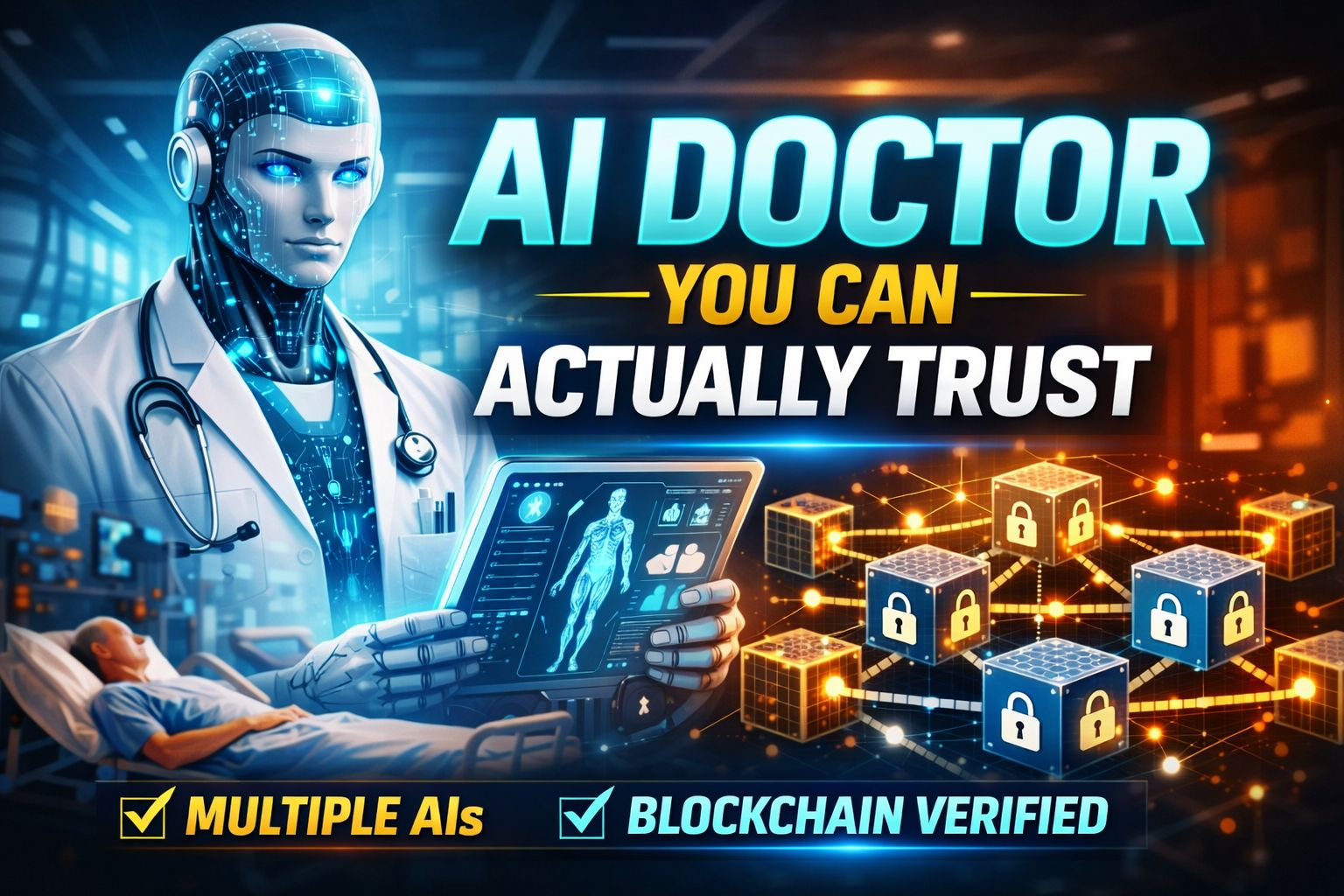
What Is Mira Network?
Mira Network is a decentralized verification protocol designed to transform AI outputs into cryptographically verified information.
Instead of trusting a single AI model’s response, Mira introduces a trustless validation layer powered by:
Multiple independent AI models
Distributed verification nodes
Blockchain consensus
Economic incentives
In simple terms:
Mira doesn’t try to replace AI.
It verifies AI.
How Mira Works: Step-by-Step
Let’s go back to the AI doctor example.
Step 1: AI Generates a Diagnosis
An AI model analyzes the patient’s symptoms and outputs a diagnosis and recommended treatment.
Normally, this answer would be taken as-is.
But under Mira’s system, that answer becomes the beginning — not the end.
Step 2: Breaking the Output into Verifiable Claims
Instead of treating the response as one block of text, Mira:
Breaks the diagnosis into smaller claims
Extracts factual statements
Identifies verifiable components
For example:
“Patient shows signs consistent with early-stage pneumonia.”
“Recommended treatment includes antibiotic X.”
“Chest X-ray indicates inflammation.”
Each statement becomes a claim that can be independently verified.
Step 3: Distributed AI Cross-Verification
These claims are distributed across a network of independent AI models.
Instead of relying on:
One centralized AI.
The system uses:
Multiple independent AI agents that evaluate the claim separately.
If the majority of independent models confirm the claim, it moves forward.
If disagreement arises, additional verification can be triggered.
Step 4: Blockchain-Based Consensus
Verification results are recorded and validated through blockchain consensus.
This means:
The process is transparent
It cannot be altered retroactively
No single authority controls validation
Results are cryptographically secured
Now, the final diagnosis isn’t just “AI-generated.”
It’s AI-generated and consensus-verified.
Why This Matters for Healthcare
Healthcare demands precision.
A hallucinated citation in a blog post is annoying.
A hallucinated diagnosis can cost a life.
Mira’s model provides:
✅ Reduced hallucination risk
Multiple AI systems cross-check each claim.
✅ Bias mitigation
Diverse models reduce systemic bias from one dataset.
✅ Transparent decision trail
Every verification step can be audited.
✅ Cryptographic integrity
Data cannot be tampered with after validation.
This doesn’t eliminate risk entirely — but it dramatically lowers blind trust.
Beyond Healthcare: The Broader Impact
While the “AI Doctor” story is powerful, Mira’s implications go far beyond hospitals.
1️⃣ Finance
Imagine AI managing billions in capital.
Without verification:
A hallucinated data point could trigger massive losses.
With Mira:
AI trade decisions can be validated before execution.
Risk models can be consensus-checked.
Financial AI becomes auditable.
2️⃣ Legal Systems
AI tools are already drafting contracts and reviewing legal cases.
But legal interpretation errors can have serious consequences.
Mira allows:
Legal conclusions to be verified.
Claims to be cross-validated.
Outputs to be transparently audited.
3️⃣ Government & Policy
If AI begins assisting in governance decisions:
Transparency becomes mandatory.
Mira introduces:
Trustless verification
Open validation mechanisms
Reduced centralized AI control
This could prevent opaque, unaccountable AI governance systems.
Decentralization: The Core Advantage
Today, most AI systems are centralized.
They are:
Controlled by corporations
Hosted on private servers
Updated without public transparency
Governed by internal policies
Mira shifts the power dynamic.
Instead of:
Trusting the company behind the AI.
You trust:
A decentralized network validating the AI’s output.
This is the same philosophical leap that blockchain made in finance.
Bitcoin removed the need to trust banks.
Mira aims to remove blind trust in AI models.
Economic Incentives: Why Nodes Act Honestly
Verification in Mira isn’t just technical — it’s economic.
Participants in the network are incentivized to:
Validate claims accurately
Act honestly
Maintain network integrity
If a validator consistently provides incorrect verification, it risks economic penalties.
This creates alignment:
Honest validation becomes financially rational.
The Future: Autonomous Systems with Verified Intelligence
As AI becomes more autonomous, verification becomes essential.
Think about:
Self-driving vehicles
Autonomous trading bots
AI-powered supply chains
Robotic manufacturing systems
If these systems make decisions independently, someone must verify them.
Without a verification layer, the world risks:
Opaque decision-making
Concentrated control
Systemic AI failures
Economic extraction by centralized AI providers
Mira proposes a different future:
A world where:
AI decisions are validated by decentralized consensus before execution.
From “Smart” to “Trusted”
AI today is smart.
But intelligence alone is not enough.
Critical systems require:
Trust
Transparency
Auditability
Economic alignment
Decentralized oversight
Mira transforms AI from:
Probabilistic text generator
Into:
Consensus-verified digital intelligence.
Final Thought
Imagine a future where you ask:
“Can I trust this AI decision?”
And the answer isn’t:
“Trust the company.”
It’s:
“The network verified it.”
In healthcare, finance, law, and governance — that difference could define the next era of digital civilization.
Mira isn’t trying to make AI smarter.
It’s trying to make AI trustworthy.
And in a world increasingly shaped by autonomous systems, that may be the most important layer of all.
@Mira - Trust Layer of AI #Mira $MIRA
