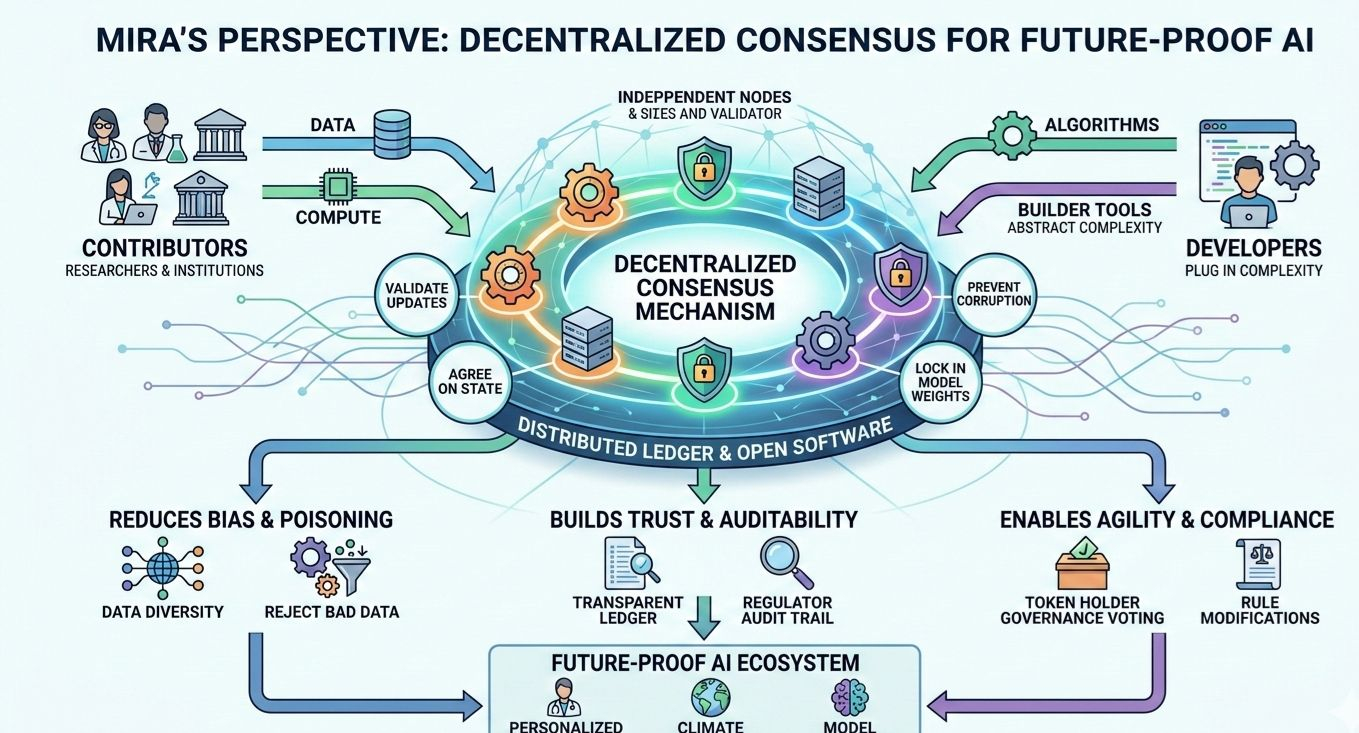
@Mira - Trust Layer of AI is a new kind of artificial intelligence platform that puts trust at its core. Mira believes that the only way to keep intelligence safe and useful for years to come is to use a decentralized consensus mechanism in every part of its operation. In this article Mira shares why that design choice matters for the future of intelligence.
Decentralized consensus is a process where many independent people verify and agree on data and decisions. Each person runs a node that follows the rules and records the same state of the system. The agreement of the nodes creates a source of truth that cannot be altered by one person. Mira uses that truth to lock in model weights and training data. When a model update is proposed it must be validated by the network before it can be applied. This validation step prevents updates that could corrupt the model. It also ensures that improvements are the result of scrutiny.
In an artificial intelligence pipeline one company holds the data and the compute. If that company makes a mistake the error spreads to all users. If that company is forced to shut down the artificial intelligence service disappears. Decentralized consensus eliminates those points of failure. Mira spreads responsibility across a network of validators. The network operates on hardware and open software. Anyone can join as a validator long as they meet the minimal requirements for compute and storage. The openness of the network creates a barrier to censorship.
Governance decisions are made by holders who vote on proposals. Proposals can cover anything from fee structures to model architecture upgrades. The voting process is transparent because every vote is recorded on the ledger. This transparency builds confidence among users and developers. The consensus model also protects against model poisoning attacks. In a poisoning attack an attacker tries to insert data to skew the model. Because the network requires independent signatures before an update is accepted the attacker must corrupt many nodes simultaneously. That level of coordination is extremely costly and therefore unlikely.
Even if an attack succeeds on a subset of nodes the rest of the network can isolate the compromised segment. The isolation process is automatic because the consensus rules reject data. This log also provides an audit trail that regulators can inspect. This auditability is a requirement for responsible artificial intelligence deployment. Another advantage of consensus is that it encourages collaboration. Researchers from institutions can contribute data or compute to the network. Their contributions are rewarded through an incentive scheme. This reward system aligns the interests of contributors with the health of the network.
As a result the network grows in capacity and diversity. This diversity improves model robustness because the training data reflects perspectives. It also reduces bias because no single party can dominate the data pipeline. With participants the network can handle larger datasets and more complex models. This scalability future-proofs Mira against the growth of artificial intelligence workloads. Because consensus does not rely on an authority it can adapt to regulatory changes. If a new law requires a type of data handling the network can vote to modify the rules. The modification is then enforced by every node automatically. This agility keeps Mira compliant without interrupting service.
Miras team has built tools that make it easy for developers to plug algorithms into the consensus framework. The tools abstract away the complexity of the underlying ledger. This abstraction lets developers focus on model innovation than on infrastructure. The result is an ecosystem of applications that run on top of Mira. From personalized healthcare assistants to real-time climate monitoring solutions the ecosystem demonstrates the power of an artificial intelligence foundation.
All of these benefits trace back to the core principle of consensus. It guarantees that no single entity can unilaterally rewrite the truth. It also makes the system resilient, transparent and adaptable. That is why Mira believes that decentralized consensus is the key to creating intelligence that will stand the test of time. The path forward, for intelligence is not to concentrate power but to distribute trust. Mira invites anyone who shares that vision to join the network and help shape the future of machines.
#Mira @Mira - Trust Layer of AI $MIRA