
I have been tracking how the $MIRA narrative is being positioned in the market — specifically the Chainlink comparison that keeps appearing in content and community discussions. spent time mapping what Chainlink actually solves versus what MIRA is attempting, and honestly? the comparison flatters MIRA in ways that obscure how much harder its problem actually is 😂
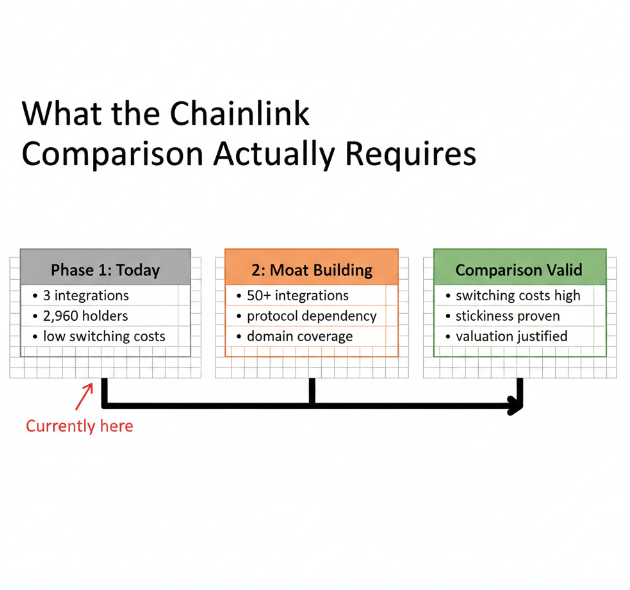
let me build both sides properly because the distinction matters enormously for anyone trying to understand what they're holding.
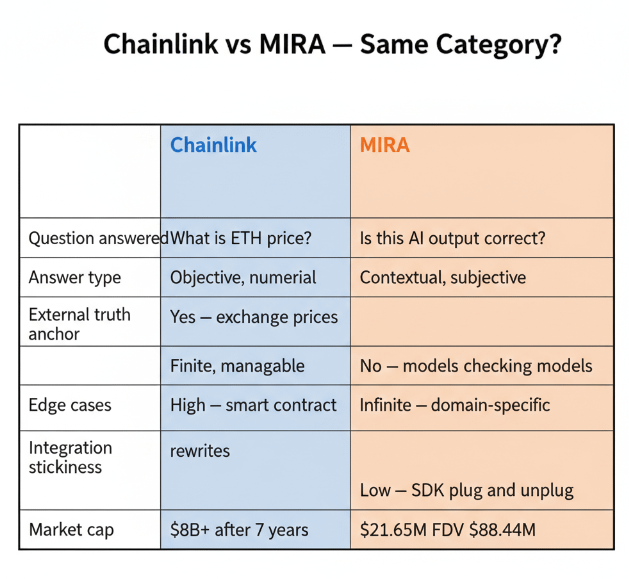
Chainlink answers a specific question: what is the price of ETH right now. that question has one correct answer at any given moment. the answer is numerical. it's objective. it's verifiable against multiple independent sources simultaneously. a decentralized oracle network aggregates price feeds from exchanges, reaches consensus on the correct number, delivers it on-chain. the problem is hard from an infrastructure standpoint. the problem itself is simple. one question, one answer, objective truth exists.
MIRA answers a different kind of question entirely: is this AI output correct. that question has no single correct answer. correctness is contextual. it depends on the claim being evaluated, the domain it sits in, the knowledge cutoff of the models doing the evaluating, and whether truth itself is contested in that domain. infinite edge cases. no objective external source to aggregate against. the problem isn't just harder than Chainlink. it's harder by several orders of magnitude.
what bugs me:
the Chainlink comparison is being used to frame MIRA as the next logical infrastructure layer — price oracles for data, verification oracles for AI outputs. clean narrative. but the analogy breaks at the most important point. Chainlink's oracle nodes are checking facts against reality. ETH price exists independently of what the oracle says. MIRA's validator nodes are checking AI claims against other AI models. there's no external reality to anchor against. consensus becomes the truth by definition, not by verification.
the tokenomics angle nobody discusses:
circulating supply: 234.07M — 23.41% of total. locked: 765.92M — 76.59%. FDV/MC ratio: 4.08x. insider total roughly 33.83% — team and advisors 20%, private sale investors 13.83%. public allocation: 0.10%.
the unlock pressure that makes the Chainlink comparison economically relevant: March 26 brings 23.6M tokens — more than double today's Feb 26 unlock of 10.79M. September spike: 25.82M across five allocations. 38 unlock events remaining. Chainlink today has a market cap exceeding $8 billion built over seven years of oracle dominance across hundreds of DeFi protocols. MIRA's FDV is $88.44M with 2,960 total holders and three known integrators.
the original frame worth running: Chainlink's moat is switching costs. once a DeFi protocol integrates Chainlink price feeds, replacing them requires rewriting smart contracts, migrating liquidity, convincing governance to approve the change. that stickiness is what justifies the valuation. MIRA's SDK integration is currently low-friction by design — easy to plug in means easy to unplug. the verification layer that gets compared to Chainlink needs to build the same switching cost moat before the comparison is economically valid, not after.
my concern though:
the mechanism of concern isn't that MIRA is solving the wrong problem — AI output verification is a real and growing need. the concern is that the Chainlink comparison sets a valuation expectation that requires MIRA to achieve a level of protocol stickiness that Chainlink took seven years and hundreds of integrations to build. $MIRA is being priced partially against that comparison while sitting at 2,960 holders, three integrations, and 76.59% of supply still locked. the gap between the comparison and the current reality is where the risk lives.
what they get right:
the atomic claims decomposition approach is genuinely smarter than whole-output verification. breaking an AI response into individual factual statements — each verified separately — means a single hallucinated claim doesn't corrupt the entire output's credibility. that's a more granular and more useful trust signal than a binary verified/unverified label on a complete response. no existing oracle network attempts this at the claim level.
the multi-model consensus design has real security logic. Chainlink uses multiple independent node operators checking the same external data source. MIRA uses multiple independent models trained on different datasets evaluating the same claim. the diversity-as-security assumption is structurally similar even if the underlying verification target is different. if node diversity is genuine — different operators, different models, different training data — correlated errors become meaningfully less likely.
Base network as the settlement layer is a credible foundation. Chainlink operates across dozens of chains. MIRA starting on a single credible L2 with Coinbase backing is a more defensible initial position than trying to be everywhere immediately. focused execution on Base before multichain expansion is the right sequencing.
the Klok integration processing billions of tokens daily gives MIRA something Chainlink didn't have at a comparable stage — a production-scale workload running through the verification layer from day one. that's real data about real performance under real load, not testnet benchmarks.
what worries me:
the subjective verification problem doesn't get easier at scale — it gets harder. Chainlink adding more price feeds doesn't change the nature of the problem being solved. MIRA adding more integrators means more domains, more claim types, more edge cases where consensus and truth diverge in ways that matter. a financial AI agent getting a factual claim wrong is a different failure mode than a healthcare diagnostic AI getting the same kind of claim wrong. MIRA's one consensus mechanism has to handle both. Chainlink never had to solve domain-specific truth.
vol/mkt cap at 37.18% on a 2,960 holder token with 86.16% of float controlled by two wallets is the market structure reality sitting underneath the Chainlink comparison narrative. the comparison works as a vision frame. the current token structure is much earlier stage than the comparison implies.
honestly don't know if MIRA builds the integration depth and switching cost moat that makes the Chainlink comparison eventually justified, or if the comparison is doing more work for the narrative than the current protocol can support. those are very different long-term outcomes from the same infrastructure idea.
what's your take - legitimate next-generation oracle category or comparison running ahead of the reality?? 🤔