

Three weeks ago, a friend asked an AI to summarize a 40 page legal contract. The model returned a beautifully structured analysis. Confident tone. Bullet points. One problem: it invented an entire liability clause that didn't exist. My friend almost signed based on that summary.
This is where we are in 2025. AI generates content faster than humans can verify it. And verification? That's the bottleneck nobody's solving.
Mira Network looked at this mess and built something genuinely different. Not another model. Not another wrapper. A verification layer that turns AI outputs into cryptographically proven facts.
How It Actually Works
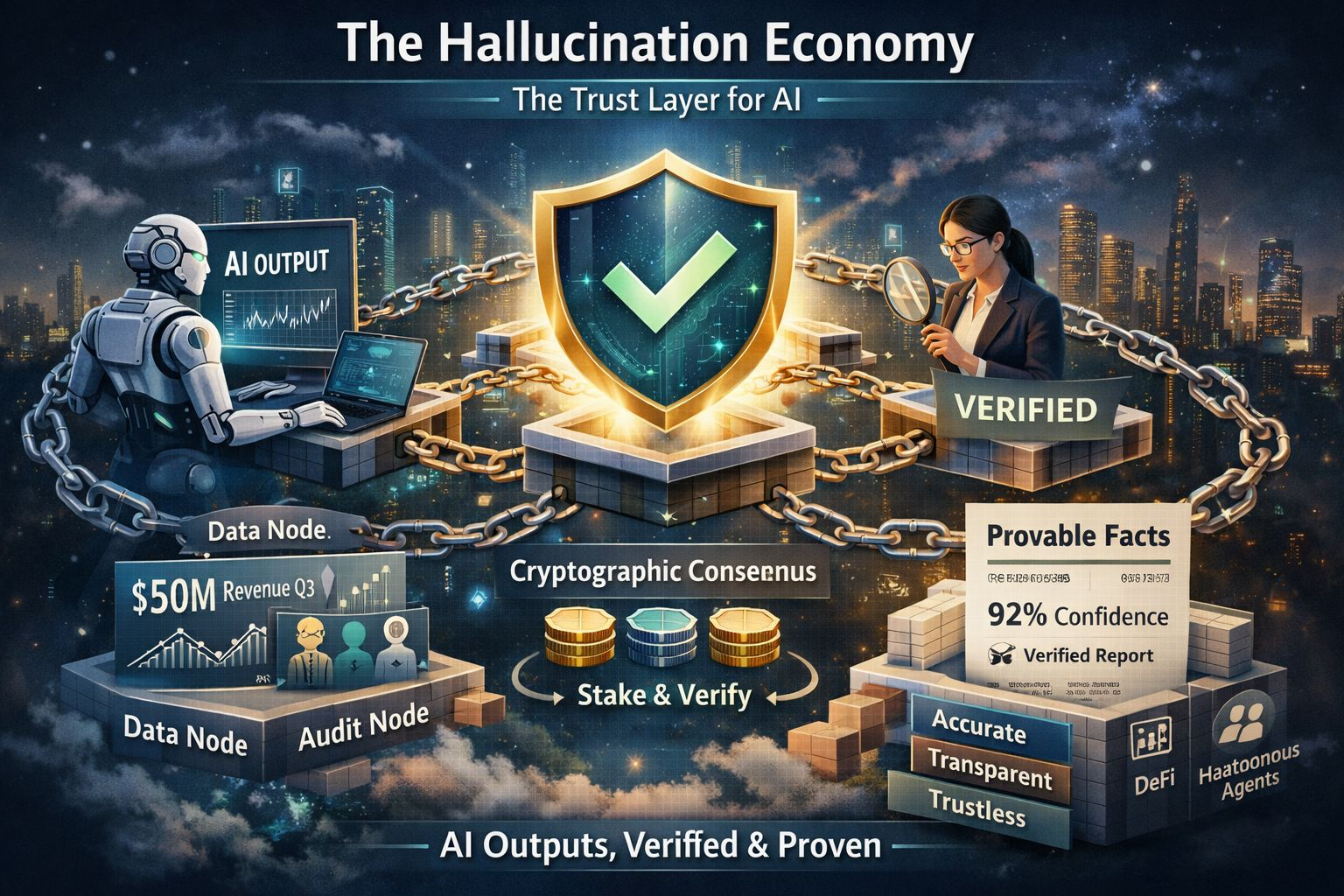
Picture a sentence. "Company X reported $50M revenue in Q3, up 20% year over year." An AI writes this. But is it true?
Mira doesn't ask one model to check. It breaks the claim into pieces. Entity: Company X. Metric: revenue. Value: $50M. Timeframe: Q3. Comparison: 20% YoY growth. Each piece becomes a separate verification task.
These tasks scatter across independent nodes. Different AI systems. Different data sources. Different architectures. Each node evaluates blindly, staking tokens on its answer. Consensus emerges from disagreement. Majority rules, but minorities pay for being wrong.
The result? A confidence score backed by economic skin in the game. Not "trust me." Not "probably right." Provable verification with cryptographic receipts.
Why This Matters Now
We're entering the autonomous agent era. AI systems that execute trades, file reports, make medical recommendations without human pause. Current AI accuracy maybe 85%, maybe 90% sounds good until you realize that's 10-15% catastrophic failure rate at scale.
Mira doesn't fix the models. It fixes the trust problem. Developers can wrap verification around any AI output. Users see consensus scores before acting. Bad information gets caught before it spreads.
The network effect is real. More verifiers means more diverse perspectives. More diverse perspectives means harder to game consensus. The system gets stronger as it grows, not weaker.
The Ecosystem Play
This isn't just infrastructure. It's a new primitive. DeFi protocols can price risk using verified AI assessments. Healthcare apps can flag diagnostic contradictions before they reach patients. Content platforms can cryptographically prove fact checking occurred.
The tokenomics align incentives properly. Verifiers earn for accuracy, lose for errors. Developers pay for verification, but gain user trust. Users get transparency without needing to understand neural networks.
My Take
I've watched countless "AI + blockchain" projects launch with vague promises and no working product. Mira's different. The verification pipeline is live. Accuracy improvements are documented jumping from ~73% baseline to over 91% with proper consensus configurations.
What impresses me is the restraint. They're not trying to replace OpenAI or build the biggest model. They're solving a specific, painful problem with a mechanism that actually works. Economic incentives plus cryptographic proof creates something neither pure AI nor pure blockchain achieves alone.
The deeper insight? We're not heading toward perfect AI. We're heading toward AI that's accountable for its mistakes. Mira enables that accountability at scale.
In a world drowning in generated content, verification becomes the scarce resource. Mira's building the infrastructure to mine that resource trustlessly. Whether you're building autonomous agents or just tired of AI lies, this is infrastructure worth understanding.
The trust layer for AI didn't exist. Now it's being built, block by verified block.
#Mira @Mira - Trust Layer of AI $MIRA
