
I the rapidly evolving world of artificial intelligence, one issue continues to surface again and again: trust As AI models become more powerful, more autonomous, and more deeply integrated into financial systems, social platforms, research pipelines, and governance structures, the question is no longer just “What can AI do?” but rather, “How do we verify what AI produces?” This is where the concept of Verified AI becomes essential—and where infrastructure projects like @mira_network aim to redefine the foundation of trust in intelligent systems.
Verified AI is about ensuring that outputs generated by AI systems are accurate, auditable, reproducible, and tamper-resistant. Today’s dominant AI paradigm relies heavily on centralized providers. These systems operate as black boxes: users submit prompts, receive outputs, and are forced to trust that the underlying process was honest, unbiased, and technically sound. In high-stakes domains such as decentralized finance, scientific research, and autonomous agents, blind trust is not a sustainable model.
The rise of blockchain technology introduced the concept of trustless verification for financial transactions. Networks like Bitcoin demonstrated that decentralized consensus could replace centralized intermediaries. Later, Ethereum expanded this idea with programmable smart contracts, allowing logic to be executed transparently and verifiably on-chain. Yet AI computation largely remains off-chain, opaque, and unverifiable.
the problem by building a decentralized verification layer for AI outputs. Instead of relying on a single model provider, verification mechanisms can evaluate, cross-check, and validate results. This transforms AI from a “trust me” system into a “prove it” system. The shift is subtle but revolutionary. It introduces accountability into machine intelligence.
First, AI hallucinations are not minor inconveniences—they are systemic risks. As AI agents begin executing trades, approving loans, writing code, or managing governance proposals, incorrect outputs can lead to financial loss or structural instability. Verified AI infrastructure introduces redundancy and validation before execution. In other words, it reduces single-point-of-failure risk in autonomous systems.
Second, decentralization aligns incentives. When verification is distributed across independent nodes rather than concentrated in one provider, manipulation becomes harder and transparency increases. This mirrors the security model pioneered by Bitcoin but applied to intelligence rather than currency.
Third, composability becomes possible. Imagine decentralized applications that integrate AI modules whose outputs are cryptographically verifiable. This would allow smart contracts to rely on AI-driven insights without compromising security assumptions. It opens the door to AI-powered DeFi, autonomous DAOs, and self-optimizing protocols operating on verified intelligence.
There is also a broader philosophical implication. AI is increasingly shaping public discourse, economic activity, and decision-making processes. Without verification, we risk entering an era of synthetic content with no accountability layer. Verified AI infrastructure acts as a safeguard against misinformation, adversarial manipulation, and opaque algorithmic governance.
mira network represents the convergence of two transformative technologies: decentralized consensus and artificial intelligence. Just as Ethereum provided programmable trust for financial logic, Verified AI infrastructure could provide programmable trust for machine reasoning.
The long-term vision is profound. As AI evolves toward autonomous agents capable of independent economic action, verification will become not optional but foundational. Systems will not merely generate answers they will generate proofs.
the next phase of Web3 and AI convergence, the competitive edge will not belong to the fastest model, but to the most trustworthy one. Verified AI is not a feature; it is the missing infrastructure layer. And projects like @mira_network are positioning themselves at the center of this transition from intelligent outputs to accountable intelligence.@Mira 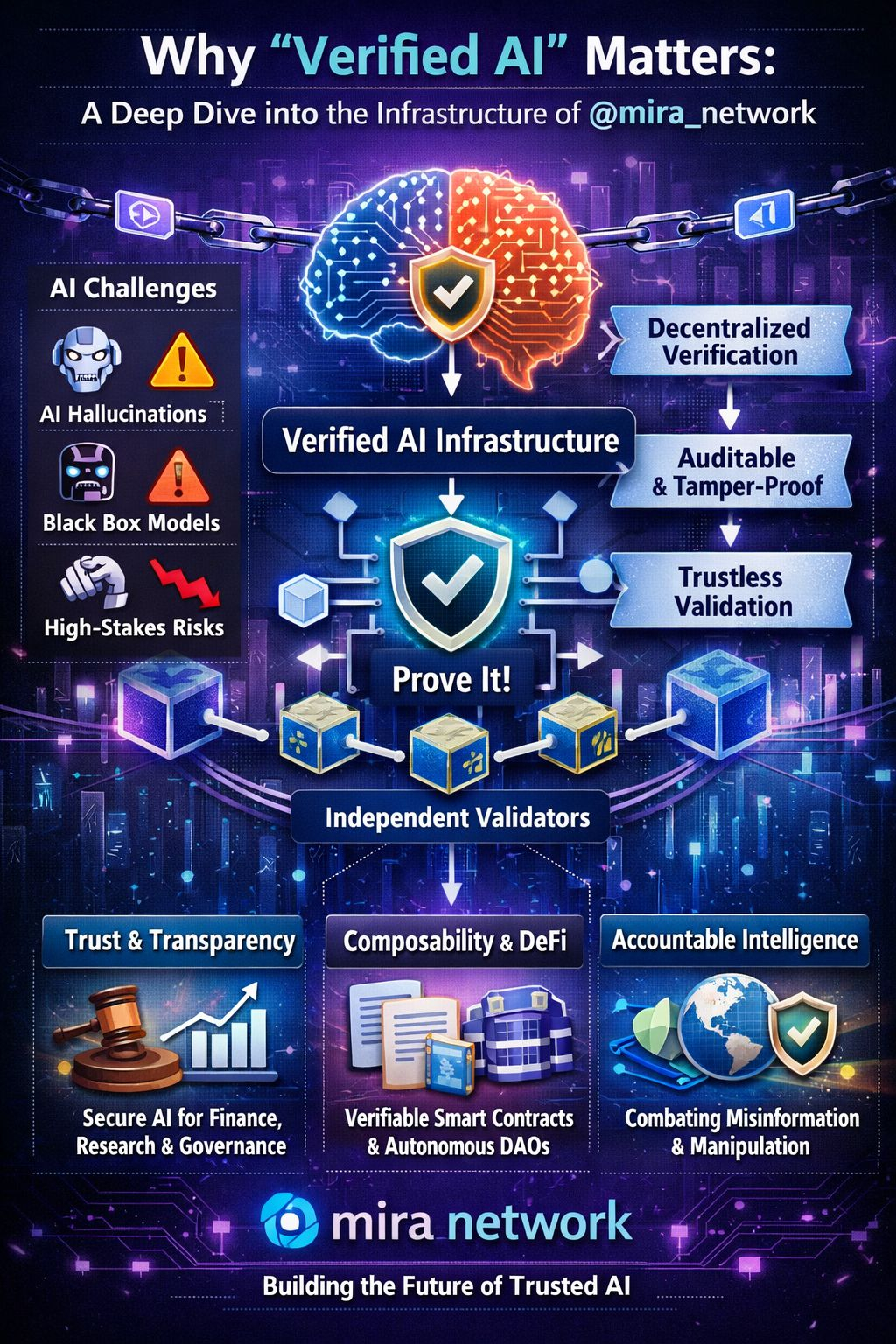 #Mira $MIRA