
VRID-91C4E2 claim: c-4817-b
I send the answer into Mira.
Confidence felt high. Not a number I could defend. Just that smooth internal “yeah.”
The Mira decentralized verification protocol doesn’t log that feeling. It logs fragments.
The verification latency window opens and the paragraph splits before I even finish rereading the first line. The trace inside Mira shows three claims routed out into separate lanes. No drama. Just motion.
I expected a stall, but verification quorum formation starts immediately. A handful of validators report in fast. I glance at the counter and misread it, think it’s already near closure, then realize I’m staring at the wrong row. Thumb blur. Correct lane.
threshold: 67% round age: 2.8s
quorum: 9/19 → 11/19 → 12/19
Across the 110+ model verification network, fragments don’t wait for my confidence to catch up. They enter distributed multi-model consensus with weights already attached in Mira. My cursor hovered anyway.
One claim clears early, and I feel my shoulders loosen for a second before the lane I trusted most stays open.
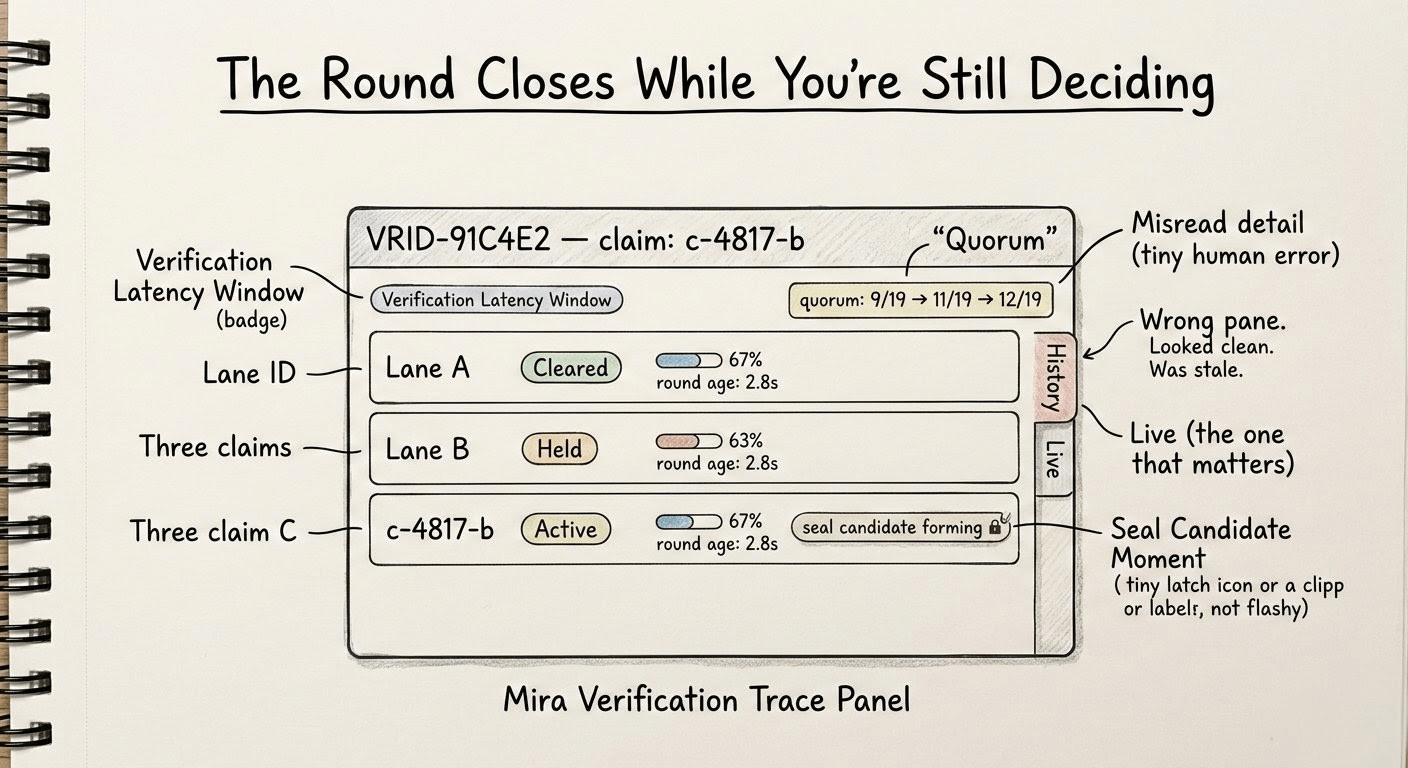
A single phrase gets interpreted as conditional by a couple independent AI verifier nodes. Two reads, one conditional. Model diversity arbitration doesn’t debate tone; it recalculates the obligation. The score softens. The lane slows. It doesn’t flip red. It just… refuses to close under Mira.
I open the trace to see why and hit the wrong pane. History instead of live. Everything looks clean for a second. Then I realize it’s stale. Back. Live view on Mira.
Now I can see it: cross-model disagreement resolution tightening on one fragment while the other keeps breathing. The “safe” claim is the one dragging. I hate that.
A seal candidate forms on c-4817-b. It happens quietly, like a door latch. The system is already moving toward settlement while I’m still deciding whether I trust the sentence, and Mira doesn’t wait for that.
Consensus before belief.
A proof-of-verification hash begins assembling for the cleared fragments. Short string. Ugly. Real. I copy it and stop myself halfway through, like copying makes it true.
In the on-chain claim registry, c-4817-b is recorded as verified and Mira flips the state without changing the paragraph view. Same cadence. Same confidence. But inside the registry, only parts of it exist.
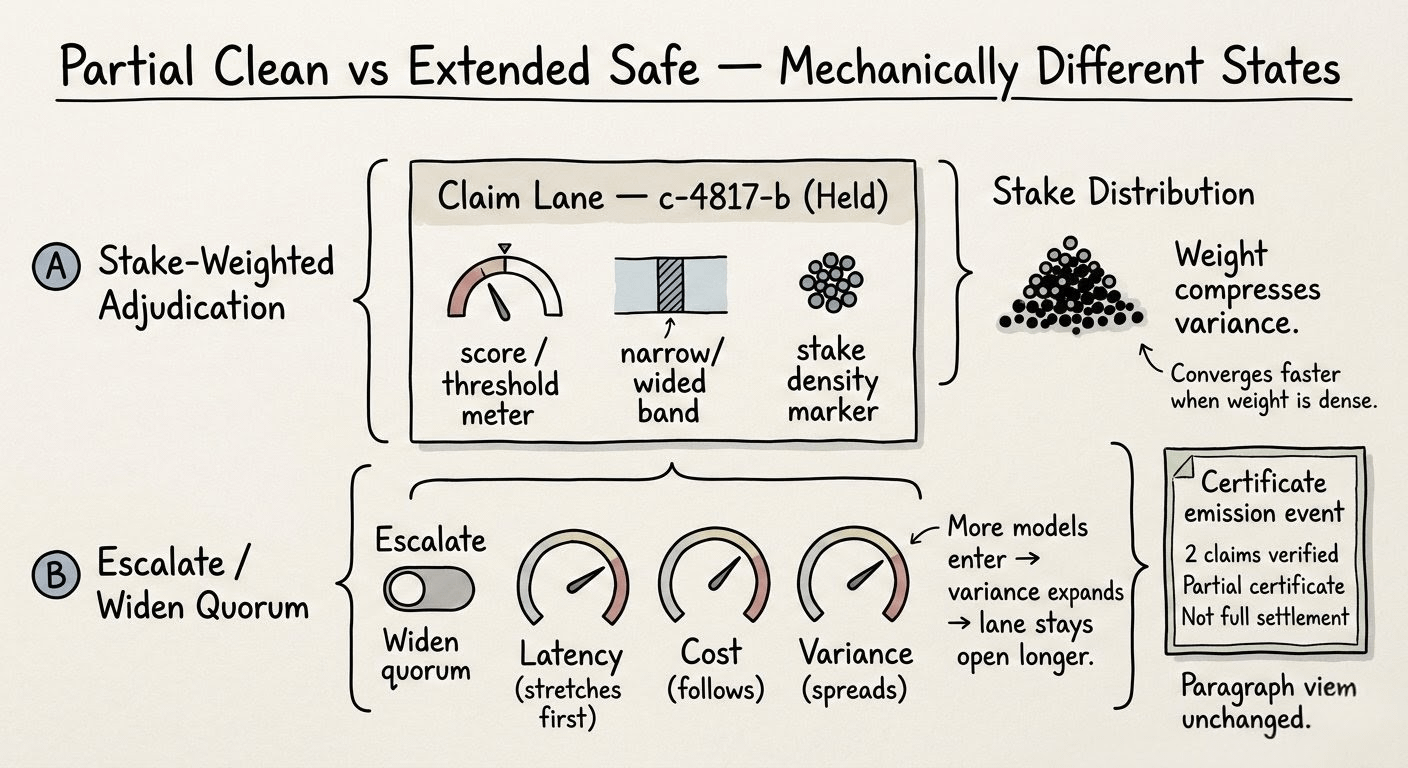
The stalled fragment sits below threshold, held. Not collapsing. Not resolving. Just lingering in the lane like it’s waiting for the room to agree what the words meant.
I check stake distribution. A heavier cluster is pulling the line toward closure. Under stake-weighted adjudication, weight compresses variance. It converges faster when the weight is dense, and Mira makes that feel uncomfortably efficient.
I could widen the quorum.
More models would enter. The variance would spread again. The lane would stay open longer. The number might move upward. Or it might drift further down.
Latency stretches first. Cost follows. Always.
The partial state feels cleaner. The extended state might feel safer.
A certificate emission event fires for two claims. Partial certificate. Not full.
My confidence drops anyway.
The system already moved.
The fragment still hasn’t.
I hover over “escalate” and don’t click. Forcing it would change the math. It wouldn’t change what the models meant.
The round stays active.
The stalled claim keeps breathing inside Mira.
My certainty is still forming.