
Most token openings should be looked out of. An allocation table tells a story before the first day of trading. The $MIRA tokenomics plan is more resilient than most projects currently trending here, in my opinion. The token structure needs to reflect the building's purpose, and verified AI infrastructure is trending as a category.
The Box of Goods
One billion in total. Cap that is hard. Only 19.12% of TGE had red blood as of September 26, 2025. The unlock plan goes through 2032.
A 19.12% initial float puts most of the trading pressure on a small box that is moving around. They made a decision to apply controlled release. For investors, it's a puzzle: a 12-month cliff and 36 months of straight payment. The same puzzle faces early investors: 12-month cliff, 24-month linear. In the first year, there is no free leave.
What Each Bucket Pays For
The largest one is the 26 percent Ecosystem Reserve. Grants, partnerships, and other rewards for developers. Others unlock at TGE and others more than 35 months. The prize for builders is straight access to funds. Through this group is the quest for network expansion. A second quest is run through Node Rewards: each day, 16% is given automatically to verifiers who do correct reasoning. The reward is given for honest work that everyone agrees on. They quickly learn that honest inference gets points and dishonest inference gets cut.
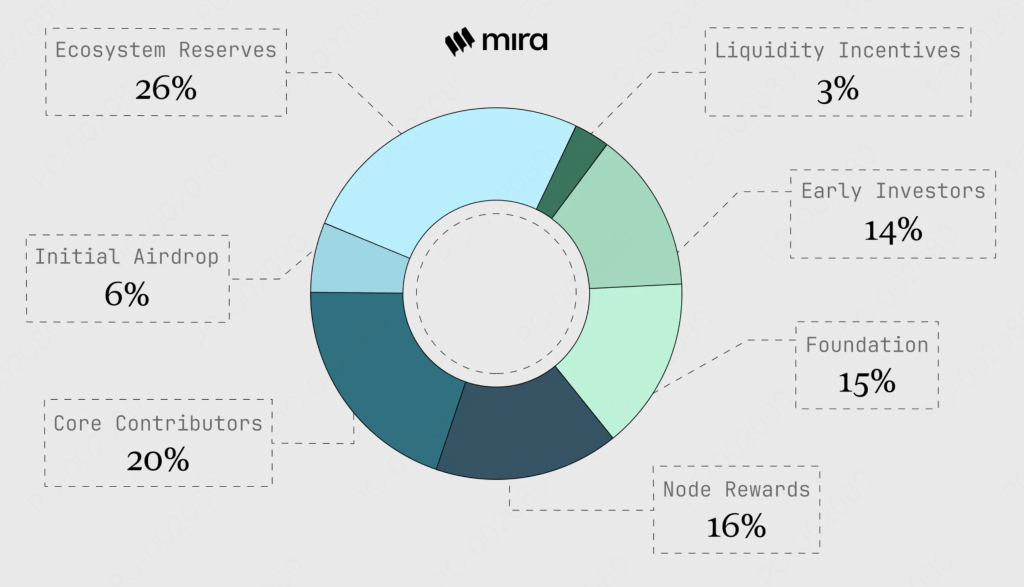
The Foundation has ownership of 15% that vests after 36 months with a 6-month cliff. The Mira Foundation was an independent governing organ when it started on August 27, 2025. There is a 3% Liquidity Incentives allocation that helps make markets and support trading pairs.
The Four Utility Rail Tokens.
A red flag in infrastructure token research is that they don't have any real use. It is not safe for a network to use an object that doesn't have a red-line demand floor. $MIRA as four separate utility lines.
Start with API access. The developers have to pay in MIRA use the Verified Generate API and the Mira Flows platform. Holders of tokens earn lower prices. Every time a quiz or piece of code is run through the API, someone wants to pay. The same is true if you run a second code process. Every confirmed claim packet brings in money for the protocol. There is a cryptographic proof in every packet.
Second, stake. The owners of the node take part in verification at risk of $MIRA. Slashing starts when a wrong claim is made. Honesty gets the operator a fee share. Every quiz that is turned in and every claim that is checked creates a fee demand for staked validators.
Third, government. Holders are the ones that choose the level of emission, how to advance the system and the way to alter the structure. On-chain is where the competition between proposals takes place. One word from the original team doesn't determine what will happen. Every word in a plan for governance is given a token weight. Learn the steps and have a say in how the strategy is run.
Fourth, projects that are starting up in the Mira environment use $MIRA their base trading pair. The base asset must be used to solve liquidity pairs for each new project. There is free market desire, not manufactured demand. The prize for the environment is that as more projects are built, they will be more useful.
What Does Long Vesting Mean?
Multi-year walls depict long-term goals. Fundamental investors receive their cash through 36 months beyond the cliff. Quick exit in the first year will not exist. Short vesting turns early allocations into sell pressure, which is the challenge with AI-blockchain projects. Problem-solve adoption before vesting windows close for the second challenge. The reward range moves to 2027 because of Mira's structure.
Verified AI is a competition in a certain area. When it comes to structure, @Mira - Trust Layer of AI is ahead not because of stories but because of live services that run every day.