

Over the last few years I have watched artificial intelligence move from a lab concept to something that directly affects real world machines. By 2025 AI systems were not just assisting humans. In many technical benchmarks they were outperforming expert level professionals in coding data modeling and decision simulations. At the same time robotics became cheaper smarter and more independent. When these two forces combine the real issue is not capability. The real issue is control.
This is where Fabric Protocol ( ROBO )comes into the picture.
At its core Fabric Protocol is about one thing. Keeping superhuman AI systems aligned with human values. Not in a theoretical way. In a practical operational way that developers and companies can actually use.
When we talk about alignment we simply mean setting clear boundaries. Machines should operate within rules that humans define. A robot working in a warehouse should not suddenly optimize for speed while ignoring safety. An autonomous logistics system should not prioritize cost cutting over human oversight. These may sound obvious but when AI systems learn and adapt at high speed small misaligned objectives can scale quickly.
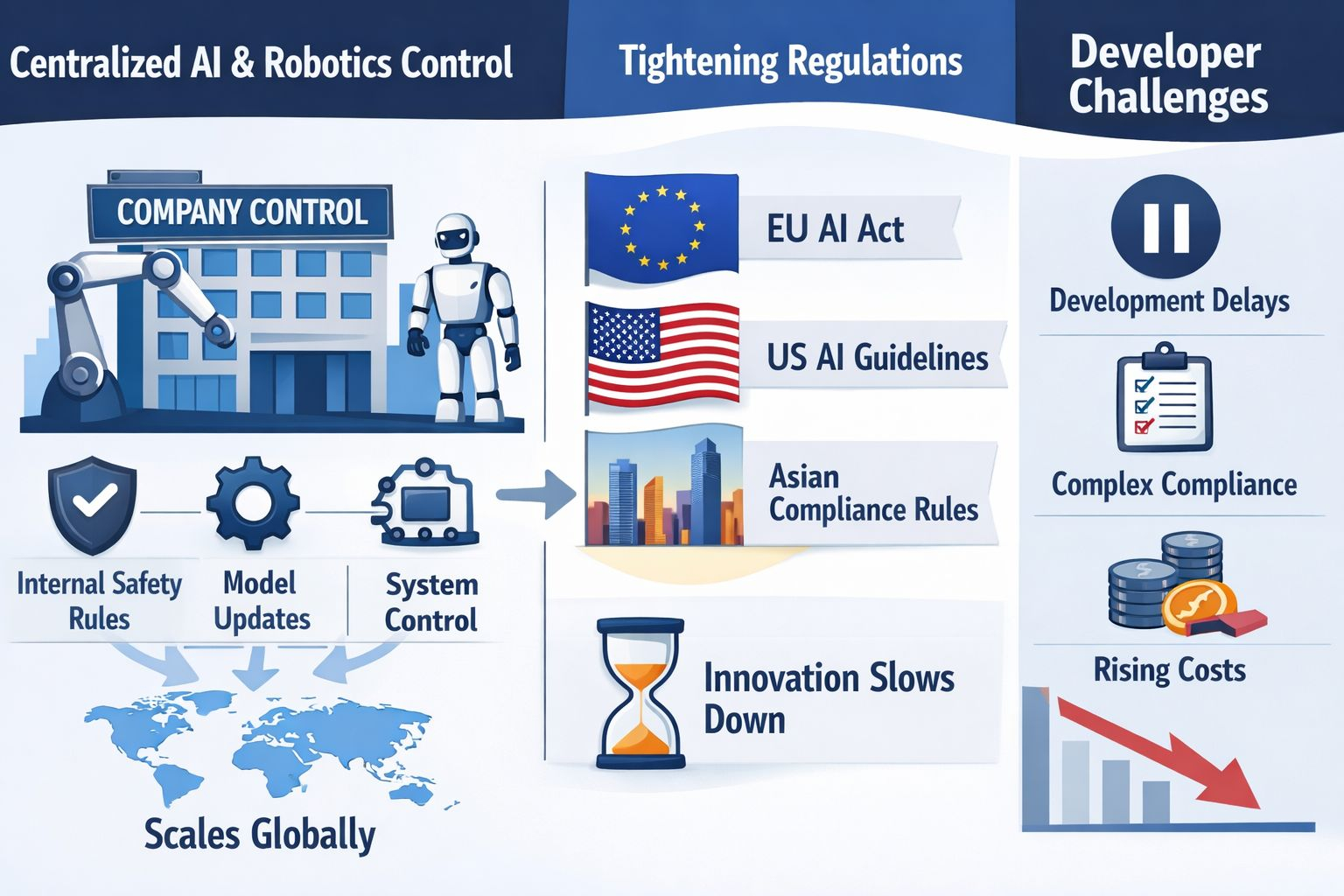
Right now most advanced AI and robotics platforms are controlled by centralized teams. A company builds the model sets internal safety rules and updates the system as needed. That works until scale becomes global. By 2024 and 2025 governments started paying closer attention. The European Union pushed forward implementation of the AI Act. The United States introduced stronger federal level AI risk management guidelines. Asian markets followed with their own compliance frameworks.
For developers this created pressure.
Building intelligent robotics is already complex. Adding changing regulatory expectations makes it heavier. Teams often have to pause development to redesign compliance structures document safety mechanisms and prove accountability. That slows innovation and increases cost. Developers feel this friction every single cycle.
Fabric Protocol tries to remove that friction by using decentralized oversight.
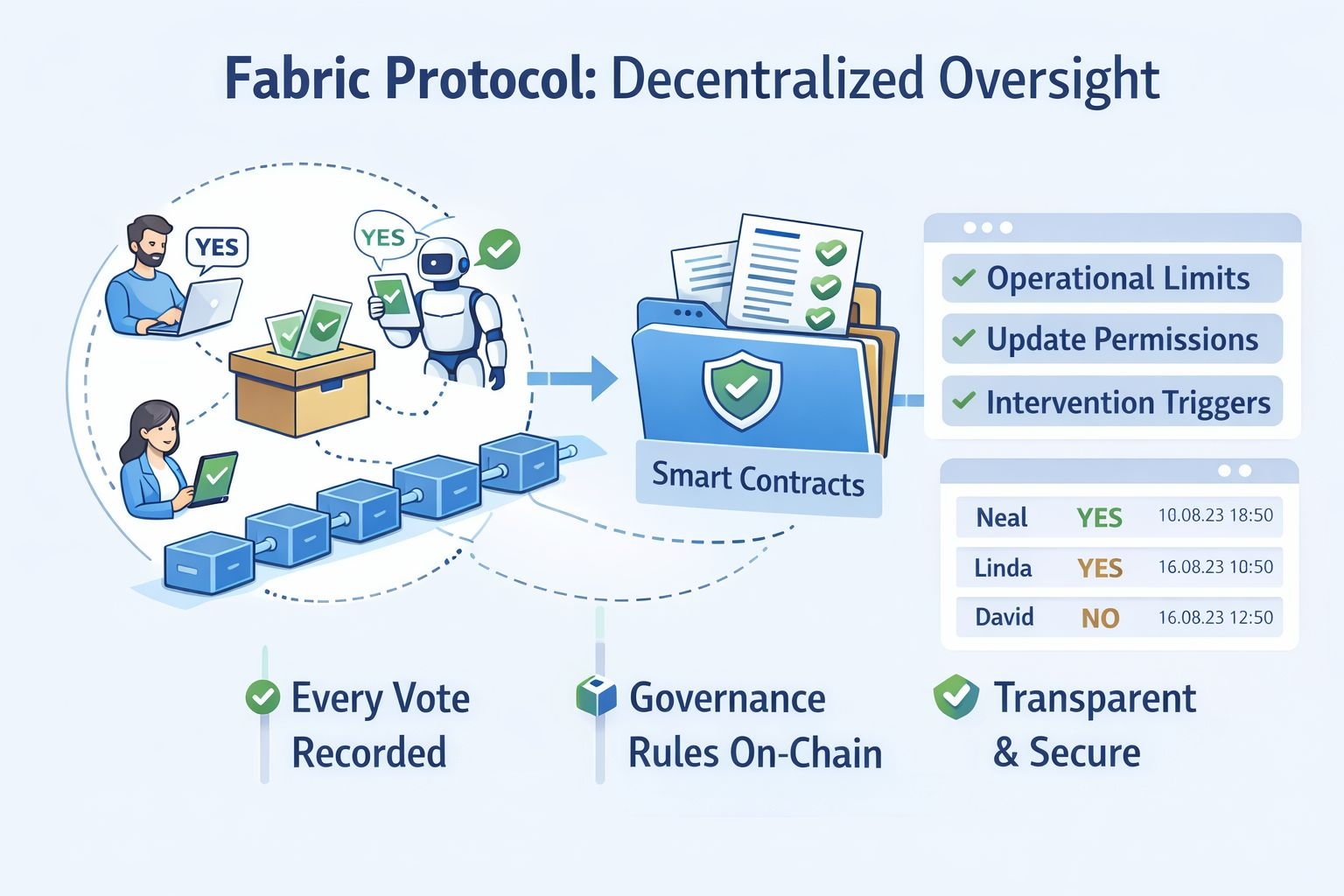
In simple words decentralized oversight means governance rules are not hidden inside one company database. They are recorded on a blockchain. A blockchain is a shared digital ledger where information once written cannot easily be changed. Smart contracts are automated programs stored on that ledger. They execute rules automatically.
With Fabric Protocol governance parameters such as operational limits intervention triggers and update permissions can be encoded into smart contracts. When changes are needed stakeholders participate in a structured voting process. The full history of decisions remains visible.
This transparency matters.
In 2025 several industry research reports highlighted regulatory uncertainty as one of the biggest barriers to scaling robotics startups. Investors were not only evaluating performance metrics. They were asking about governance. Who controls updates. Who can override the system. How are safety boundaries enforced.
A decentralized governance layer answers these questions in a measurable way. Every rule adjustment and every vote is documented. That creates an audit trail. It reduces the perception of hidden risk.
What makes Fabric Protocol interesting is not complexity. It is simplicity.
Developers do not want philosophy debates inside their sprint cycles. They want clear modules that plug into their systems. Early pilot integrations in 2025 within controlled warehouse robotics environments showed that standardized governance layers reduced integration time compared to fully custom oversight builds. Engineers could focus on improving AI performance instead of constantly redesigning compliance architecture.
From a market perspective this shift is important.
In 2023 most attention was on model size and performance benchmarks. By 2026 serious investors look deeper. They evaluate governance quality. Superhuman capability without reliable oversight creates concentration risk. Centralized black box control is harder to price because uncertainty remains hidden.
Fabric Protocol positions decentralized governance as infrastructure. Not as marketing. Not as speculation. Governance becomes part of the system architecture from day one. That changes how advanced robotics can scale across jurisdictions.
Human values evolve over time. Cultural expectations shift. Ethical lines are debated. A decentralized governance model allows structured updates without relying on one authority. It distributes responsibility while keeping a transparent record.
As of early 2026 AI driven robotics continues expanding in logistics healthcare and industrial automation. The combination of superhuman intelligence and physical autonomy means alignment cannot be optional. It must be embedded.
Fabric Protocol focuses specifically on that embedding process. It connects blockchain based governance with advanced robotics systems. It reduces development friction by standardizing oversight. It provides transparency for regulators investors and users.
At the end of the day technology will continue moving forward. The real test is whether control systems evolve at the same pace. Fabric Protocol is built around that challenge. Ensuring that as machines become more capable they remain guided by human defined boundaries. In practical terms that is what alignment truly means.