
AI is entering its autonomous phase. Agents now execute trades, manage liquidity, optimize treasuries, and even influence governance. But as machine intelligence begins to move capital and shape protocol decisions, one question 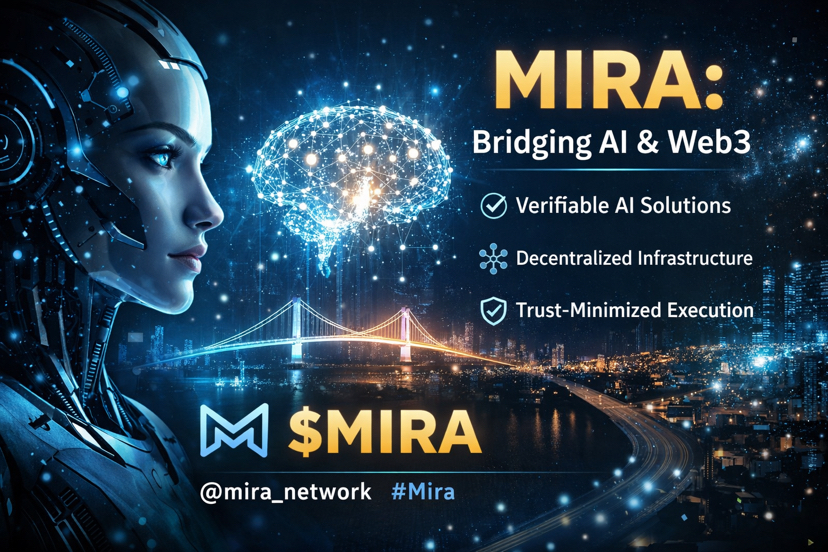 dominates: who verifies the verifier?
@Mira Network positions itself as the accountability layer for this new AI economy. Rather than competing in model training like Bittensor or distributed compute like io.net, Mira focuses on output validation. Through cryptographic proofs, validator consensus, and on-chain attestation, AI-generated results become auditable, challengeable, and economically secured.
 As DeFi automation scales and DAO governance increasingly relies on AI-driven analytics, unverifiable outputs become systemic risk. Mira’s validator model introduces economic incentives via $MIRA staking, aligning network security with truthful verification. Validators are rewarded for honest consensus and penalized for malicious approvals, embedding accountability directly into protocol economics.
Compared to Gensyn’s training coordination or Allora’s predictive markets, Mira’s advantage lies in trust infrastructure. It does not chase compute cycles — it secures credibility. In an environment where AI hallucinations can trigger financial loss, verification becomes the moat.
We are early in the “proof-of-intelligence” cycle. As regulators and institutions demand transparency in automated systems, verification layers will shift from optional feature to mandatory backbone.
@Mira - Trust Layer of AI $MIRA #Mira
Key Insight: The next AI bull cycle will prioritize verifiability over raw model power.
Risk Factor: Adoption depends on AI protocols integrating external validation standards.
Future Catalyst: Institutional DeFi and regulated AI deployments requiring auditable outputs.
Strategic Takeaway: Accumulate infrastructure that secures trust, not just attention.