


It’s late right now and I’m scrolling through my timeline feeling genuinly exhausted with how completly predictable this entire space has become over the past few months. Every single week without fail there’s some new AI plus blockchain project claiming it’s about to fix intelligence itself as if the fundamental problems with AI are just marketing issues. As if slapping a token onto a language model suddenly transforms it into some source of divine truth that never makes mistakes. The whole thing feels increasingly absurd when you step back and look at what’s actually happening versus what people are promising.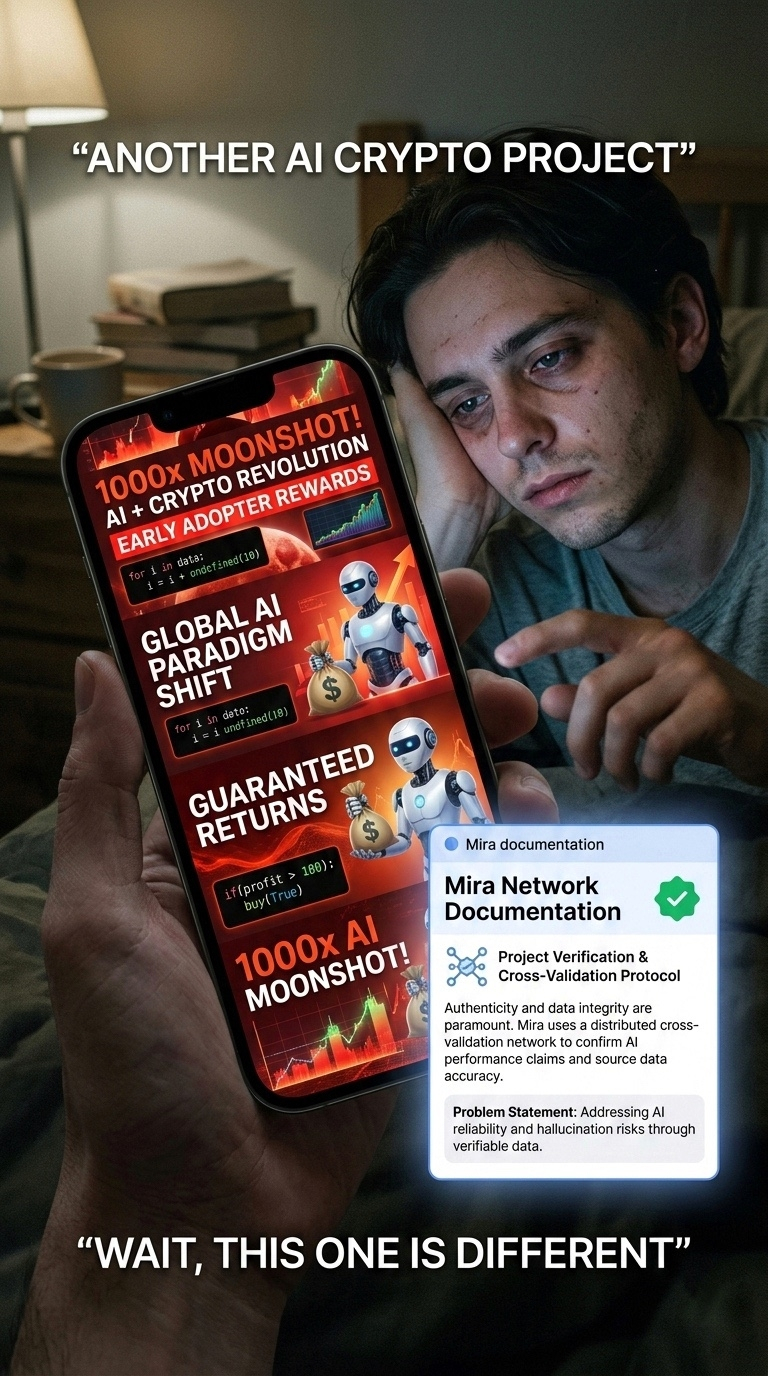
AI right now has a very obvious problem that everyone can see but nobody wants to talk about honestly. It sounds incredibly confident even when it’s completly wrong about basic facts. It hallucinates information that sounds plausable but is totally fabricated. It carries embedded bias from training data. It fills knowledge gaps with confident sounding nonsense. And yet we keep pretending collectively that it’s somehow ready to run autonomous finance systems and legal document reviews and medical diagnosis analysis and critical national infrastructure. We desperately want machines making important decisions for us but we absolutly don’t want to admit out loud that they still fundamentaly guess at things rather than knowing.
Why Mira Caught My Attention Despite My Cynicism
That’s where Mira Network caught my attention not because it was screaming the loudest or had the flashiest marketing but because it focused on something uncomfortably real that most projects avoid: verification of AI outputs. The core idea is actually simple in theory even though execution is obviously complex. Instead of blindly trusting whatever a single AI model outputs you systematically break that output into smaller individual claims that can be evaluated separately. Then you distribute those atomic claims across multiple genuinly independent AI models. Let them cross check each other’s reasoning. Anchor the entire validation process in blockchain consensus mechanisms so verification isn’t controlled by one centralized company. Add economic incentives so participants get rewarded for honest verification work and penalized for manipulation attempts.
It’s basically taking the don’t trust verify principle that made Bitcoin work and applying it directly to artificial intelligence. And honestly that’s a significantly healthier starting point than most AI crypto projects I’ve evaluated recently. Right now the crypto market feels messy again in that familiar chaotic way. Liquidity moves incredibly fast between narratives. Stories rotate weekly. Half the market is chasing AI agents that supposedly trade better than experienced human traders. The other half is farming yields that barely justify the gas fees required. Everyone wants to find the next explosive price chart. Almost nobody wants to have boring conversations about infrastructure that takes years to mature.
Why Infrastructure Actually Matters More Than Hype
But infrastructure is genuinly what actually survives market cycles while hype narratives come and go. Blockchains don’t fail because the underlying cryptography is mathematicaly wrong. They fail when actual traffic hits the network. When real users pile in simultaneously. When automated bots swarm looking for opportunities. When economic incentives get gamed in ways developers didn’t anticipate. When genuine usage stresses the system in ways the whitepaper never predicted or tested. Technology usually works perfectly in isolated lab conditions. It breaks spectacularly under real adoption pressure.
That’s exactly why verification layers matter significantly more than flashy demos that look impressive in controlled environments. If AI is genuinly going to operate autonomously trading on chain and negotiating smart contracts and executing tasks without human supervision we absolutly need reliability first. Not good vibes. Not impressive benchmark scores. Actual measurable reliability. Mira’s fundamental approach tries to solve that challenge by transforming AI outputs into something much closer to provable information. Instead of one model deciding something and calling it truth a distributed network of models verifies each individual piece of the reasoning independently. The blockchain records consensus permanently. Economic incentives align participant behavior toward honesty.
At least that’s how the design is supposed to work on paper. But design specifications and messy reality are completly different worlds that rarely meet cleanly. Here’s where I stay genuinly cautious despite understanding the vision. Crypto economic incentives are incredibly powerful tools but they’re also surprisingly fragile under certain conditions. If validators get rewarded with tokens then token economics matter enormously. Liquidity depth matters. Market stability matters. If the underlying token collapses in value the entire security model collapses with it. We’ve witnessed this exact pattern happen before in other infrastructure projects. Security budgets look impressively strong on paper until price volatility turns them into dust.
The Human Behavior Problem Nobody Solves
Then there’s human behavior which is always the unpredictable wildcard in these systems. If developers can get good enough results from a simple centralized API most will choose that path every time. Engineers optimize naturally for speed and simplicity. Adding decentralized verification layers only makes practical sense if the risk of not using verification becomes genuinly serious. Companies rarely choose additional complexity voluntarily unless forced by regulation or catastrophic failures.
And AI verification isn’t trivial to implement properly. Natural language is inherently messy. Context matters enormously. Breaking complex reasoning chains into atomic verifiable claims sounds clean in theory but the real world is rarely that clean. Multiple models verifying each other doesn’t automatically eliminate systemic bias either especialy if they’re all trained on overlapping data sets. Still I genuinly respect the direction Mira is taking. Instead of pretending AI is somehow perfect they assume it’s fundamentaly flawed and build protective guardrails around it. That’s significantly more honest than the usual narrative of our model is just better than everyone else’s. They’re not trying to win some intelligence arms race. They’re trying to secure AI systems that already exist.
In today’s chaotic environment that approach feels surprisingly mature and focused. There’s also this bigger structural shift happening beneath the surface. AI agents are slowly moving toward genuine autonomy. They’re trading assets and deploying smart contracts and interacting with other agents independently. If that trend continues verification layers might become absolutly essential infrastructure. You genuinly can’t have autonomous systems blindly trusting each other’s outputs without verification. That’s exactly how cascading system failures happen that nobody predicted.
Why Timing Is Everything
But timing is absolutly everything in crypto markets. Launch too early and nobody cares because the problem doesn’t feel urgent yet. Launch too late and someone else already owns the narrative and captured market share. Adoption is always the hardest part of any project. Not technology development. Not whitepaper quality. Adoption. Real users are impatient. Investors want returns yesterday not in three years. Infrastructure takes substantial time to build properly. It’s not sexy or exciting. It doesn’t pump overnight unless pure speculation outruns actual utility. And when speculation outruns real utility the inevitable crash comes significantly faster than roadmap updates.
I’ve personally watched too many technically sound projects fade into irrelevance because genuine usage never materialized at scale. Not because they were wrong about technology. Because the broader ecosystem wasn’t ready for what they built. Mira feels like one of those ideas that could quietly become foundational infrastructure or quietly disappear depending on adoption. It depends entirely on whether AI actually moves into high stakes autonomous operations. It depends on whether enterprises demand cryptographic audit trails for machine decisions. It depends on whether developers see verification as necessary rather than optional overhead.
It also depends critically on how well the network handles stress when it arrives. When transaction traffic increases dramatically. When economic incentives get exploited by sophisticated actors. When validators try gaming the system for profit. Crypto doesn’t test systems gently. It stress tests them brutaly. I’m not bullish in a hyped up way. I’m not bearish either. I’m just observing carefully. The strongest thing about this concept is that it acknowledges a genuinly real problem. Hallucination isn’t a marketing angle. It’s a serious liability. Bias isn’t theoretical. It’s measurable. Verification isn’t a luxury feature. It’s a fundamental requirement if AI is going to touch serious systems.
The Paradox Nobody Talks About
But the market doesn’t always reward what’s actually required. It rewards what’s exciting and generates attention. Right now excitement still lives in AI agents that promise trading returns not in verification protocols that promise boring reliability. Reliability is completly invisible when it works properly. Nobody celebrates the bridge that doesn’t collapse. That’s the fundamental paradox. If Mira succeeds most people won’t even think about it consciously. It’ll just sit underneath quietly validating outputs while flashy applications get all the attention. If it fails it’ll probably be because adoption lagged or incentives misaligned or developers chose convenience over security.
That’s the honest reality nobody wants to admit. I’m watching it the way I watch most infrastructure plays now with measured interest. Not because I expect instant gains. But because real shifts in crypto usually start boring and completly unnoticed. Maybe decentralized AI verification becomes standard practice in a few years. Maybe regulators eventually push for it. Maybe autonomous agents make it unavoidable. Or maybe everyone keeps chasing hype cycles endlessly and nobody bothers to verify anything until something breaks badly enough to force change. That’s crypto. It builds incredible systems and ignores them until crisis makes them necessary. Mira might be early. It might be essential. It might be both simultaneously. I genuinly don’t know. But I do know this with certainty: if AI is going to run critical parts of our financial and digital world trust me bro absolutely cannot be the security model. Verification has to live somewhere. Whether anyone actually shows up to support it that’s the part nobody can guarantee.