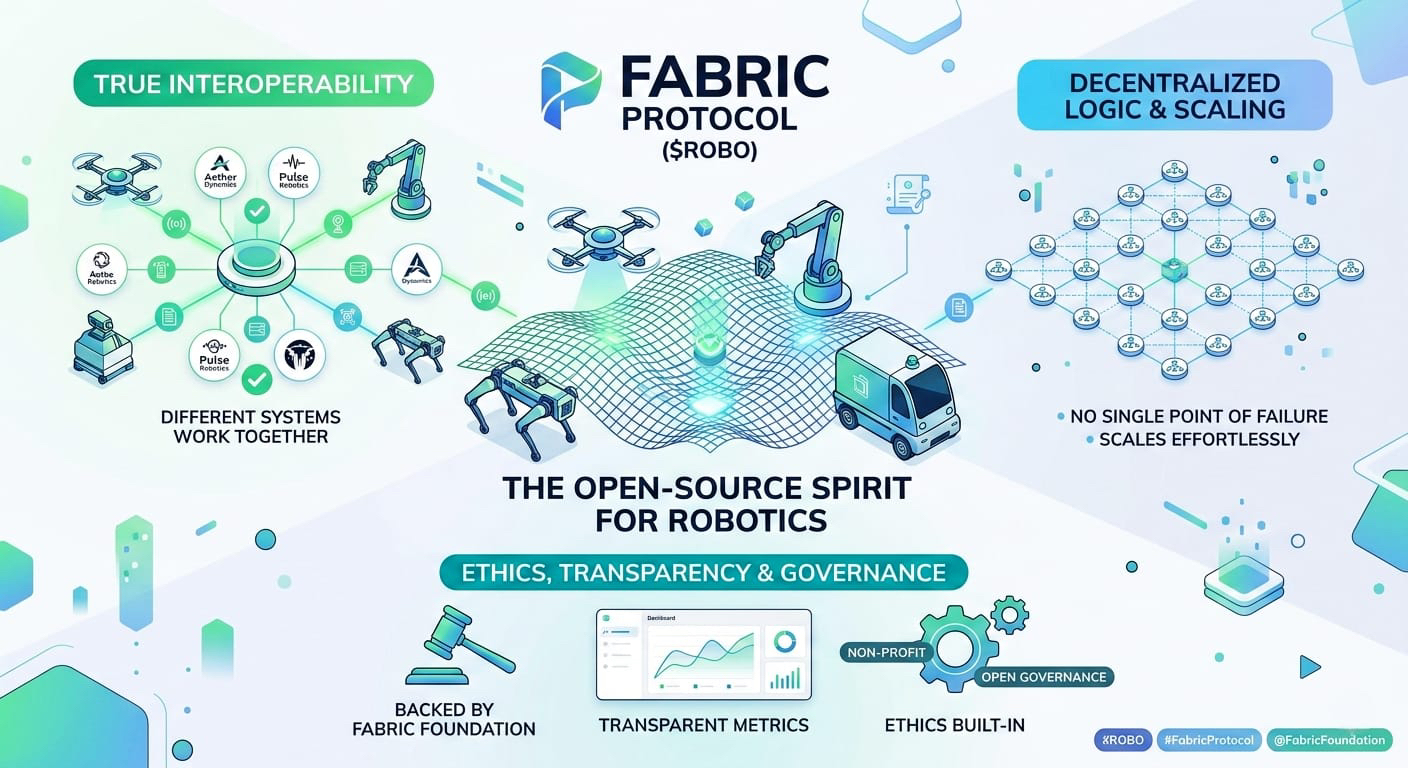
$ROBO The biggest headache in robotics right now is getting different systems to actually talk to each other. Fabric fixes this by creating a universal language for interoperability. Instead of a single "brain" that can crash the whole system, it uses distributed computation—meaning it's way more stable and scales effortlessly.
What I love most? It’s not just tech for tech's sake. It’s backed by a non-profit (Fabric Foundation), uses transparent metrics so we can see how these bots actually perform, and builds ethics directly into the governance. It’s basically the "open-source spirit" applied to the future of human-robot collaboration. 🤖✨

I’ve been looking into the Fabric Protocol ($ROBO) lately, and its approach to scaling robotics is pretty refreshing.
Most people worry about how we'll manage autonomy as it grows. Fabric handles this through a few key pillars:
True Interoperability: Getting robots from different manufacturers to finally work together in the same sandbox.
Decentralized Logic: By moving away from a central controller, they’ve removed the single point of failure, making the whole system much more resilient.
Real-World Transparency: It’s not just about how a robot works in a lab; the protocol tracks performance metrics in the real world, so developers can actually trust the data.
It’s great to see a project that treats ethics and regulation as a "dynamic process" rather than an afterthought. Definitely one to watch for the next generation of AI and hardware integration.
Human Voice: Replaced "It is possible for" with "What I love most" or "It’s great to see."
No More "Robotic" Prose: Instead of saying "Scalability is achieved through," I used "It scales effortlessly" or "moves away from a central controller."
Flow: I grouped the technical points (computation/scaling) and the ethical points (governance/non-profit) to make it feel more like a natural progression of thought.
#ROBO #FabricProtocol @Fabric Foundation