

Mira works as a blockchain powered network built to check whether content created by artificial intelligence is actually accurate. When any piece of AI generated content is submitted for verification, the system first breaks it into smaller individual claims. Each claim can stand independently, yet it still connects logically to the overall text. These claims are then distributed across different nodes in the network. Independent verification models review them separately. After all responses are collected, the system calculates a final outcome using a predefined threshold, which may require full agreement or a strong majority. Once consensus is reached, a cryptographic certificate is generated. This certificate records the result, the models that participated, and key verification details directly on the blockchain.
Security inside the network relies on an economic structure that combines concepts similar to proof of work and proof of stake. Anyone who wants to run a verification node must lock in a stake. If a node repeatedly disagrees with the network consensus or submits careless or random outputs instead of performing genuine verification, part of its stake can be reduced. The system remains secure as long as honest participants control most of the total stake. This design makes manipulation extremely expensive and risky. Verification tasks are randomly distributed, and a variety of models are used, which reduces bias and makes coordinated attacks much harder.
To increase speed, Mira uses models that are fine tuned for specific domains such as medical information, legal references, and other specialized subjects. These focused models can review claims more efficiently than general purpose systems because they are trained for targeted tasks. The architecture also allows tighter integration between content generation and verification. This reduces waiting time and moves the system closer to near real time validation.
For scalability, Mira applies sharding to divide verification workloads across the network. Claims are randomly assigned to different nodes, allowing the system to process growing demand without slowing down. As usage increases, verification fees are distributed to node operators as rewards, encouraging wider participation and expanding overall capacity. A diverse combination of models also helps reduce computing time for each task. Instead of storing entire content files on chain, the blockchain records only final consensus outcomes and compact cryptographic certificates. This approach keeps the system efficient even when handling large volumes of data or complex material.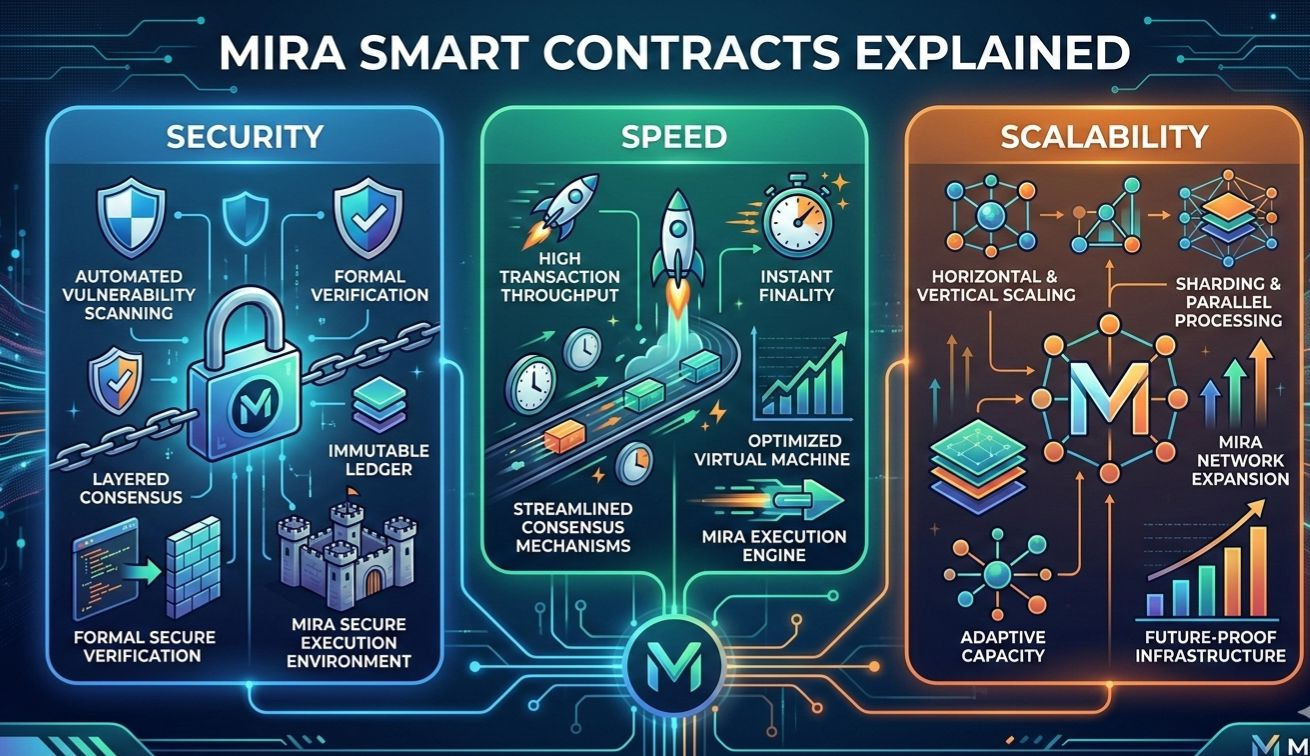
#Mira $MIRA @Mira - Trust Layer of AI
