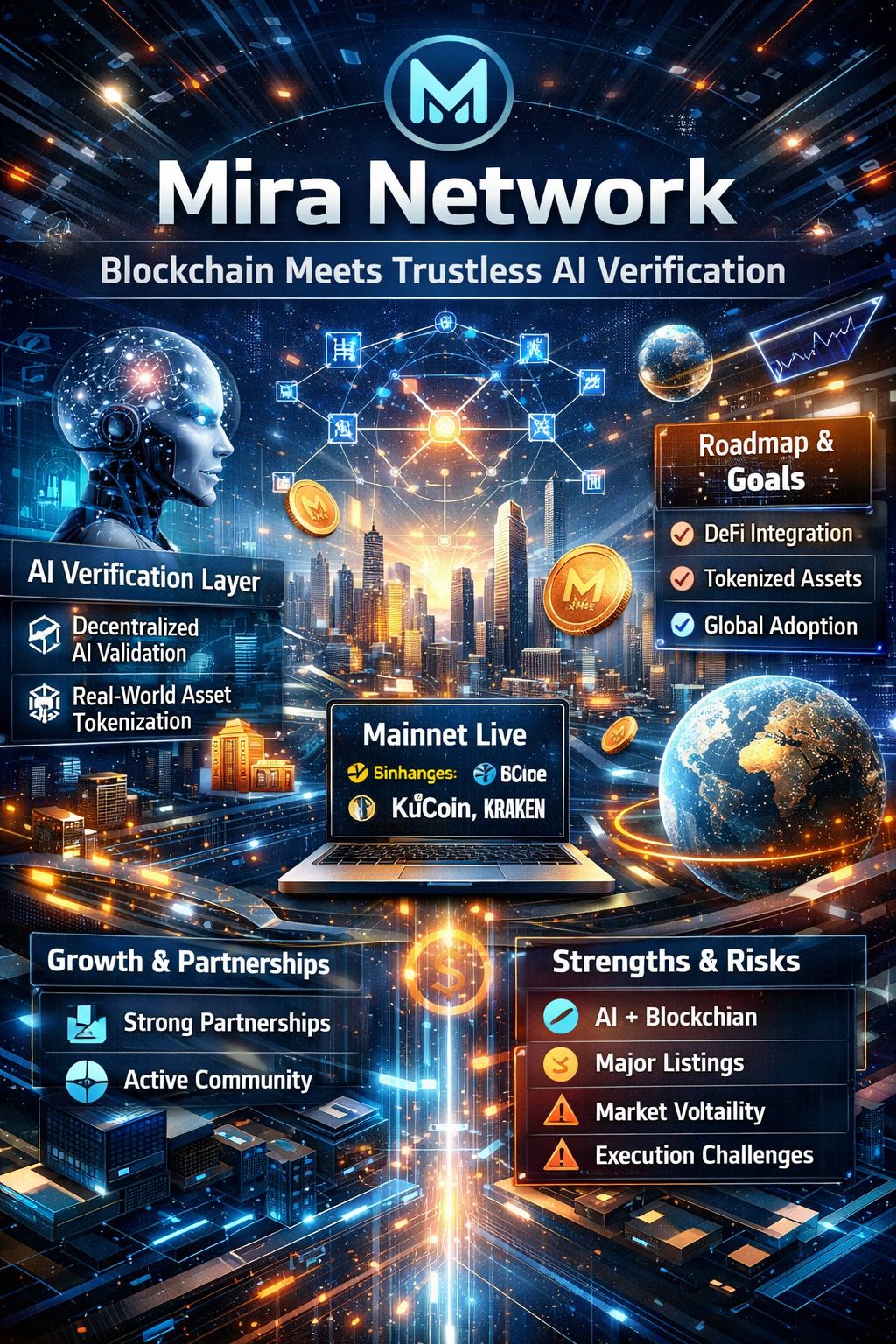
$MIRA (@Mira - Trust Layer of AI ) Network is a blockchain project that blends decentralized technology with AI verification and real-world asset tokenization. Instead of just being another token, its vision centers on creating trust and reliability in AI outputs and blockchain applications — an increasingly discussed problem in the crypto and AI space.
At its core, Mira’s native $MIRA token is used for:
Governance: letting holders vote on protocol decisions.
Staking and rewards: incentivizing participation in network security and AI verification activities.
Transaction fees and utility within the ecosystem.
2. Core Developments & Tech Highlights
Mira isn’t just a token — it combines blockchain with AI validation tools and real-world finance features:
🧠 AI Verification Layer
Mira’s tech claims to help improve the accuracy and reliability of AI models by using a decentralized verification protocol, reducing hallucinations and errors common to language models. This makes it attractive for enterprises using AI in sensitive fields.
🌐 Mainnet Launch & Exchange Listings
The Mira mainnet officially went live in late 2025, and the $MIRA token got listed on major exchanges, including Binance, Upbit, KuCoin, Kraken, and others — which increases accessibility and liquidity for traders.
🧩 Partnerships & Growth
Mira has built partnerships with infrastructure and AI service providers (e.g., GPU compute and AI startups), which supports its ecosystem’s scalability and technical depth.
🛠 Development Progress So Far
Here’s a snapshot of confirmed developments:
✔️ Completed Milestones
Distribution of MIRA token and staking/governance setup.
Mainnet launch and deployment of AI verification layer.
Active community engagement campaigns (e.g., AI verification campaigns).
Early airdrop rewards executed via Binance’s HODLer program.
Progress Summary: The project successfully shifted from testnet into real operation with listings on major exchanges — a key step in any crypto project’s development.
🛣 Roadmap — Strategic Path Ahead
Mira’s roadmap extends from technical maturity (2025–2026) into broader adoption by 2027 and beyond:
2025
Continued AI engagement campaigns — like the Kaito AI Season 2 — to increase real utility usage.
Strategic rebranding (to “Mirex”) to better align the project identity.
Integration of advanced governance modules and platform expansions.
2026
DeFi integration: lending, liquidity services, and network scaling.
Tokenized asset marketplace: a platform to trade real-world tokenized assets.
Global developer outreach and regulatory compliance efforts (e.g., KYC/AML).
2027 and Beyond
Aim to onboard millions of users worldwide and deepen real-world use cases.
Build out DAO governance frameworks and broader ecosystem services like healthcare and education integrations.
In short: Mira’s roadmap moves from core tech deployment towards ecosystem expansion and compliance — a necessary evolution for long-term sustainability.
📈 Strengths & Risks
Strengths
✅ Strong technological vision combining AI and blockchain — an emerging sector.
✅ Mainnet deployment and exchange listings enhance credibility and liquidity.
✅ Active community and airdrop campaigns encourage user participation.
Risks
⚠️ Market volatility: After the launch, MIRA experienced significant price correction — a common risk in new crypto assets.
⚠️ Execution risk: Complex roadmaps face delays and require strong development discipline.
⚠️ Brand clarity and competition: Rebrands require clear communication to maintain investor confidence.
🧠 Final Thought
Mira represents a high-ambition intersection of AI and blockchain. Its blend of decentralized verification, token utility, and real-world asset features positions it differently than many standard utility tokens. However, technology adoption and sustained execution will be key in determining long-term value. Always remember to do your own research whenever evaluating crypto assets, especially high-volatility ones.