
@Mira - Trust Layer of AI When I first started exploring MIRA Coin, I didn’t look at it as “just another crypto project What caught my attention was the structure behind it- the idea of a native asset designed not only for transactions, but for powering an entire ecosystem. From my understanding, $MIRAI Coin is more than a token; it is the economic engine of the MIRA -20 blockchain, created with a clear focus on speed, utility, and long-term network sustainability. Here is a clear understanding on this-
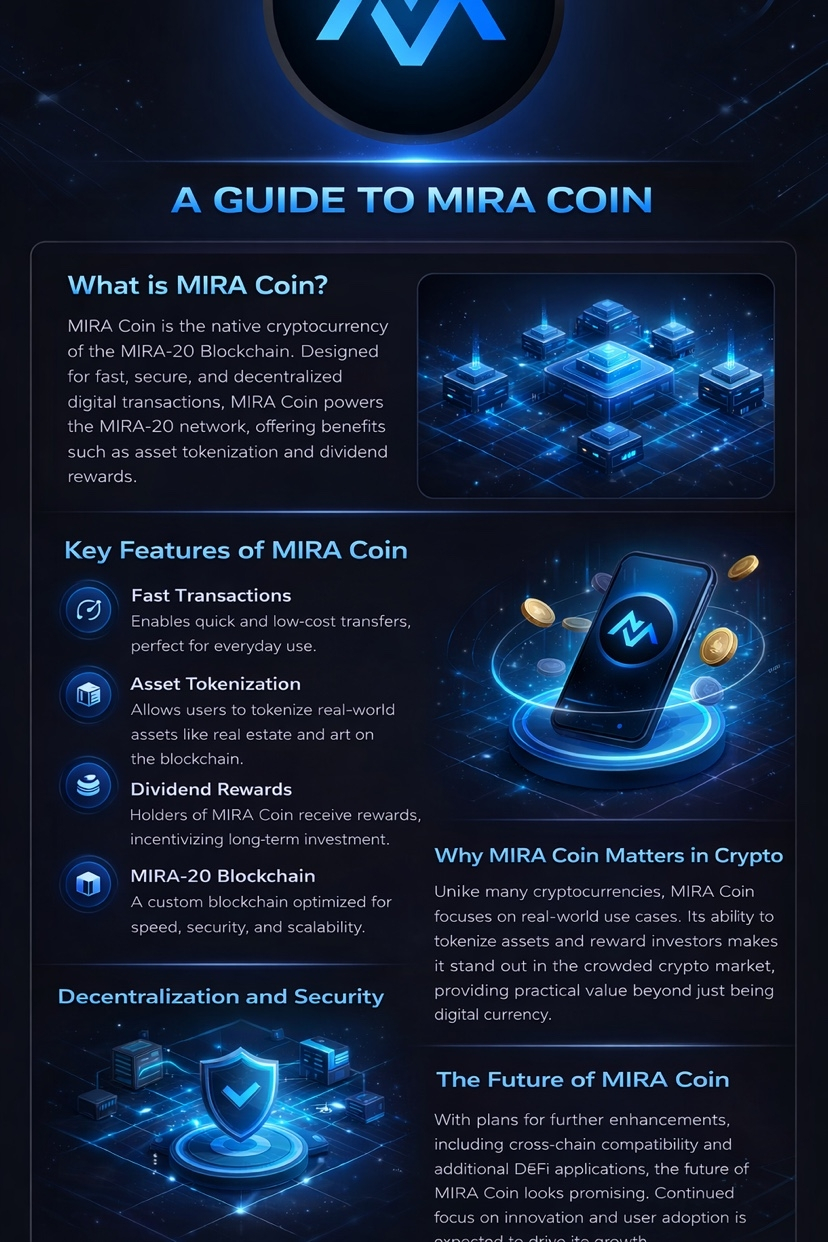
At its core, $MIRAI Coin functions as the native cryptocurrency of the MIRA-20 blockchain. This means every transaction, interaction, and asset movement within the network is supported by MIRA. What stands out to me is the emphasis on fast and low-cost transactions. In today’s blockchain environment, scalability and transaction efficiency are not luxuries — they are necessities. A network that cannot process transfers quickly and affordably struggles with adoption. MIRA appears to be designed with this reality in mind.
Another key aspect that I find interesting is asset tokenization. The ability to tokenize real-world assets — such as real estate, artwork, or other tangible investments — opens the door for broader financial participation. Tokenization can reduce barriers, increase liquidity, and make traditionally illiquid markets more accessible. If implemented properly, this feature alone could give MIRA a practical edge beyond speculative trading.
Dividend-style rewards for holders are also part of the ecosystem design. From my perspective, this creates an incentive model that encourages long-term participation rather than short-term speculation. Many crypto projects struggle because users are only focused on price volatility. A reward mechanism shifts the mindset from trading to holding and supporting network growth. It aligns user interest with ecosystem development.
Security and decentralization are foundational pillars in any blockchain project, and MIRA seems to position itself strongly in this area. A custom blockchain like MIRA-20 suggests optimization specifically for performance and protection. Decentralization reduces reliance on a single authority, which strengthens trust. In an era where users are increasingly cautious about centralized control, this design philosophy matters.
What makes MIRA particularly relevant in the broader crypto market, in my view, is its focus on real-world usability. Many cryptocurrencies promise innovation, but few clearly articulate how they integrate into everyday economic systems. MIRA’s direction toward asset tokenization, network rewards, and scalable infrastructure indicates a practical roadmap rather than a purely theoretical one.
Looking ahead, the future potential of MIRA Coin depends largely on adoption and ecosystem expansion. Cross-chain compatibility would be a strong next step, allowing MIRA to interact seamlessly with other blockchain networks. Integration into decentralized finance (DeFi) applications could further strengthen its utility. The more use cases a token has, the stronger its long-term position becomes.
However, I also believe that any crypto project — including MIRA — must prioritize transparency and trust. Clear communication, open governance models, and measurable development milestones are essential. The crypto market is maturing, and investors are no longer impressed by buzzwords alone. Sustainable growth requires substance.
In conclusion, based on my understanding, MIRA Coin represents a structured attempt to combine speed, tokenization, security, and incentive-driven participation within one ecosystem. It is positioned not merely as a digital currency, but as the backbone of a broader blockchain economy. While its long-term success will depend on execution and community adoption, the framework suggests a project aiming for practical relevance rather than hype.
For me, #Mira Coin reflects a bigger shift happening in crypto — from speculation toward structured digital economies. And that shift is where real value will ultimately be buil