During the market downturn, it is also the time when the market has a clearer view of which coins truly have strength and growth potential. According to statistics, more than 60% of coins cannot survive the crypto winter, let alone grow. However, Ethereum is a different story.
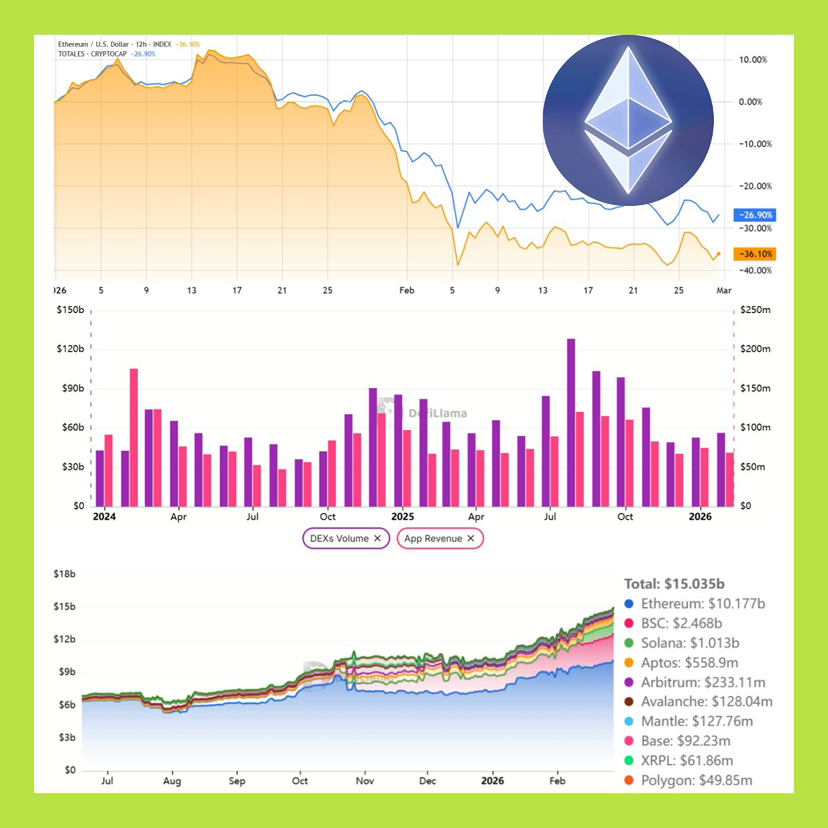
Since the peak in 2025, $ETH has decreased by about 60%. Specifically, in 2026 it is also down more than 36%, and the 3,000 USD mark now seems quite distant as the price retreats to around 1,900 USD.
If we only look at the chart, it's easy to conclude that Ethereum is losing steam. But the market is not just about price.
📌 DEX activity has declined, but it's not the whole picture
The trading volume on Ethereum's DEXs has dropped significantly. In February 2026, it reached about 56.5 billion USD, much lower than the 128.5 billion USD in August 2025. Thus, network fees and application revenue have also declined, weakening the short-term holding incentive for ETH.
In the same period, Solana only dropped about 21%, with the most recent month's volume reaching 95.5 billion USD.
This contraction has led to decreased network fees and DApp revenue, thereby weakening the short-term holding incentive for ETH.
📌 But organizations still choose Ethereum
If we look at the TVL, Ethereum still accounts for about 57% of the entire market, equivalent to over 52 billion USD. When considering layer-2 networks like Base, Arbitrum, or Optimism, the market share rises to around 65%.
Comparison:
> Solana: 6.4 billion USD TVL
> $BNB Chain: 5.5 billion USD TVL
In the realm of real assets brought to blockchain (RWA), Ethereum holds nearly 70% market share; this also shows that besides ETH, BNB is performing very well.
More importantly, many large financial institutions are still deploying on-chain products on Ethereum: from tokenized funds, proprietary layer-2 networks to bank-issued stablecoins. This shows that long-term confidence remains intact.
📌 New direction: Empowering the base layer
Vitalik Buterin recently emphasized upgrading the base layer directly instead of relying too much on layer-2 networks. Proposals focus on parallel verification, optimizing transaction fees, and implementing virtual machines using zero-knowledge proofs.
Alongside this is the roadmap preparing for the quantum computing era. Although there are many technical challenges, Ethereum still has a clear plan for long-term scalability and security.
Ethereum has the advantage of being a first mover, a strong development community, and sufficient reliability for institutions to make long-term bets.
Prices can fluctuate cyclically. But in terms of infrastructure and position in decentralized finance, Ethereum has not collapsed.
And perhaps that's why, even though ETH is disappointing in the short term, institutional money has not left.