
When observing the cryptocurrency market, I often look at projects like $MIRA , which combines artificial intelligence with blockchain to verify AI outputs in a decentralized manner. Launched a few months ago, this token operates in an evolving sector, with a market capitalization of around $22 million and a fully diluted value estimated at $89 million. This leaves room for measured growth, without falling into excessive optimism.
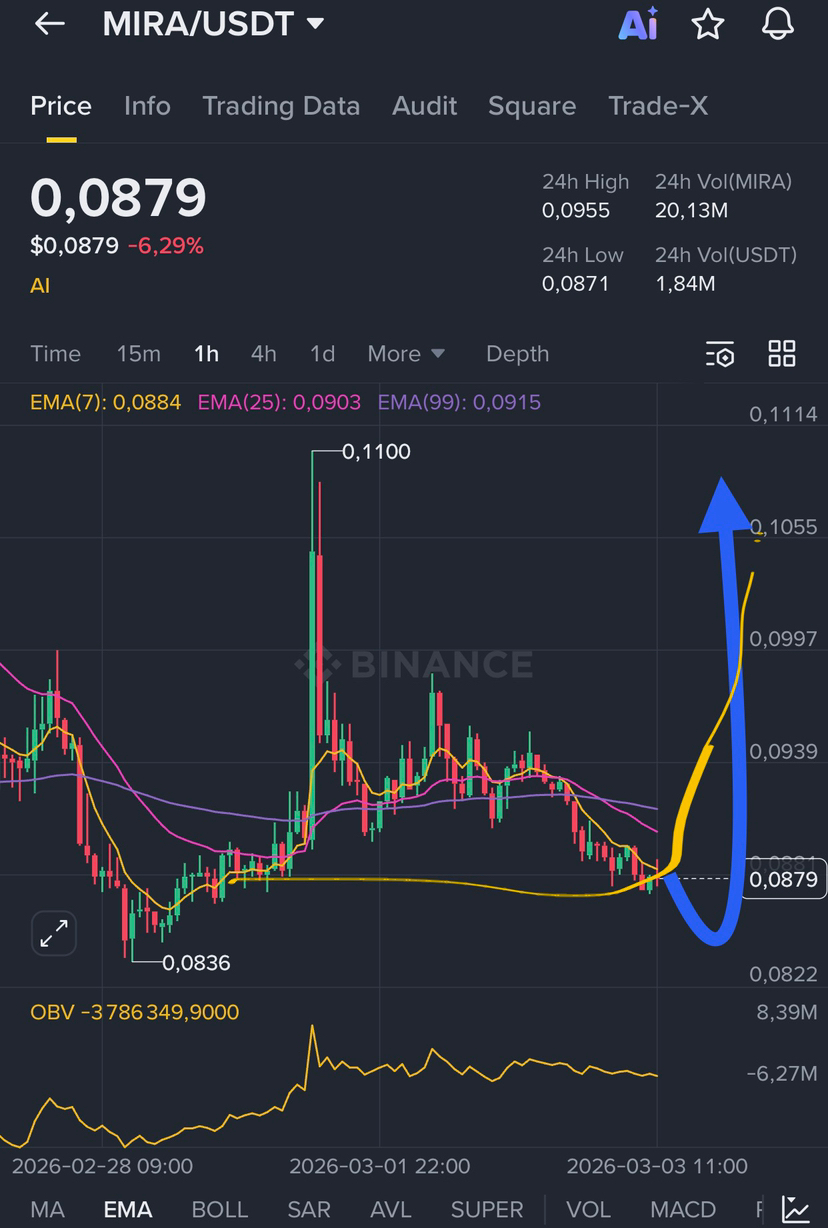
Let's look at the recent chart on Binance. The price is around 0.0879 USDT, marking a 6.29% drop over the last 24 hours, after peaking at 0.1055 followed by a sharp correction.
The exponential moving averages EMA 7 at 0.0884, EMA 25 at 0.0903, and EMA 99 at 0.0915 are placing the price below these levels, suggesting a short-term bearish trend.
The OBV indicator, negative at -37.86 million, reflects an accumulation of selling, while the volume, at 1.84 million USDT, is tending to stabilize, perhaps indicating a consolidation phase rather than a collapse.
From a long-term perspective, I consider this volatility to be normal fluctuation in a young asset. Since its all-time high of $2.61, MIRA has corrected by 96%, but it has rebounded by 17% from its recent low of $0.07657.
Average projections point to $0.25 by the end of 2026, and potentially $1 to $2 by 2030, if the adoption of decentralized AI continues.
My personal strategy involves buying gradually at these low levels, around $0.085 to $0.09, with a cost-weighted average, and a sell-below-cost threshold of $0.075. I monitor developments such as distributions or partnerships, while keeping in mind the risks of competition and future dilution.
Ultimately, MIRA seems like a sensible choice for those willing to be patient in the unpredictable cryptocurrency market. Especially with an improvement in geopolitical tensions threatening the entire economy and especially risky assets.