

😆😆The past few days have simply been the exclusive days of $ROBO , 📈📉 I've been eating back and forth non-stop, and writing articles can also earn a bit more, it's really great. I suggest you can take a little bit of spot trading here, and it might not be certain that you can ride a wave in the future.
In recent years, with the rapid development of general robotics technology, how to achieve responsibility tracking, behavior auditing, and deviation supervision has become an important topic in the industry. The logs of traditional centralized systems are easily subject to modification, overwriting, or loss, making it difficult to meet the demand for objective and tamper-proof records of robotic autonomous actions. To address this pain point, verifiable computing based on blockchain technology and public ledger mechanisms has been proposed as core infrastructure.
♟️ Open-source black box: Blockchain ledger as the auditing layer for robot behavior
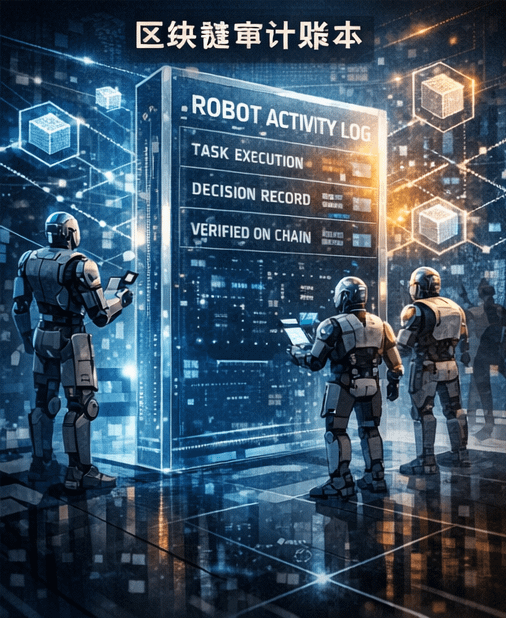
@Fabric Foundation is a globally open network aimed at building, governing, owning, and evolving the infrastructure for general-purpose robots. This protocol coordinates data, computation, and regulatory mechanisms through a public ledger, enabling every critical decision and execution operation of robots to generate corresponding proofs via on-chain verifiable computing, which are then recorded in the public ledger. Unlike traditional ledgers that only record transfers, this on-chain log becomes an all-day behavior diary for robot groups, achieving a transparent and traceable auditing system.
Verifiable computing essentially confirms the correctness of the robot's computation path through mathematical proof mechanisms without exposing sensitive raw business data. When the protocol detects deviations from preset rules or anomalies in the generated proofs, consensus nodes can refuse to put that behavior on-chain, achieving automated regulation and deviation prevention from the underlying rules.
♟️ Token economy and consensus incentive mechanism
Maintaining a comprehensive behavior log in a decentralized ledger requires continuous computing power and verification resources. Therefore, the Fabric Protocol introduces a native functional token #ROBO as an economic incentive mechanism. This token is used not only to pay on-chain interaction fees but also for identity staking, network coordination, verification node incentives, and governance voting. Through this token economy system, nodes contributing hardware resources and computing power can receive token rewards issued by the protocol, while malicious behavior may result in the forfeiture of staked tokens, thereby enhancing the security and reliability of the network on an economic level.
The intention behind the design of Fabric is to transform the cost of secure regulation of robot networks into an economically sustainable ecological contribution activity. ROBO not only acts as the fuel for protocol operation but also carries the consensus costs paid by participants to maintain the 'safety bottom line' of the entire behavior auditing system.
$robo
♟️ Practicality and ecological development
The community development and ecological collaboration of the Fabric Protocol are reflected in the issuance of native tokens and network promotion. According to official releases, ROBO has undergone public sales on platforms including Kaito Capital Launchpad and has initiated prioritized allocation plans with community ecological partners. 40% of the publicly issued tokens are prioritized for allocation to project cooperative communities to promote ecological collaborative development and multi-party participation.
At the same time, ROBO has been launched on multiple trading platforms, such as spot trading on Bybit, providing liquidity support and network interaction experiences for participants.
♟️ The underlying closed loop of secure collaboration
By deeply integrating the blockchain ledger into the operational monitoring layer of general-purpose robots, the Fabric Protocol has built a foundational infrastructure capable of full-process tracking of robot behavior, verifiable auditing, and rule deviation isolation. Verifiable computing and node consensus mechanisms ensure the objectivity and irreversibility of on-chain data, while the token economic model guarantees the sustainability of incentives for long-term operation.
This design not only enhances the safety collaboration capabilities of robots in both the physical world and virtual scenarios but also provides possibilities for achieving larger-scale autonomous and regulatory capabilities for general-purpose robots in the future.