

I keep coming back to one practical confusion.When a crypto project says the crowd can help “genesis” robots, what exactly are people getting? That wording is powerful. It can sound like early community members are buying into robot upside the way a shareholder buys into a company. I’m not sure that is the right mental model for Fabric Foundation. From what the whitepaper and the newer site language actually say, the mechanism looks much closer to coordinated access and bootstrapping than to ownership. #ROBO @Fabric Foundation That distinction matters more than it sounds.In crypto, expectation management is half the product. If users hear “crowdsourced robot genesis” and mentally translate that into “I own part of a robot fleet,” disappointment comes later, even if the documents were technically clear from day one. Fabric’s materials try to draw that line pretty explicitly. The whitepaper says participation units are used to coordinate network initialization and “do not create ownership interests, profit-sharing rights, or investment contracts.” The project’s recent website language says participation does not represent ownership of hardware, revenue rights, or fractional interest in fleet economics, and that participation units are non-transferable and do not confer investment returns.So what is Fabric actually offering here?As I read it, the offer is not: “fund this robot and enjoy passive upside.”It is closer to: “commit resources early, help coordinate launch demand, and receive protocol-level priority and participation rights if the robot network activates.”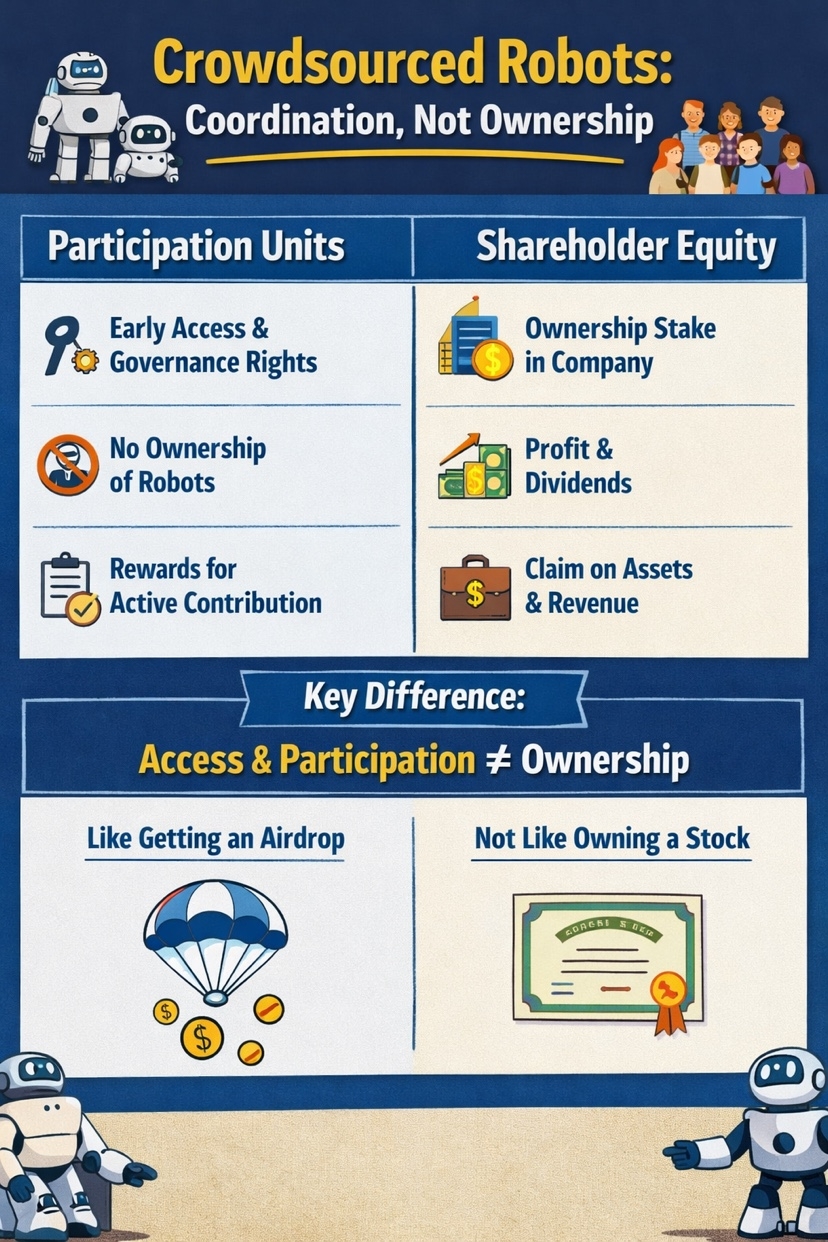
That is a very different thing. In the whitepaper’s architecture, users contribute $ROBO into a time-bounded coordination contract tied to a specific genesis robot. In return, they receive participation units, with an early-participation bonus function that gives more weight to earlier contributors. If the threshold is not met by expiry, contributions are returned in full with no penalty. If the threshold is met, those units can influence early priority access, some initial network parameter calibration, and a one-time conversion path into governance participation weight during bootstrap, subject to concentration limits.
That is why I think the cleanest analogy is this:Fabric’s participation units look more like an airdrop-style access primitive than a shareholder certificate.Not literally an airdrop, of course. You still contribute tokens and take coordination risk. But economically, the framing is nearer to “you get network utility if this launches and if you actively use it” than to “you now own a claim on future robot cash flows.” A shareholder usually expects some residual claim on profits, assets, or the enterprise itself. Fabric’s documents repeatedly deny exactly those claims. The units appear designed to manage who gets early protocol utility, not who owns productive assets.The small real-world scenario I keep thinking about is simple.Imagine two users each commit the same amount of $ROBO toward the launch of a service robot. User A thinks this is basically seed investing in robot economics. User B reads it as an early-access coordination mechanism. Six months later, the robot goes live. There is no dividend. No direct revenue share. No transferable asset claim. What User B may get is better positioning to request early services, maybe stronger initial protocol standing, maybe governance weight if they take additional active steps. User A, meanwhile, feels misled, even if the documents did not actually promise ownership. The friction came from interpretation, not necessarily from formal disclosure.This is why the contributor framing is doing heavy work.Fabric also pairs genesis coordination with a broader “proof-of-contribution” logic. The whitepaper says token rewards are tied to verified activity such as task completion, data provision, compute, validation work, and skill development. It separately says these distributions are contingent on active participation and are not investment returns or profit-sharing arrangements. That tells me Fabric wants the community to think of itself less as passive capital and more as an operating edge: people who help bootstrap usage, provide work, improve skills, and make the network usable.
That model has a real advantage.It may reduce one of the most dangerous habits in crypto robotics: selling the dream of robot ownership before there is enough real-world deployment, utilization, maintenance, insurance, and service reliability to justify that story. Even Fabric’s own website notes the project is still early and that robot fleets at scale will require real deployment partnerships, operational maturity, insurance frameworks, and reliable service contracts. So a coordination-first framing is, in one sense, more honest. It says: first solve launch, access, usage, and contribution; do not pretend you have already solved financialization.
Even if the legal and economic language is careful, the narrative layer can drift. “Own the robot economy” is a powerful slogan. “Crowdsourced robot genesis” is a powerful slogan too. Retail readers do not always parse the difference between protocol access and economic ownership, especially when tokens, robots, and future revenue are discussed in the same universe. So the challenge for Fabric is not only designing the mechanism. It is repeatedly teaching the community what kind of participation this is and what it is not.Fabric may be trying to build a more disciplined coordination layer for early robot networks, not a synthetic equity wrapper around hardware. If that is true, the project deserves credit for saying so in its documents. But the market will only absorb that if the messaging stays as disciplined as the mechanism. In crypto, access, governance, rewards, and ownership get blurred fast. Once that blur starts, community trust becomes harder to recover than token price.So the real question is not whether Fabric can get people excited to join robot genesis.It is whether Fabric can keep contributors thinking like participants instead of accidental shareholders.
Can Fabric build mass community participation without letting the market misread access rights as ownership claims?