

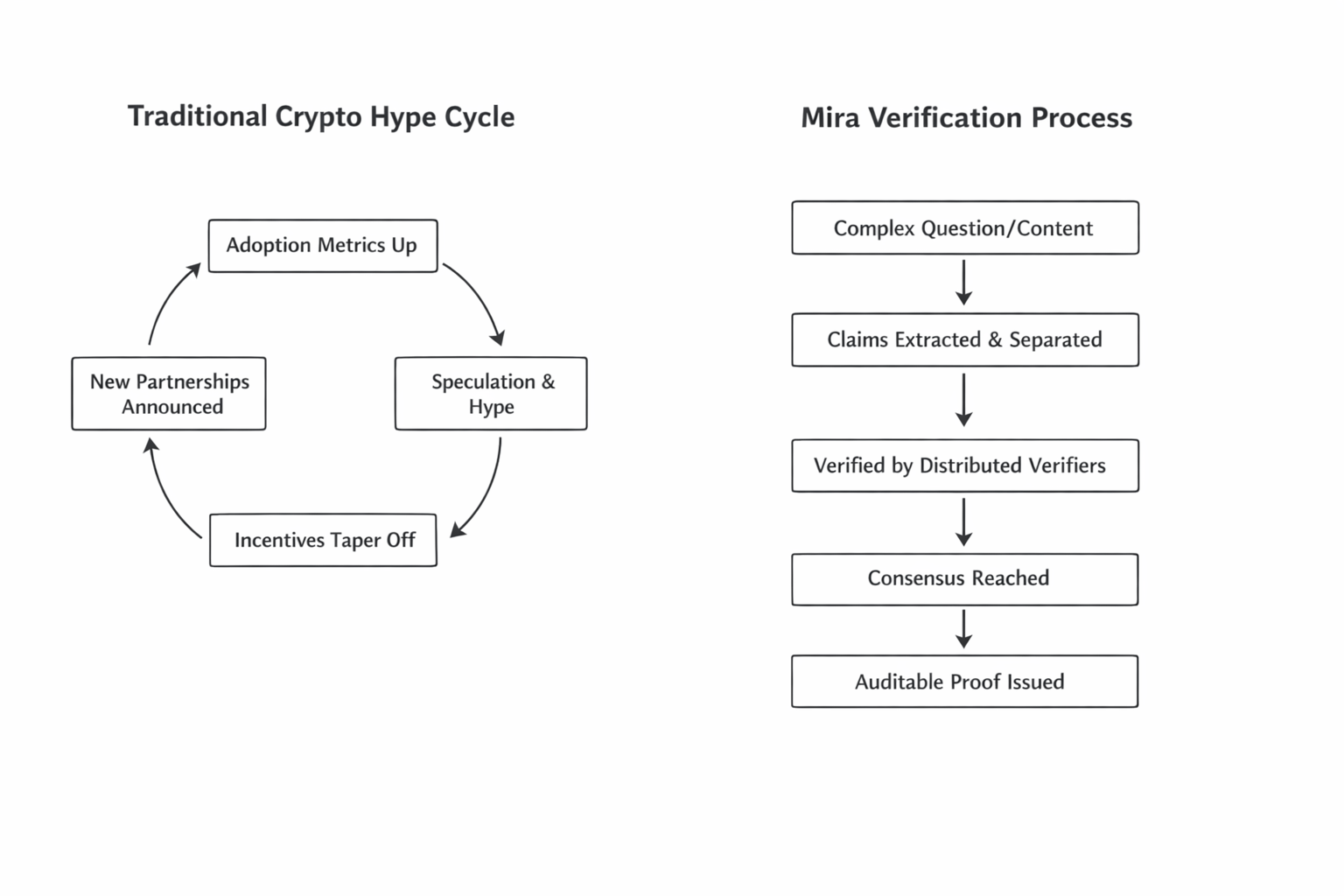
I learned the hard way that a clean dashboard can be the most misleading thing in crypto. A couple cycles ago I kept telling myself I was “tracking adoption” because the chart looked healthy, the community numbers were climbing, and every weekly update had a new partnership logo. Then incentives tapered, withdrawals picked up, and the whole thing went quiet. What I should have obsessed over was the retention problem: do people keep showing up when the dopamine fades, or was I just watching a temporary event dressed up as traction. That scar is why the idea behind Mira clicks for me, because it is basically a retention filter for truth. Not in a social sense, but in an evidence sense. “Trustless by Design” is not a marketing line if you read it literally. Mira’s core claim is that an AI output should not be trusted because a single model said it confidently, or because one platform stamped it “verified.” Instead, Mira turns a response into smaller, independently checkable claims, routes those claims to a distributed set of verifiers, and only then produces a cryptographic certificate that records what was checked and how consensus formed. That workflow is straight out of the protocol’s own research framing, with the emphasis on transforming complex content into verifiable claims and using distributed consensus to reduce bias and hallucinations. If you are a trader, the market angle is simple: this is an attempt to price a trust layer, not just another model wrapper. On chain, MIRA is deployed on Base as an ERC 20 token. Right now, the basics look like an actively traded mid tail asset: roughly 13,007 holders on BaseScan, max supply of 1,000,000,000, circulating supply about 244,870,157, and recent 24 hour token transfer activity in the hundreds. Price and volume float with the market, but as a snapshot it has been trading around nine cents with eight figure daily volume and a low eight figure market cap on common trackers. None of that proves product market fit, it just tells you attention exists and liquidity is real. What I actually watch is whether verification gets used when it is inconvenient. Here is a real life example from my own workflow: when I am scanning narratives, I do not just want “an answer” about why a token moved, I want the underlying claims separated. Was there a specific filing, an on chain transfer, a listing notice, a governance vote, a macro print. Mira’s approach, claim splitting then multi model verification then an auditable certificate, is designed for that kind of disciplined checklist thinking. But I am not treating this as guaranteed. What could go wrong is mostly incentive and surface area. Verifier collusion, low quality verifiers that rubber stamp, adversarial prompts that sneak in ambiguous claims, and the classic crypto failure mode where speculation outruns sticky usage. If developers can get similar reliability by just running two models and eyeballing it, Mira has to earn its place with speed, cost, and credibility. The retention problem shows up again here: do apps keep paying for verification once the novelty is gone and margins get tight. If you are eyeing MIRA, do not fall in love with the idea. Pull the Base contract, watch holders and transfers, and look for evidence that verified outputs are being demanded by real products, not just talked about on socials. If you can point to repeat usage under normal conditions, not launch week conditions, then you are no longer trading a story, you are trading a behavior loop, and that is where conviction stops being a vibe and starts being earned.