

If you’ve traded the “AI narrative” in crypto over the last couple of cycles, you know how it usually goes: a handful of tokens rip on headlines, then the market starts asking the boring question what’s actually being used? That’s where Mira Network has started showing up on my radar, not because it promises magical intelligence, but because it targets a real developer headache: building AI apps is messy, slow to iterate, and full of integration friction.
At its core, Mira positions itself as infrastructure for reliable AI think of it as a verification layer that tries to reduce the risk of AI systems confidently producing wrong outputs (the classic “hallucination” problem). The project’s framing is that AI outputs can be turned into “claims” that are checked by a decentralized network, rather than trusted because one model said so. In plain English: instead of taking an AI answer at face value, you run it through a system designed to cross-check it and make the result more auditable.
But here’s the angle traders sometimes miss: even if you like the vision, adoption tends to follow convenience. Mira’s developer story leans heavily on speed and simplicity less time wiring up model providers and more time shipping. Its SDK is described as a unified interface to multiple language models, with “smart routing” (automatically choosing where requests go), load balancing (spreading traffic so one provider doesn’t become a bottleneck), and flow management (building multi step AI pipelines rather than one-off prompts). If you’ve ever watched a team lose days to model switching, rate limits, broken wrappers, and observability gaps, you get why that’s attractive.
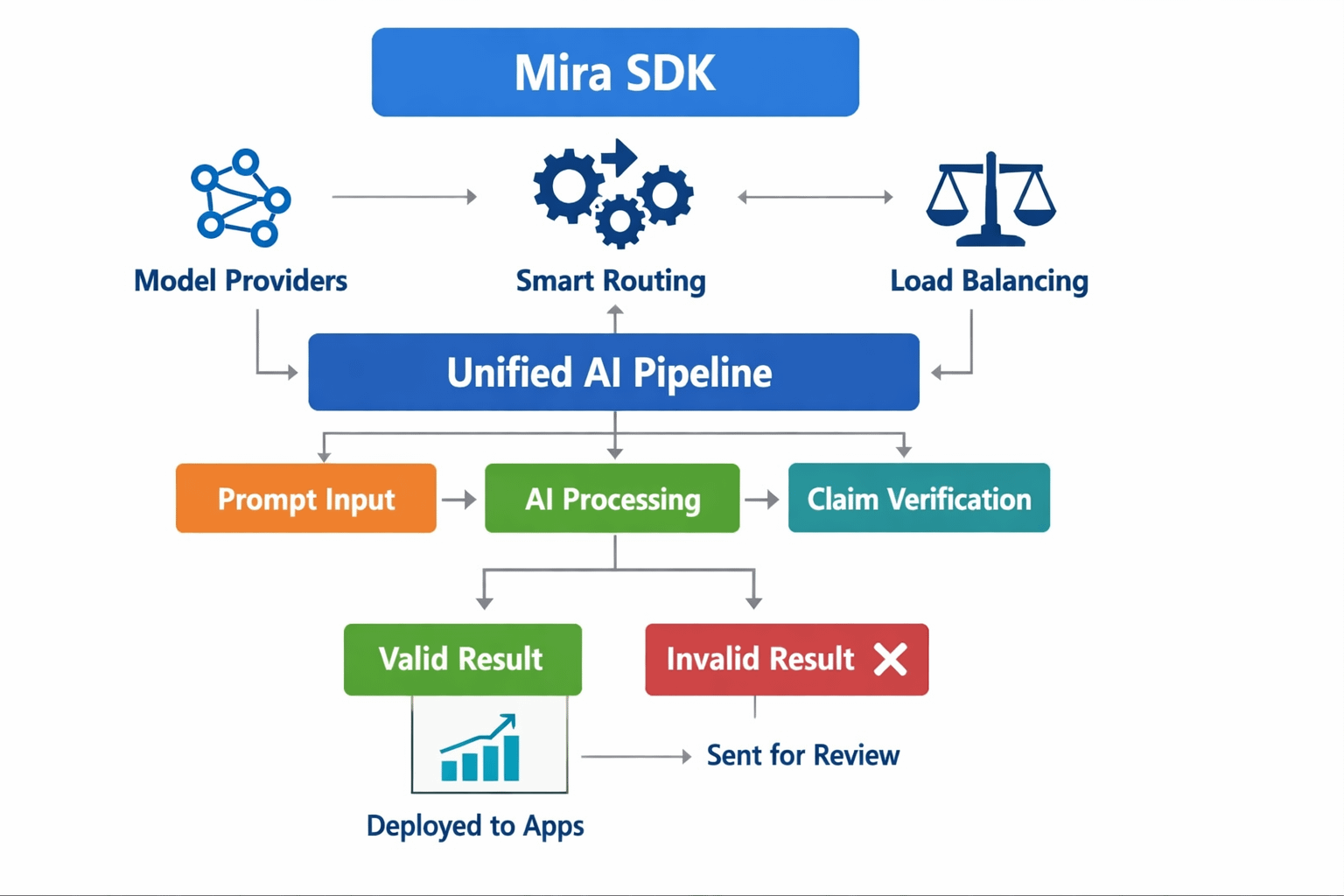
To translate the jargon: “routing” is basically deciding which model handles which request; “load balancing” is keeping performance steady by not overloading one endpoint; and “flows” are structured sequences of steps (for example: retrieve context → draft answer → verify answer → format output). Traders don’t need to code to appreciate this. Anything that reduces development friction tends to increase experimentation, and experimentation is what turns into on chain activity, dashboards, and eventually liquidity attention.
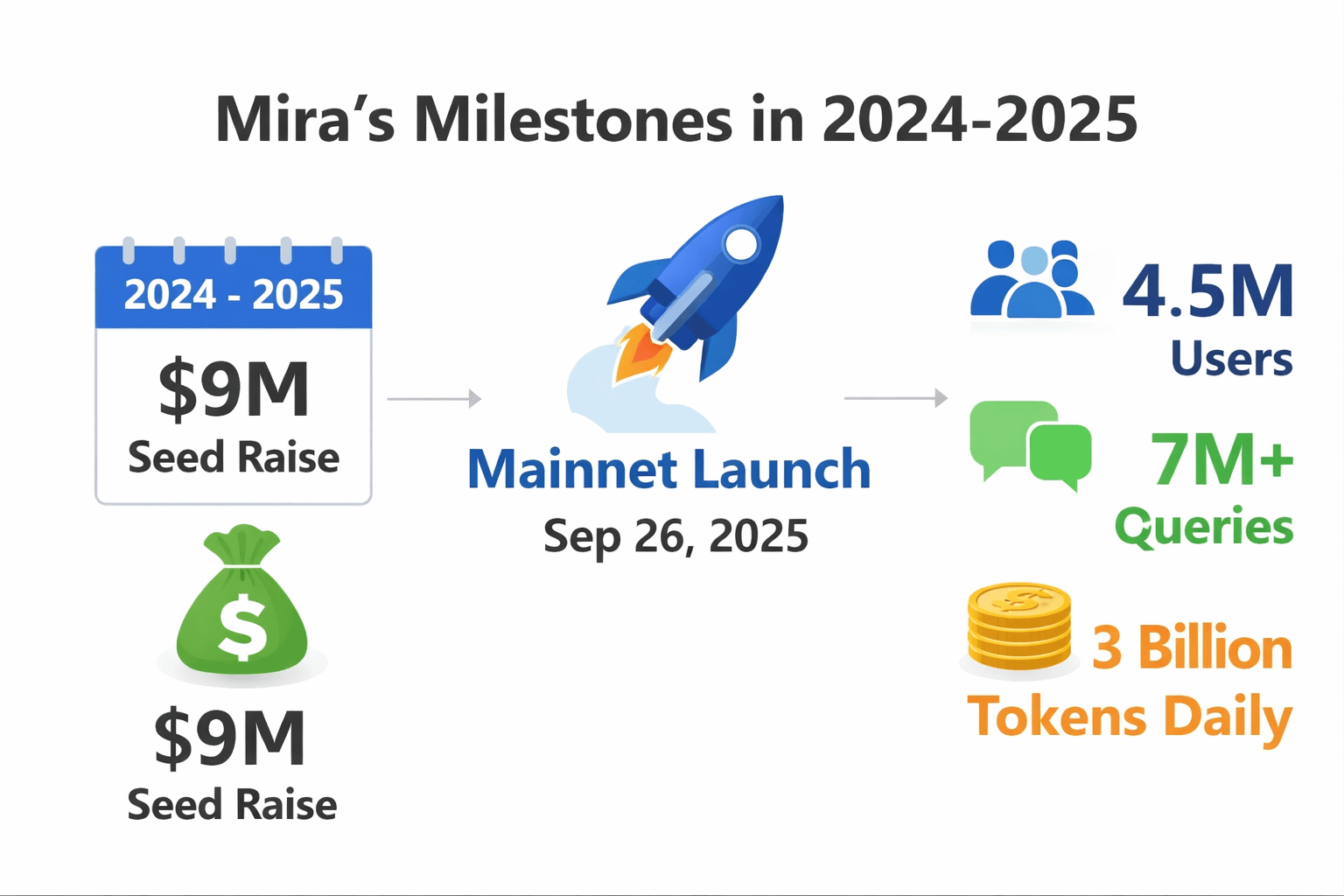
On the timeline side, Mira’s momentum isn’t ancient history. The project has pointed to major milestones in 2024 and 2025, including a seed raise reported at $9 million and a move from testnet into mainnet. Mainnet launch coverage around September 26, 2025 described the network as already serving millions of users ac@miraross ecosystem apps and processing large daily volumes of activity, with figures cited like 4.5 million users, more than 7 million queries, and “3 billion tokens daily.” Whether you take every metric at face value or treat it as directional, those are the kinds of numbers that help explain why a ticker starts getting watched by short term traders.
Listings also matter because they change who can participate. Mira’s MIRA token appeared in major exchange research/coverage around late September 2025, coinciding with the mainnet window. And in markets, access is narrative fuel: once a token is easy to trade, it becomes part of the rotating “AI basket,” for better or worse.
What about price and liquidity right now? These move fast, but as a snapshot, CoinMarketCap showed MIRA around the $0.08–$0.09 range with tens of millions in 24-hour volume and a reported circulating supply near 245 million (max supply 1 billion). I’m not citing that as a valuation argument just as context for why it may appear on scanners when AI sector volatility kicks up.
From a trader’s perspective, the “why it might appeal” comes down to a simple loop: AI sector growth pulls attention toward picks-and-shovels infrastructure; infrastructure that’s easy for developers to adopt tends to get tried; and what gets tried creates the on chain and community signals that traders chase. Mira’s bet is that verification plus a practical SDK layer can make AI apps faster to ship and safer to trust.
The neutral way I’d frame the opportunity and the risk is this: if Mira’s tooling really reduces build friction and the verification layer proves useful beyond demos, it can earn organic usage even when the AI hype cycle cools. If not, it risks blending into the crowded “AI + crypto” category where attention outpaces real demand. Either way, it’s a name that makes sense to watch when AI sector rotations heat up especially around product milestones, ecosystem integrations, and usage metrics that can be independently verified over time.