
@Mira - Trust Layer of AI #Mira
Right now, the Mira (MIRA) token has a market cap in the ballpark of $20 – $30 million, depending on which live price source you check. This number is calculated by multiplying the current price of the token by the amount of $MIRA that is actually circulating on the market.
As of the latest data:
The circulating supply of MIRA is roughly 200–235 million tokens out of a total 1 billion max supply.
That means about 20–25% of the total $MIRA supply is actively tradable, and the rest is still locked or vesting. 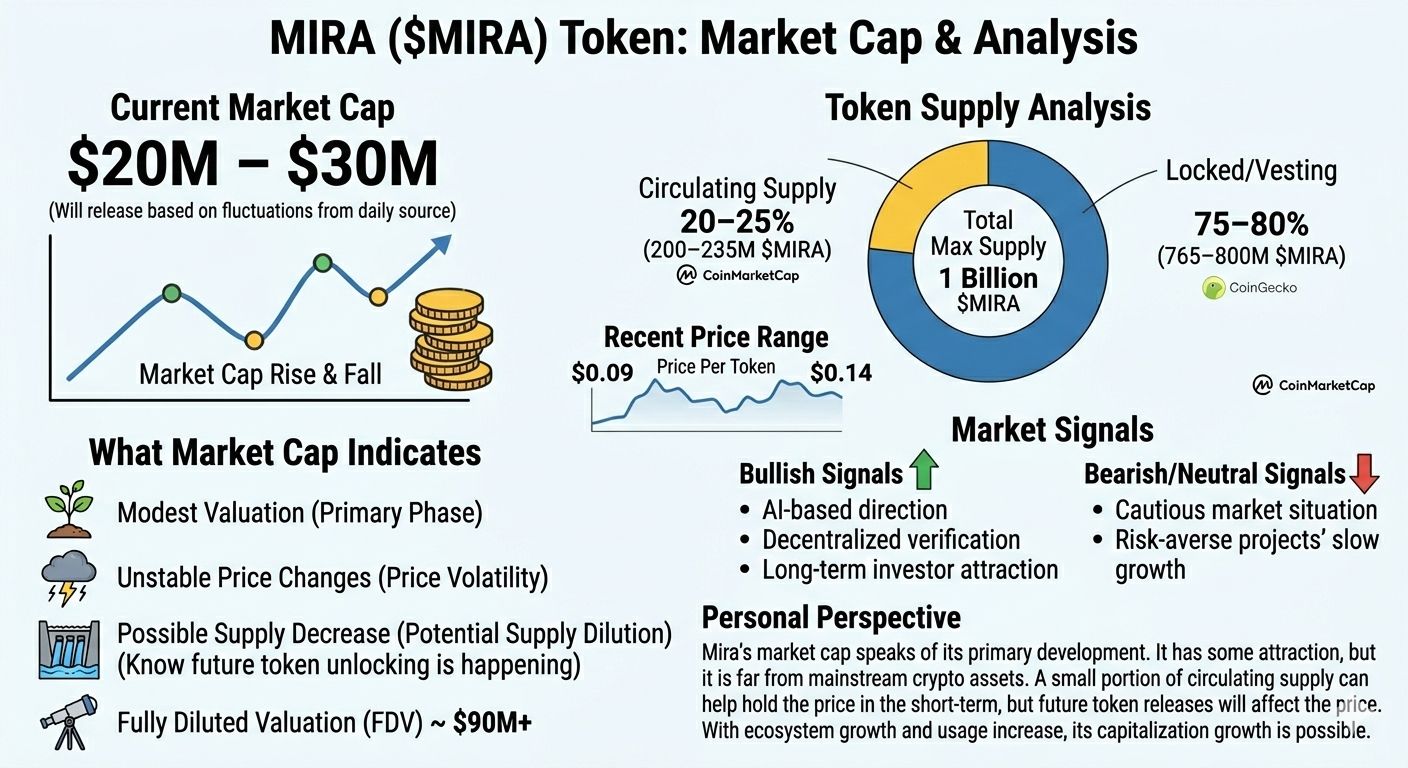
So when you multiply those circulating tokens by the live market price — which has ranged between about $0.09 to $0.14 per token recently — you get a market capitalization that fluctuates, but currently sits near ~$21M–$30M.
What the Market Cap Tells Us
Market cap is a simple but powerful number — it represents how much the market values a token at the current price. In Mira’s case:
Relatively modest valuation: A ~$20–30M capitalization is relatively small compared to bigger crypto projects, meaning the token is still early and not broadly adopted yet.
Volatile price movement: Mira’s price has swung significantly over the past months, with earlier listings and peaks much higher than current levels. This price volatility directly impacts the market cap.
Potential dilution pressure: With only about 20–25% of the token supply currently circulating, future unlocking of more MIRA tokens could put downward pressure on price unless demand grows strongly.
Fully Diluted Valuation (FDV): If all 1 billion $MIRA tokens were circulating, Mira’s theoretical market cap (FDV) would be closer to $90M+ — but that assumes future unlocks and that price stays constant.
Bullish vs. Bearish Signals
Bullish signs: What makes Mira interesting to me is its AI-focused direction. The idea of building decentralized verification for autonomous AI isn’t just another trend — it actually feels like a meaningful step forward. If they execute it properly, I can see this kind of narrative attracting serious long-term investors, not just short-term hype traders.
Bearish/neutral signs: The current market sentiment in crypto remains cautious and markets generally have been more risk-off — meaning speculative projects like Mira can struggle to grow fast unless they deliver real adoption milestones.
How I See It
From a personal perspective, Mira’s market cap tells a story of early stage development. It has some traction but is nowhere near mainstream crypto assets in terms of valuation. The fact that only a fraction of total supply is circulating might help support price in the short term, but it also means unlock schedules and future token releases could strongly influence price action later on.
If Mira can build real usage and ecosystem growth — not just speculative trading — then its market cap has room to expand. But as of now, its value is still primarily driven by community interest and broader crypto market conditions, not solid revenue or adoption metrics.