

There is a growing disconnect in AI adoption that most people don’t talk about openly.
On one side, model capability is accelerating. Systems can draft legal briefs, evaluate transactions, analyze medical data, and synthesize regulatory material at speeds that would have felt impossible three years ago.
On the other side, institutional risk tolerance hasn’t moved nearly as fast.
Boards still ask the same questions.
Compliance teams still demand traceability.
Auditors still require explainability.
Regulators still expect defensibility.
The result is friction.
AI systems are powerful enough to participate in serious decision-making, but not structured enough to be trusted without layers of human insulation. Organizations deploy models, then immediately wrap them in review gates, override mechanisms, and exception workflows.
Mira’s positioning sits precisely in that tension.
It doesn’t attempt to outcompete foundational models on raw intelligence. Instead, it focuses on the structural gap between generation and institutional reliance. That gap is where most AI deployments stall.
The issue isn’t whether AI can produce an answer. It’s whether an organization can justify acting on it.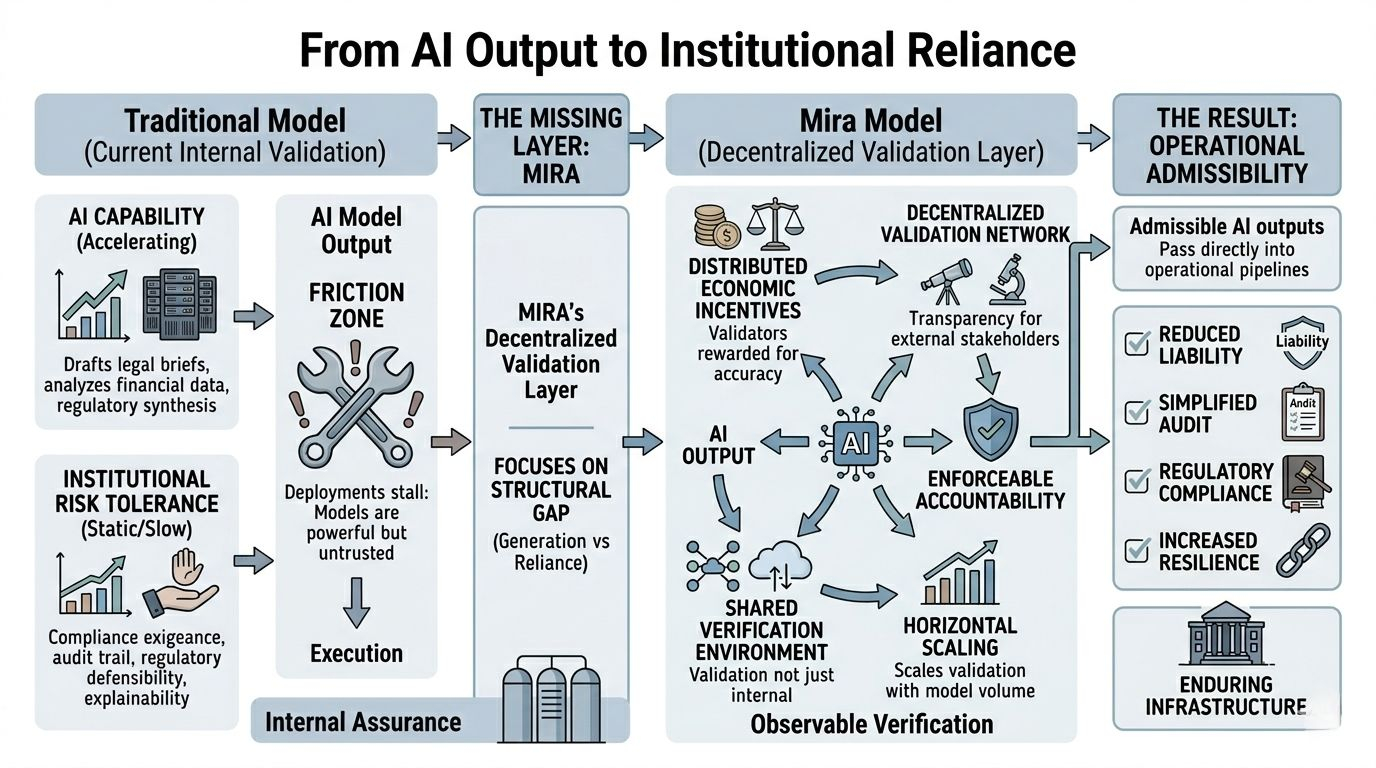
This is where Mira’s architecture becomes strategically important. By embedding AI outputs into a decentralized validation process, it reframes trust from a brand-level assumption to a protocol-level procedure.
That shift is not cosmetic.
In centralized AI systems, validation is internal. A company might claim rigorous evaluation processes, but those assurances remain inside corporate boundaries. External stakeholders—counterparties, regulators, partners—must take those assurances at face value.
A decentralized validation layer changes that dynamic.
Instead of relying on internal attestations, an organization can point to a shared verification environment where outputs were examined under transparent, economically aligned conditions. The acceptance of an AI conclusion becomes observable and inspectable.
This is particularly relevant as AI begins to intersect with regulated domains.
Financial risk scoring, automated compliance summaries, cross-border transaction monitoring, and identity verification workflows are all areas where AI capability is advancing rapidly. Yet in each case, deployment is slowed not by model weakness, but by governance uncertainty.
Who validated this output?
Under what criteria?
With what incentive alignment?
Mira’s design addresses those questions directly by turning validation into a distributed economic activity rather than a centralized administrative task.
There is also a competitive implication.
As AI becomes commoditized at the model layer, differentiation shifts upward. Enterprises will not choose AI providers solely based on marginal improvements in accuracy metrics. They will choose systems that reduce liability exposure and audit complexity.
In that environment, verification infrastructure becomes a strategic asset.
Mira appears to understand that the next wave of AI integration will not be driven by creativity or novelty. It will be driven by operational acceptability. Systems that can prove their outputs passed structured scrutiny will outcompete those that rely purely on internal confidence scores.
Another dimension of this shift is resilience.
Single-provider AI pipelines create concentration risk. If validation depends entirely on one entity’s standards, systemic trust hinges on that entity’s continued competence and neutrality. A decentralized verification layer distributes that risk across participants with aligned incentives, reducing the fragility of unilateral control.
This does not eliminate the need for governance. It relocates governance into protocol mechanics.
Participants in the network are economically motivated to evaluate accurately. Poor validation behavior is disincentivized. Over time, the system rewards precision rather than speed.
That incentive structure is crucial if AI is to move beyond experimental adoption.
Human review cannot scale proportionally with model output volume. If AI is embedded deeply into financial systems, enterprise operations, and regulatory workflows, the validation layer must scale horizontally. A decentralized structure provides that pathway.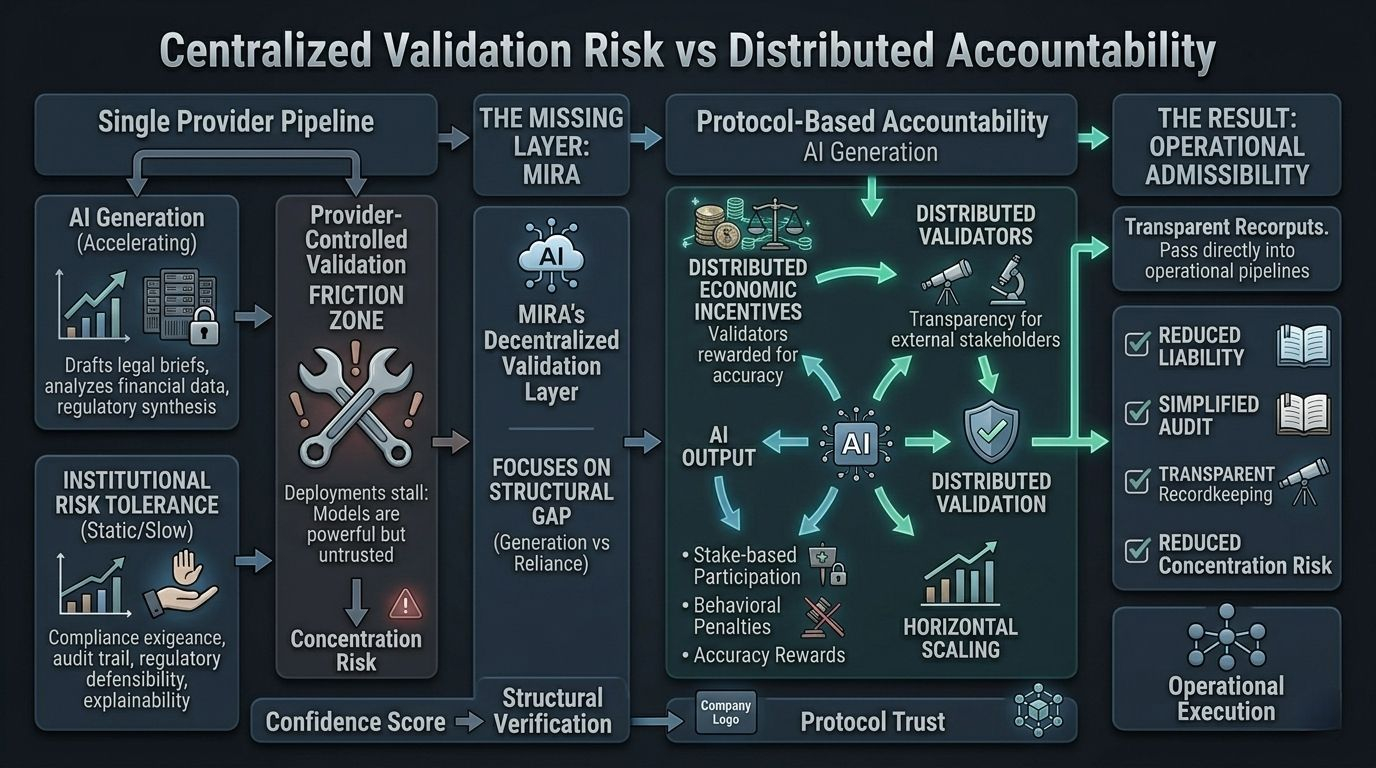
Mira is effectively arguing that the missing component in AI infrastructure is not intelligence, but enforceable accountability.
The market appears ready for that argument.
As scrutiny around AI governance intensifies globally, organizations are being pushed to demonstrate not just performance, but control. Protocol-level validation provides a credible mechanism to satisfy those demands without centralizing authority.
The broader AI ecosystem will likely continue racing toward larger models and broader capabilities. That race will generate headlines and investment cycles.
But beneath it, a quieter race is forming: which systems can make AI safe enough to integrate into high-consequence environments without paralyzing oversight.
Mira’s strategic focus places it squarely in that second race.
If it succeeds, its impact will not be measured in consumer-facing engagement metrics. It will be measured in how many institutional systems feel comfortable letting AI outputs pass directly into operational pipelines.
In other words, Mira is not trying to make AI more impressive.
It is trying to make AI more admissible.
And in the long arc of technological adoption, admissibility is often what separates promising tools from enduring infrastructure.