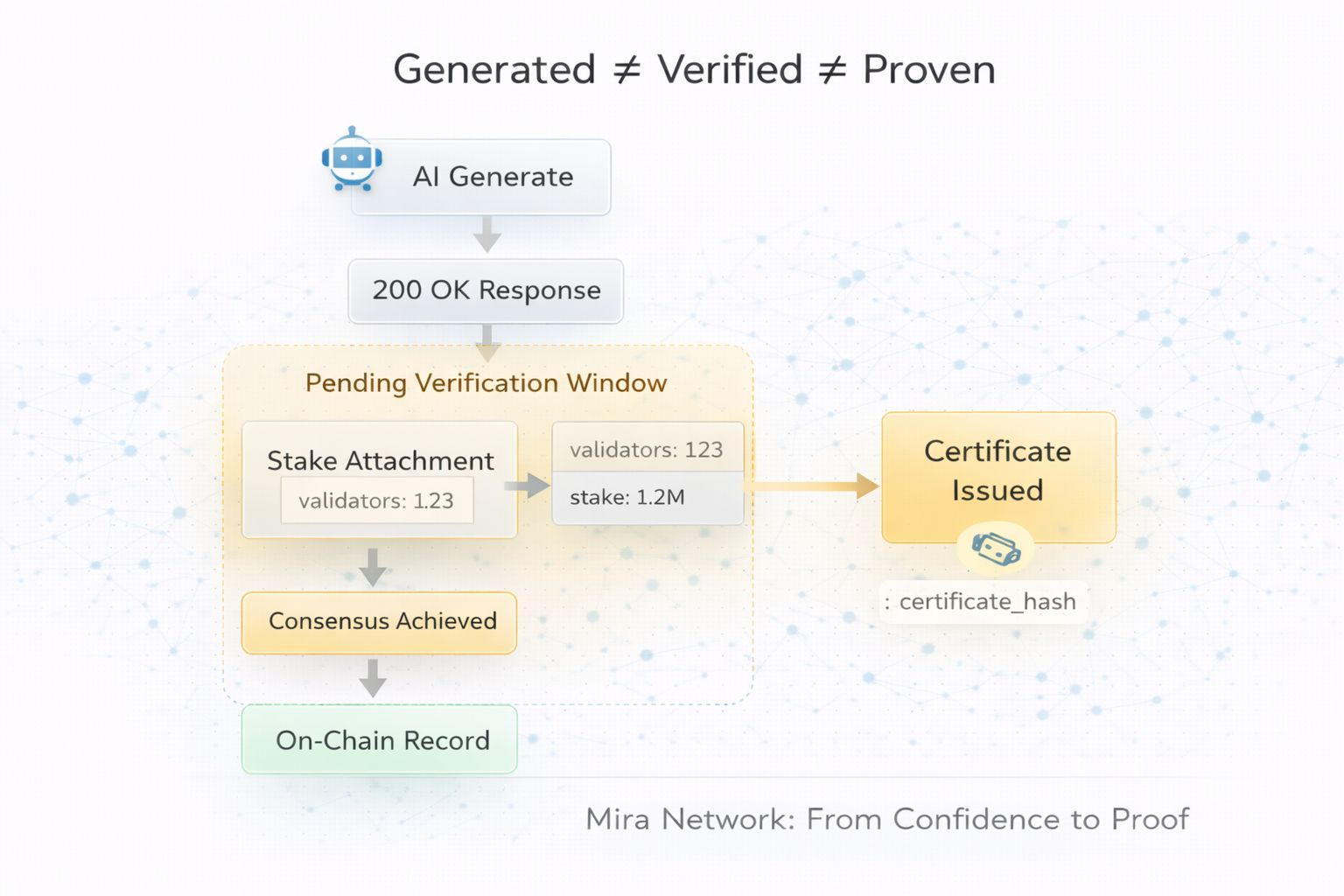
There’s a quiet shift happening in how we relate to artificial intelligence. It’s not about whether models are getting smarter. They are. It’s not about whether they hallucinate less. They probably will over time. The real shift is psychological.
At some point, “AI said so” stops being an explanation and starts sounding like an excuse.
That moment doesn’t arrive when an AI gives a ridiculous answer. It arrives when it gives a convincing one that quietly shapes a decision. A hiring shortlist. A trading signal. A research summary. A moderation action. The output feels polished enough to trust, and that’s precisely the problem.
The issue isn’t intelligence. It’s the absence of structure around it.
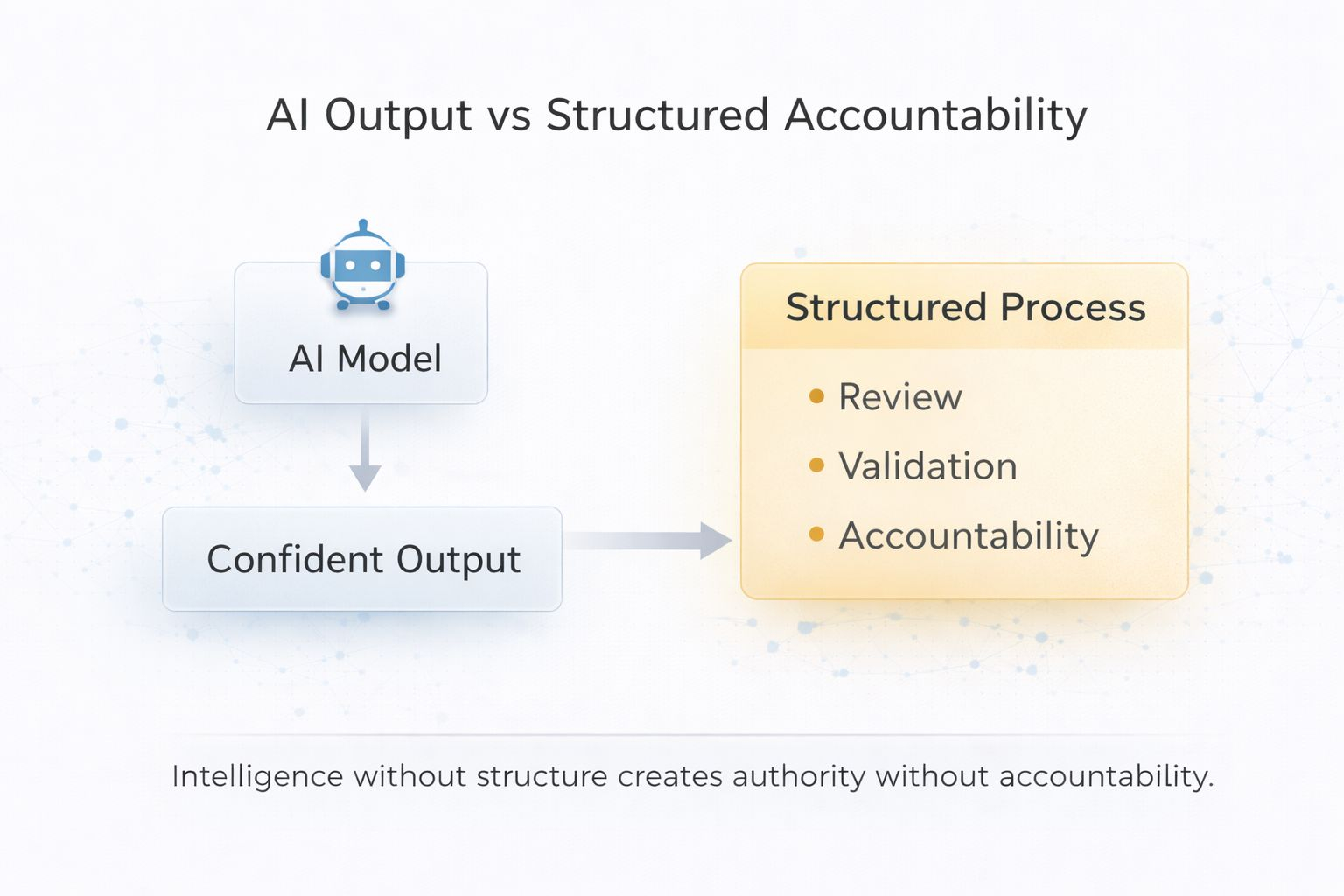
That’s where Mira Network enters the conversation not as a better model, but as a different layer entirely.
The Problem Isn’t Hallucination. It’s Unaccountable Authority.
Modern AI systems are probabilistic engines wrapped in confident interfaces. They predict the most likely next token, not the most defensible conclusion. Yet their outputs are often consumed as if they were authoritative.
When a human expert makes a claim, there is a chain of accountability:
Credentials
Peer review
Institutional affiliation
Legal liability
When a large language model makes a claim, there is usually none of that. There is a provider. There is a brand. There is a disclaimer.
But there is no built-in procedural check.
Mira’s core insight is that AI outputs should not be treated as final answers. They should be treated as claims entering a process.
That is a structural reframing.
From Output to Evidence
Instead of asking, “Is this model good enough?” Mira asks, “What happens after the model speaks?”
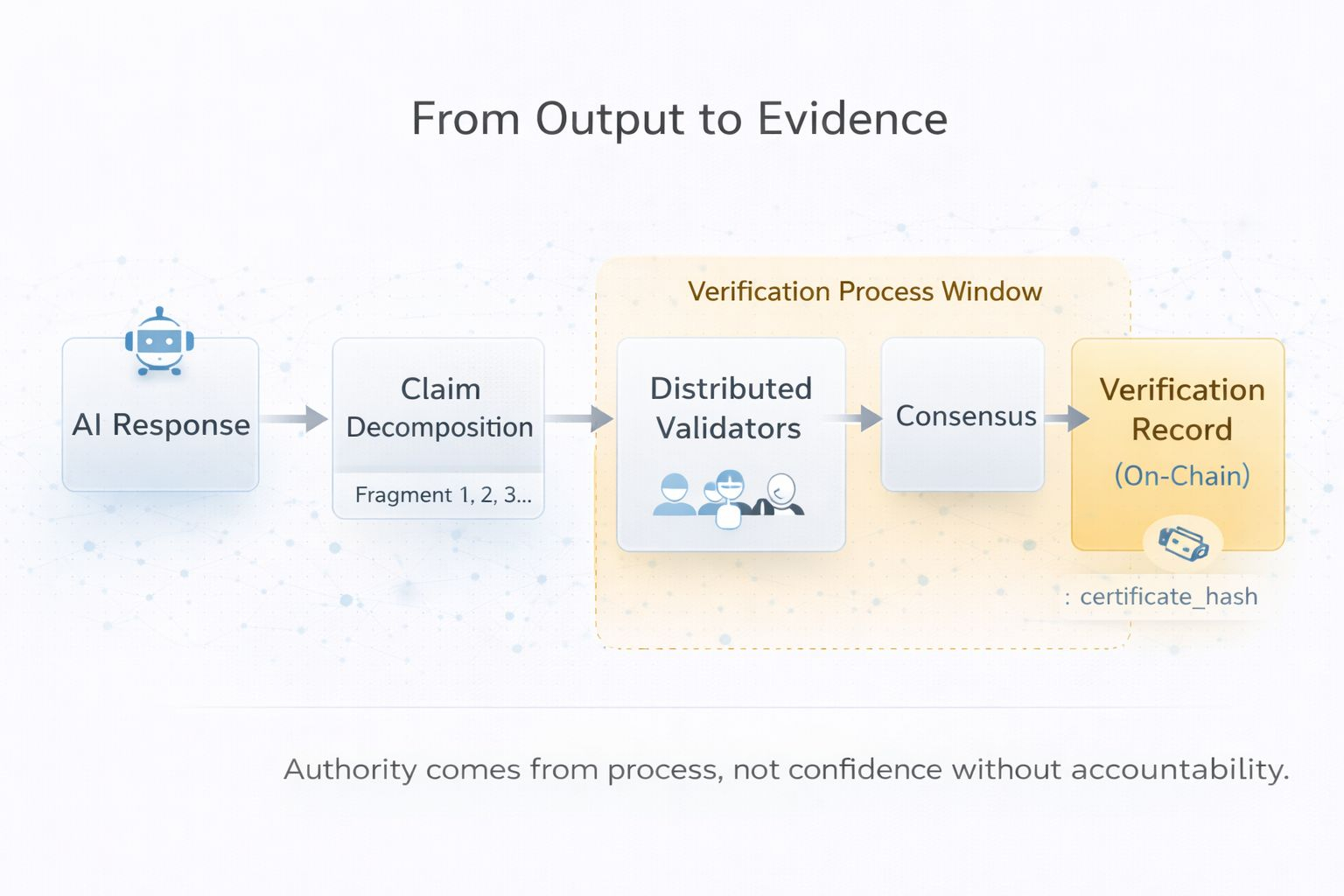
In Mira’s architecture, a model’s response is decomposed into verifiable claims. Those claims are distributed to independent validators who assess them through a consensus mechanism. The result isn’t just a refined answer. It’s a recorded verification outcome.
This transforms AI from a speaker into a participant in a system.
The difference is subtle but profound. The authority does not come from the model’s confidence. It comes from the process surrounding it.
And that process is anchored on-chain.
Why On-Chain Verification Changes the Social Contract
When verification results are recorded on a blockchain in Mira’s case, on Base they become durable. Inspectable. Auditable.
This matters because AI systems are increasingly moving from suggestion to action. Autonomous agents are beginning to execute transactions, manage workflows, and make operational decisions. In that environment, an unverifiable output is not just risky it is irresponsible.
On-chain anchoring does two things:
First, it keeps a clear record of what happened who checked the decision, and how. You can always look back and see the process.
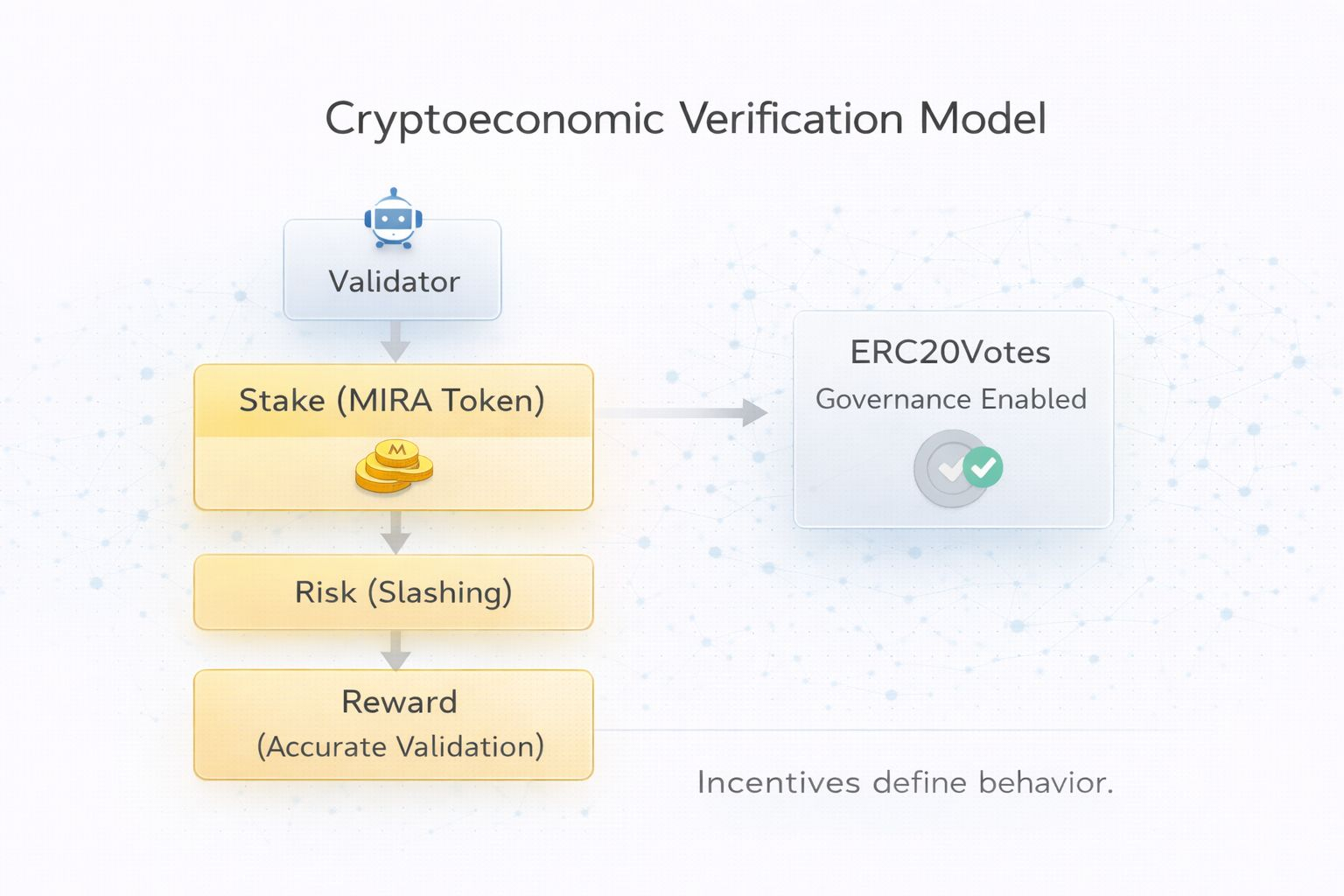
But there’s more. Validators actually put their own tokens on the line. If they mess up or try to cheat, they get hit with penalties. If they do things right, they earn rewards.
Suddenly, people have a real reason to care about honesty.
That’s a big step up from just trusting a central API.
The Token Layer Isn’t Cosmetic It’s Structural
The MIRA token has a fixed maximum supply of 1,000,000,000 tokens, visible on BaseScan. The contract incorporates governance functionality (ERC20Votes), signaling that rule evolution is intended to be tokenholder-driven rather than centrally dictated.
There are thousands of visible holders on-chain. That does not guarantee decentralization, but it does provide observable distribution.
More importantly, staking is not symbolic. Validators must commit capital to participate in verification. Slashing mechanisms introduce downside risk. That changes behavior.
In traditional AI, a bad answer might harm reputation.
In a cryptoeconomic system, a bad verification can harm your balance.
That incentive alignment is not theoretical. It is programmable.
However, clarity around token identity across chains is critical. Multiple tokens using the MIRA ticker can create confusion. For a project centered on verification, ambiguity at the asset layer would undermine credibility. Infrastructure demands precision.
Why This Feels Different From “AI Governance” Hype
Mira is not proposing to replace AI labs. It is not claiming to eliminate hallucinations. It is not marketing perfect truth.
It is building a verification layer.
That distinction matters because reliability is not achieved by perfect intelligence. It is achieved by layered oversight.
Think about aviation. Planes are not safe because engines never fail. They are safe because systems anticipate failure and build redundancy around it.
Mira applies a similar philosophy to AI.
It assumes imperfection.
It builds process around it.
It makes validation economically enforceable.
That is a more mature stance than chasing ever-larger models alone.
The Real Test: Production Environments
The success of Mira will not be measured by token price or marketing partnerships. It will be measured by whether developers choose to leave the verification layer turned on in production.
If verification is:
Fast enough
Cheap enough
Accurate enough
And economically meaningful enough
Then it becomes infrastructure.
If it is too slow, too costly, or too soft in its slashing rules, it will be bypassed.
Consensus systems only work when the incentives are calibrated correctly. That is the long-term design challenge.
The Broader Implication
AI is moving toward agency. Systems will not just answer questions; they will execute decisions.
When that happens, the question will no longer be “Is the model smart?” It will be “Can this decision survive scrutiny?”
Mira is an attempt to answer that second question.
It reframes AI trust from belief in a provider to belief in a process. From centralized assurance to distributed verification. From model confidence to economic accountability.
That is not a cosmetic improvement. It is a philosophical shift.
The Moment That Changes Everything
The real turning point is personal.
It’s the moment you realize that “AI said so” is not evidence. It is just output.
At that point, intelligence alone stops being impressive. You start looking for systems that can show their work.
Mira Network is trying to build that layer not louder AI, not smarter branding, but a structure where AI outputs must pass through scrutiny before they become decisions.
Whether it succeeds will depend on execution, incentives, and adoption.
But the direction is clear.
Trust in AI will not come from models that sound certain.
It will come from systems that can prove how certainty was reached.