
As Web3 systems mature, the conversation is slowly but decisively shifting. Early cycles obsessed over throughput, block times, and headline performance metrics. Faster chains, cheaper transactions, and higher TPS were treated as progress itself. But as decentralized systems begin to coordinate real economic activity, autonomous agents, and cross-network logic, a harder truth emerges: speed without correctness is fragile.
Automation does not forgive hidden assumptions. When systems scale, every implicit trust model is stress-tested. A single incorrect state transition, unverifiable outcome, or poorly coordinated interaction can cascade across composable networks, amplifying risk rather than efficiency. In this environment, correctness and verification are no longer optional optimizations — they are foundational requirements.
This is where @Mira - Trust Layer of AI represents a meaningful architectural shift. Instead of treating verification as something bundled inside execution or assumed through limited validator sets, Mira approaches verification as first-class infrastructure. The goal is not to make systems merely faster, but to make them provably correct and reliable under scale.
Verification Is Not the Same as Execution
Most decentralized systems today implicitly merge execution and verification. Transactions are processed, state is updated, and correctness is assumed as long as the system remains within expected parameters. This model works when complexity is low and interactions are limited. However, as systems become modular, composable, and automated, this coupling becomes a liability.
Verification-first architecture separates concerns. Execution layers focus on performance and state transitions. Verification layers independently confirm that these transitions are correct, complete, and tamper-resistant. By decoupling these roles, systems reduce hidden trust assumptions and gain the ability to scale without increasing systemic fragility.
Mira’s design reflects this principle. Verification is not an afterthought or a patch layered on top of execution — it is a neutral, reusable layer that multiple systems can rely on simultaneously. This allows decentralized applications, agents, and networks to coordinate safely without each one reinventing its own trust model.
Why This Matters as Automation Grows
The rise of autonomous agents, AI-assisted execution, and cross-network coordination fundamentally changes the risk landscape. Automated systems do not pause to question incorrect outputs. They act on them instantly and at scale. In such environments, even small verification gaps can produce outsized failures.
Verification-first infrastructure addresses this by making correctness explicit rather than assumed. Outcomes are independently verifiable. Interactions can be audited. Coordination across networks becomes safer because trust is anchored in provable guarantees instead of social consensus or opaque assumptions.
This shift is especially critical as economic value increases. When systems manage real assets, governance decisions, or autonomous execution flows, the cost of being wrong grows exponentially. Reliability is no longer a feature — it is a survival requirement.
Modular Architecture and Systemic Resilience
The broader Web3 ecosystem is moving toward modular design: execution, data availability, settlement, and verification as distinct layers. This modularity improves specialization and scalability, but only if verification remains robust and independent. Otherwise, complexity simply moves risk around instead of reducing it.
Verification-first infrastructure acts as a shared trust anchor across this modular stack. It reduces duplicated security logic, improves composability, and strengthens systemic resilience. Instead of every application enforcing its own fragile correctness model, multiple systems can rely on the same verification guarantees.
This approach does not chase attention or hype. It prioritizes durability — the kind that only becomes visible when systems are under stress.
Building for the Long Term
Projects like $MIRA reflect this philosophy. Rather than optimizing for short-term visibility, they focus on building the underlying rails future decentralized systems will depend on. These are not the loudest systems in the market — but they are often the ones that survive.
As Web3 enters a phase defined by automation, interoperability, and real economic coordination, infrastructure choices matter more than narratives. Systems that assume trust will eventually break under scale. Systems that verify correctness can evolve safely.
The lesson is clear: decentralization without verification is incomplete. Speed may attract attention, but only verification earns long-term trust. Infrastructure that prioritizes correctness-first design is not just technically sound — it is strategically necessary.
In the next phase of Web3, the winners will not be the fastest systems, but the most reliable ones. Verification-first infrastructure is how decentralized systems grow up — and Mira is pointing in that direction.#Mira 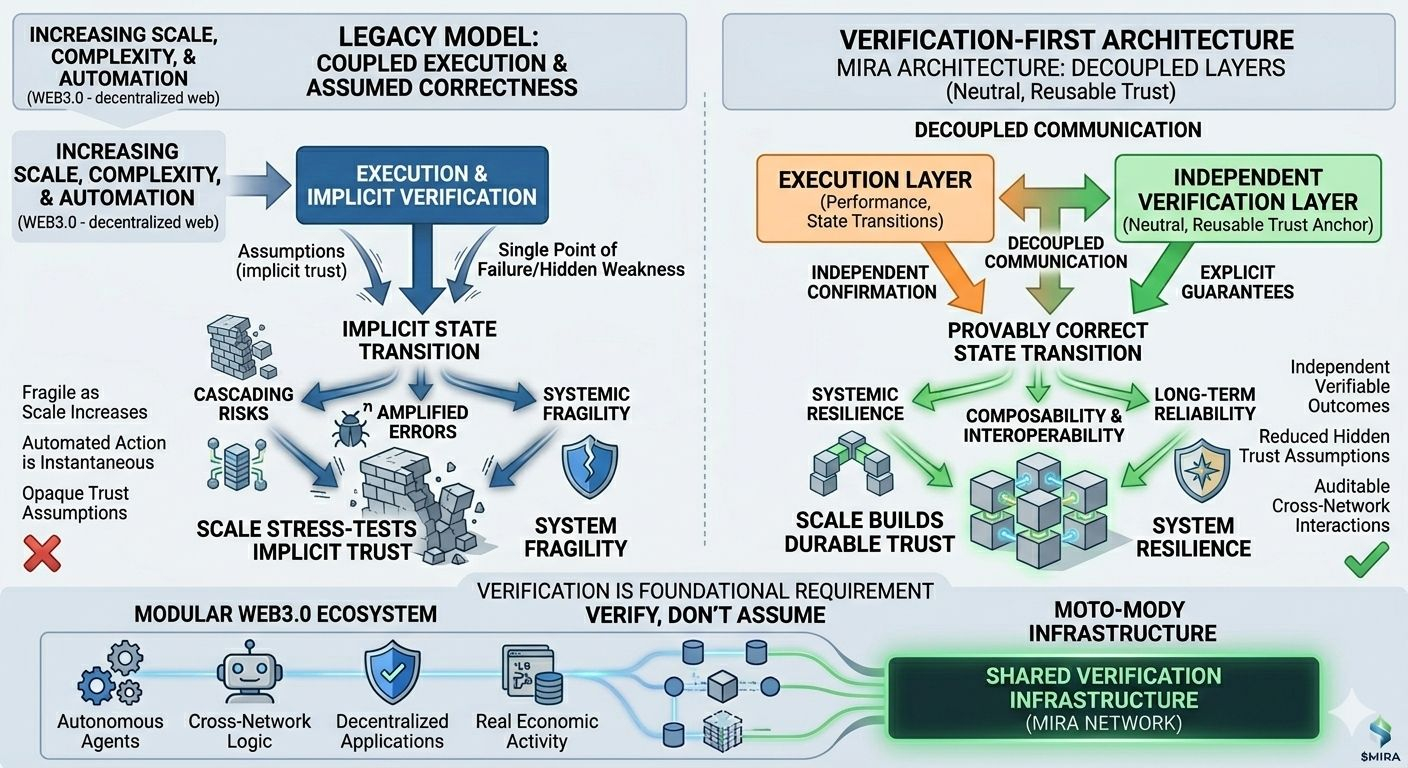



#USIsraelStrikeIran #AnthropicUSGovClash #GoldSilverOilSurge #BlockAILayoffs