
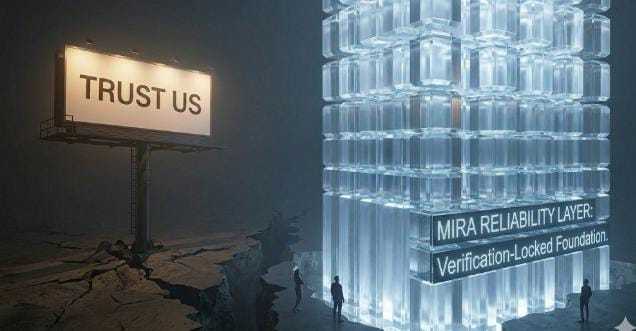
 What gives Mira its real shape as a project is not the token not the chart and not the current cycle around artificial intelligence. It begins from a problem that is easy to explain and still unresolved in practice. Intelligent systems can sound confident long before they are reliable. Most teams focus on making models smarter. Mira focuses on what happens after an answer is produced.
This distinction changes everything. Mira does not position itself as a competitor in model quality or creative output. It positions itself as a reliability layer. The network is designed to break generated responses into smaller claims that can be independently checked onchain. Those claims move through a decentralized verification process before the output is treated as trustworthy. Instead of trusting a single source Mira relies on structured verification from multiple participants.
That approach gives the project a clearer identity than many AI linked crypto efforts. It is not trying to win by speed or novelty. It is trying to win by correctness. Reliability is not a glamorous market but it is a necessary one. Users often say they want trustworthy systems yet they only notice verification when failure occurs. Mira is built around that uncomfortable reality.
Onchain architecture is central to this design. Verification is not a marketing phrase but a process enforced by economic incentives. Claims are evaluated through distributed consensus and finalized with cryptographic proof. This matters because trust only exists when rules are consistent and transparent. Mira aims to standardize what gets checked and how it gets checked so consensus is meaningful rather than symbolic.
There is also a deeper idea beneath the mechanics. Mira separates intelligence from trust. Generation and validation are treated as distinct layers. A system can be fluent and still be wrong. By pricing verification separately Mira argues that confidence should be earned not assumed. If model fluency continues to improve faster than accuracy this separation may become essential infrastructure.
The role of the token becomes clearer in that context. $MIRA is used for staking governance and access to verification services. Participants stake to verify claims and governance power follows staked commitment. Developers pay to use the network. This ties the token to behavior rather than narrative. The system needs incentives because poor verification is not always obvious and honest participation must be rewarded.
None of this removes risk. If demand for verification does not materialize token economics weaken. Mira is open about adoption and governance risks which adds credibility rather than removing it. The foundation retains a meaningful share of supply which creates an early center of gravity. For a trust focused network that tension is real and visible.
Market data reflects that uncertainty. The project is not priced as finished infrastructure. It is priced as potential. Liquidity exists but usage still defines the future. That makes valuation difficult and speculation tempting.
Mira is best understood as an attempt to build a missing layer. It asks whether trust can be externalized measured and secured. That question sits at the fault line of modern intelligent systems. Whether the market is ready remains open. What matters is that @Mira - Trust Layer of AI is building directly on that fracture line rather than pretending it does not exist. @Mira - Trust Layer of AI #Mira $MIRA
