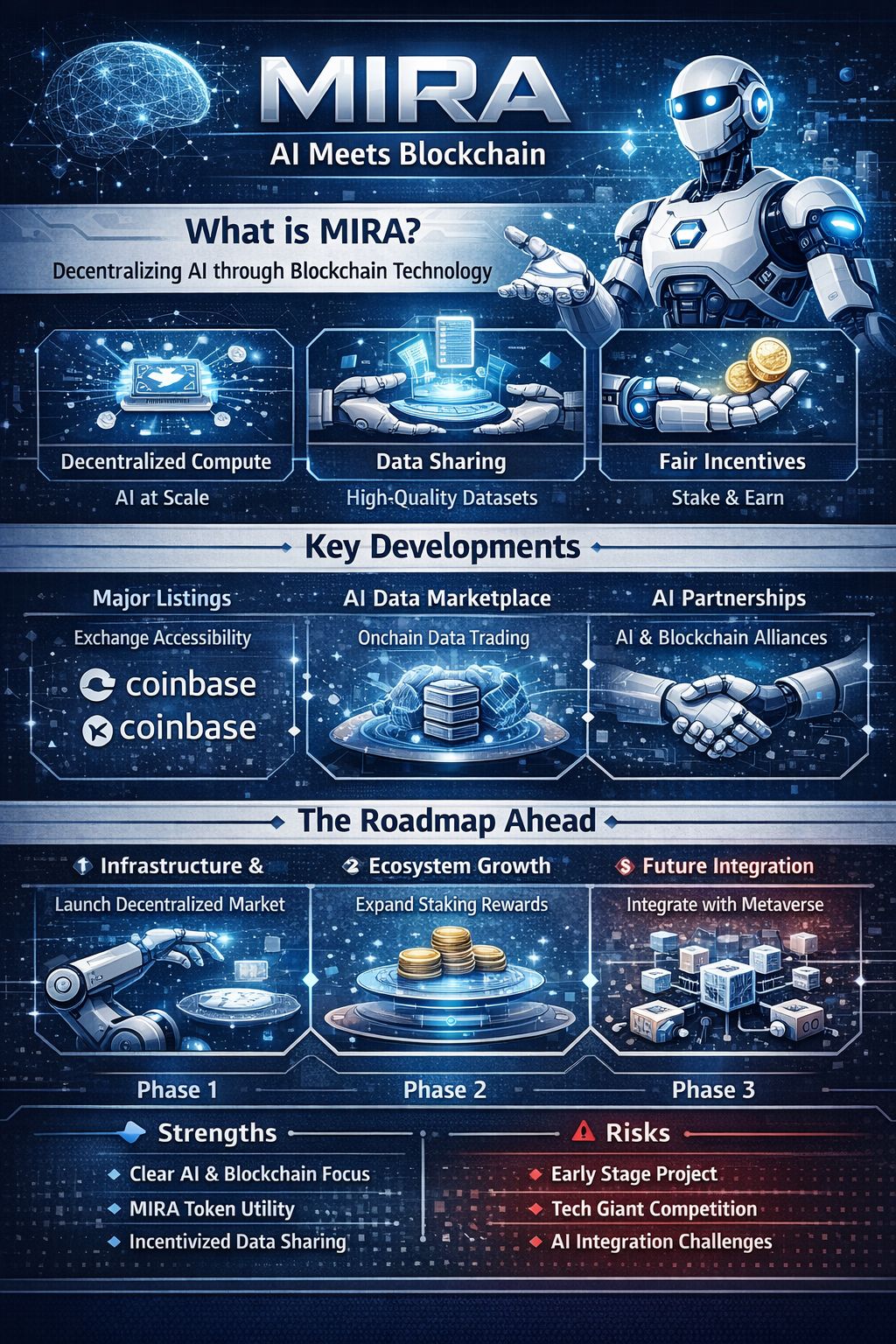
As artificial intelligence continues to reshape industries worldwide, blockchain projects are racing to integrate AI into decentralized systems. Among these emerging initiatives is $MIRA , a crypto project focused on building a transparent, decentralized ecosystem for AI development and data exchange.
Rather than competing in saturated DeFi markets, MIRA positions itself at the intersection of AI infrastructure and blockchain coordination, aiming to create a fairer and more open AI economy.
What Is MIRA?
$MIRA is designed to decentralize access to AI models, computing resources, and data. In today’s tech landscape, AI development is largely controlled by centralized corporations with massive computational power and proprietary datasets. MIRA attempts to shift that model by allowing:
Decentralized compute providers to offer processing power
Data contributors to monetize high-quality datasets
Developers to deploy AI models in a trustless environment
Users to access AI services transparently
At its core, MIRA seeks to reduce dependence on centralized AI monopolies by distributing both power and rewards across its network.
Utility of the MIRA Token
From a fundamental perspective, token utility is crucial. The MIRA token typically functions as:
A payment token for AI services within the network
A staking asset for securing the ecosystem
A governance token allowing holders to vote on upgrades
An incentive mechanism rewarding compute and data providers
This multi-layered utility suggests that token demand could grow alongside network adoption — assuming real usage develops.
Key Developments
MIRA has focused on gradually building its infrastructure rather than launching aggressively with hype.
Exchange Accessibility
The token has gained exchange listings to improve liquidity and accessibility, an important step for onboarding new participants.
AI Data Marketplace
A major development focus has been creating an on-chain AI data marketplace where contributors can list datasets and receive compensation transparently.
Partnerships and Ecosystem Growth
MIRA aims to form partnerships with AI developers and blockchain projects to expand interoperability and real-world use cases.
While adoption is still early, the structured approach shows a long-term orientation rather than short-term speculation.
Roadmap Overview
MIRA’s roadmap is divided into progressive ecosystem expansion:
Phase 1: Infrastructure Launch
Deployment of decentralized compute marketplace
Launch of AI data exchange framework
Core staking and governance systems
Phase 2: Ecosystem Expansion
Developer tools for AI model deployment
Expanded staking rewards and validator incentives
Cross-chain integrations for wider accessibility
Phase 3: Future Integration
Integration with metaverse and IoT applications
Scalable AI deployment tools
Increased decentralization of governance
The roadmap suggests gradual scaling, with focus on infrastructure before mass adoption.
Strengths
Clear focus on AI + blockchain integration
Real utility tied to compute and data
Governance participation for token holders
Long-term infrastructure roadmap
Risks
Highly competitive AI sector
Execution complexity in decentralized AI systems
Dependence on real adoption beyond crypto traders
Market volatility
Final Thoughts
MIRA represents part of a broader movement toward decentralized AI infrastructure. Its success will depend less on short-term price action and more on whether it can attract real developers, data providers, and compute contributors.
For investors, MIRA fits into the high-risk, high-innovation category a project aligned with the future of AI, but still in its formative stages.
As always, thorough research and risk management are essential before making any investment decisions.