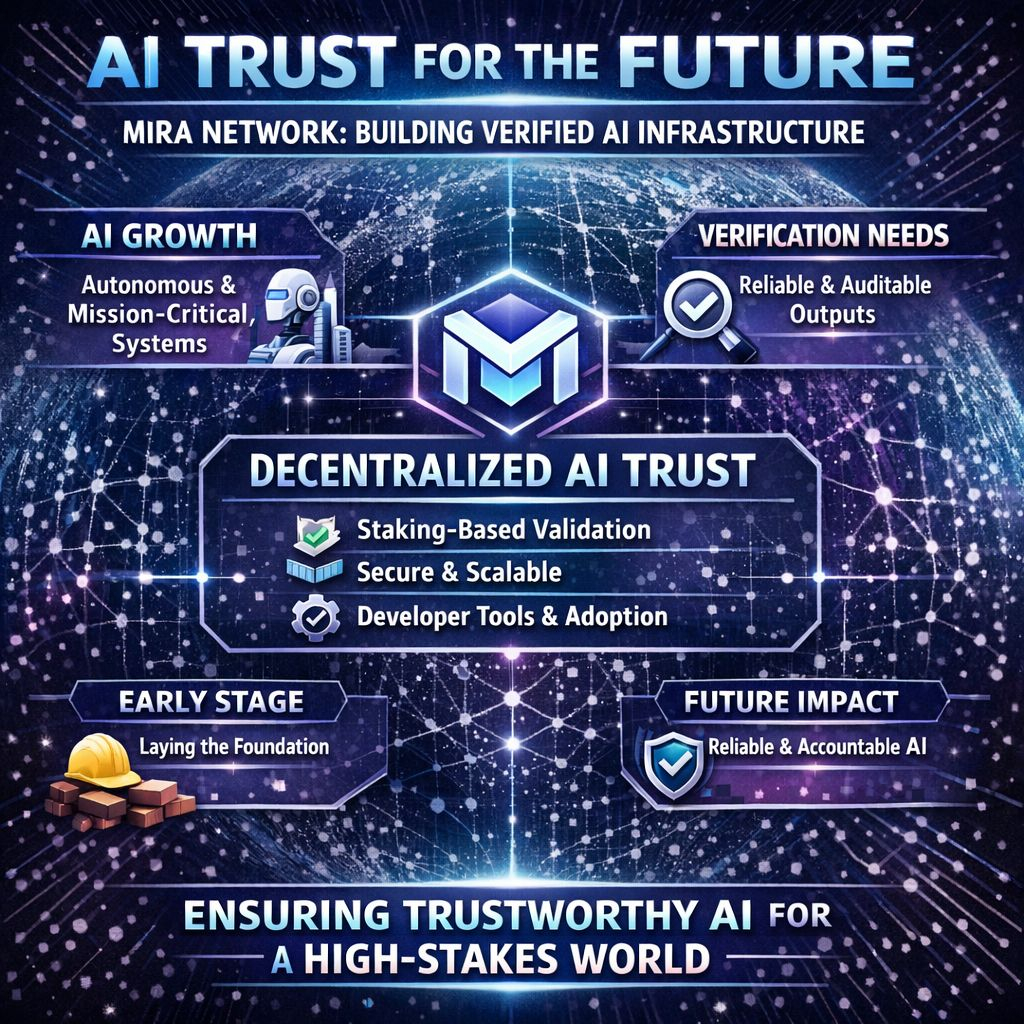
Introduction: Why AI Needs a Trust Layer
Artificial Intelligence has advanced at an extraordinary pace, but one critical issue continues to limit its reliability: trust. AI systems can generate impressive results, yet they are still prone to hallucinations, factual errors, bias, and manipulation. As AI becomes deeply integrated into finance, healthcare, governance, trading, and enterprise operations, the cost of inaccurate outputs increases dramatically.
Mira Network positions itself as a decentralized solution to this problem. Rather than building another AI model or another general-purpose blockchain, Mira focuses specifically on verification. It aims to become the trust layer that validates AI-generated information using blockchain consensus.
This article provides a detailed and updated overview of Mira Network, its architecture, token utility, recent developments, and its evolving role in the AI–blockchain ecosystem.
What Is Mira Network?
Mira Network is a decentralized verification protocol designed to validate AI outputs before they are accepted as trustworthy results. Instead of relying on a single centralized system to confirm whether an AI-generated response is accurate, Mira distributes the verification process across multiple independent validator nodes.
The core concept is simple but powerful. When an AI system produces an output, Mira breaks that output into verifiable components. These components are then evaluated by a decentralized network of validators. Once consensus is reached, the verified result is recorded on-chain, making it transparent, auditable, and tamper-resistant.
This structure transforms AI from a “black box generator” into a system whose results can be cryptographically validated.
Technical Architecture: How Mira Verifies AI?
Mira’s architecture is designed to balance decentralization, scalability, and efficiency. The protocol uses a hybrid security design combining elements of Proof-of-Stake and computational verification logic. Validators stake tokens to participate in the network, ensuring that they have economic incentives aligned with honest behavior.
When verification tasks are distributed, multiple nodes independently check AI claims. If a validator submits incorrect or malicious verification results, it risks penalties. Honest validators are rewarded. This staking mechanism strengthens network integrity while encouraging accurate verification.
Scalability has also been a major focus. Mira has implemented sharding mechanisms to distribute workload across different segments of the network. This allows large volumes of AI queries to be processed in parallel without slowing the system down. For a trust layer that may eventually verify millions of AI responses daily, horizontal scalability is essential.
In addition, Mira has introduced developer tools that make integration easier. Its SDK enables developers to connect applications directly to the verification layer without complex infrastructure building. This move significantly reduces friction for adoption.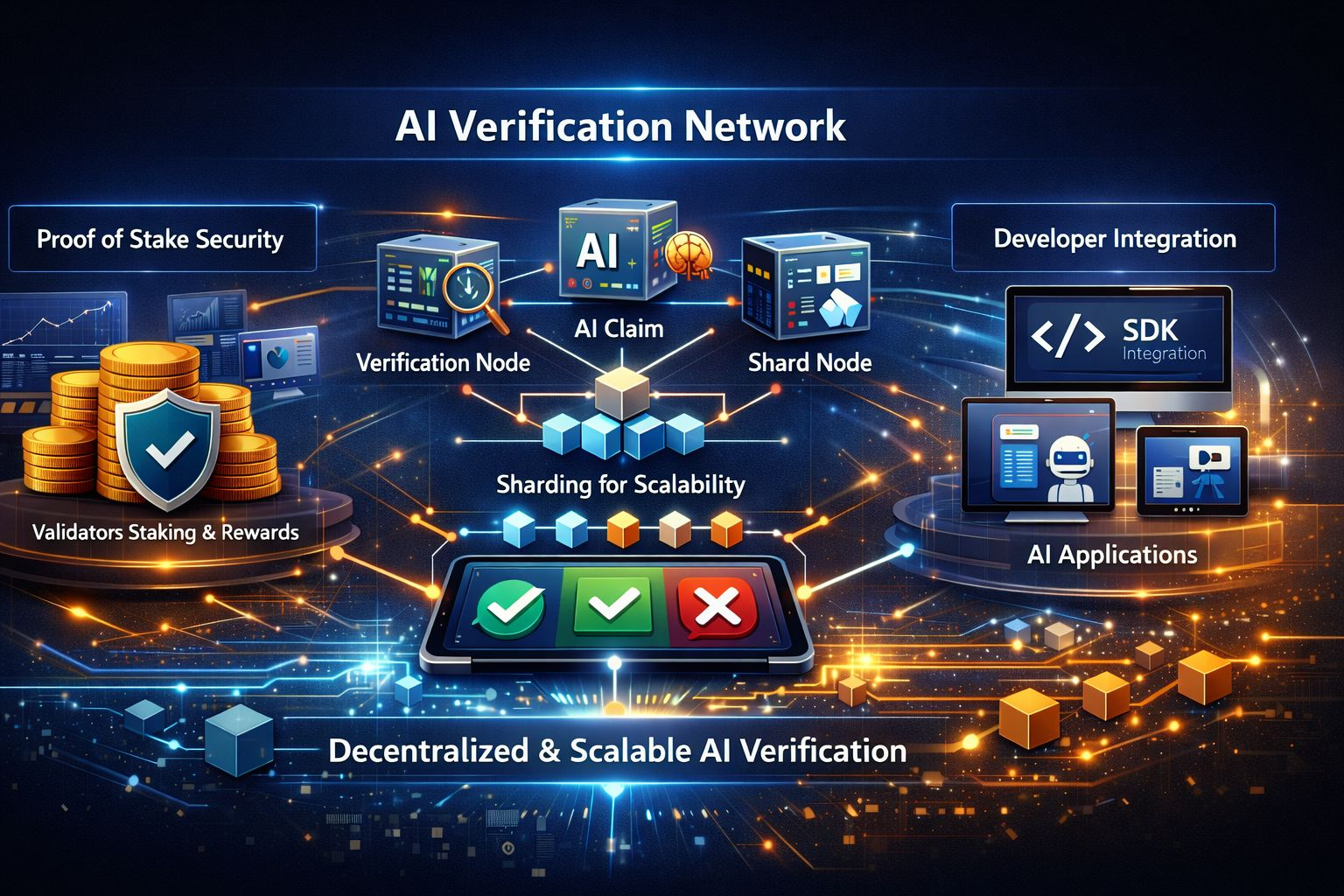
The Role of the $MIRA Token;
The native token, MIRA, plays a central role in maintaining and operating the ecosystem.
First, it acts as a staking asset. Validators must stake MIRA tokens to participate in verification tasks. This stake secures the network by aligning economic incentives with accurate validation.
Second, it is used to pay for verification services. Developers and applications that want AI outputs verified through the Mira protocol use MIRA to access these services.
Third, the token supports governance. Token holders can participate in decision-making processes regarding network upgrades, economic parameters, and protocol improvements.
Regarding supply structure, Mira has a maximum token supply capped at one billion tokens. Circulating supply is a fraction of this cap, leaving room for future ecosystem expansion, validator rewards, and development incentives. The token remains in an early growth phase, reflecting that the project itself is still expanding its adoption footprint.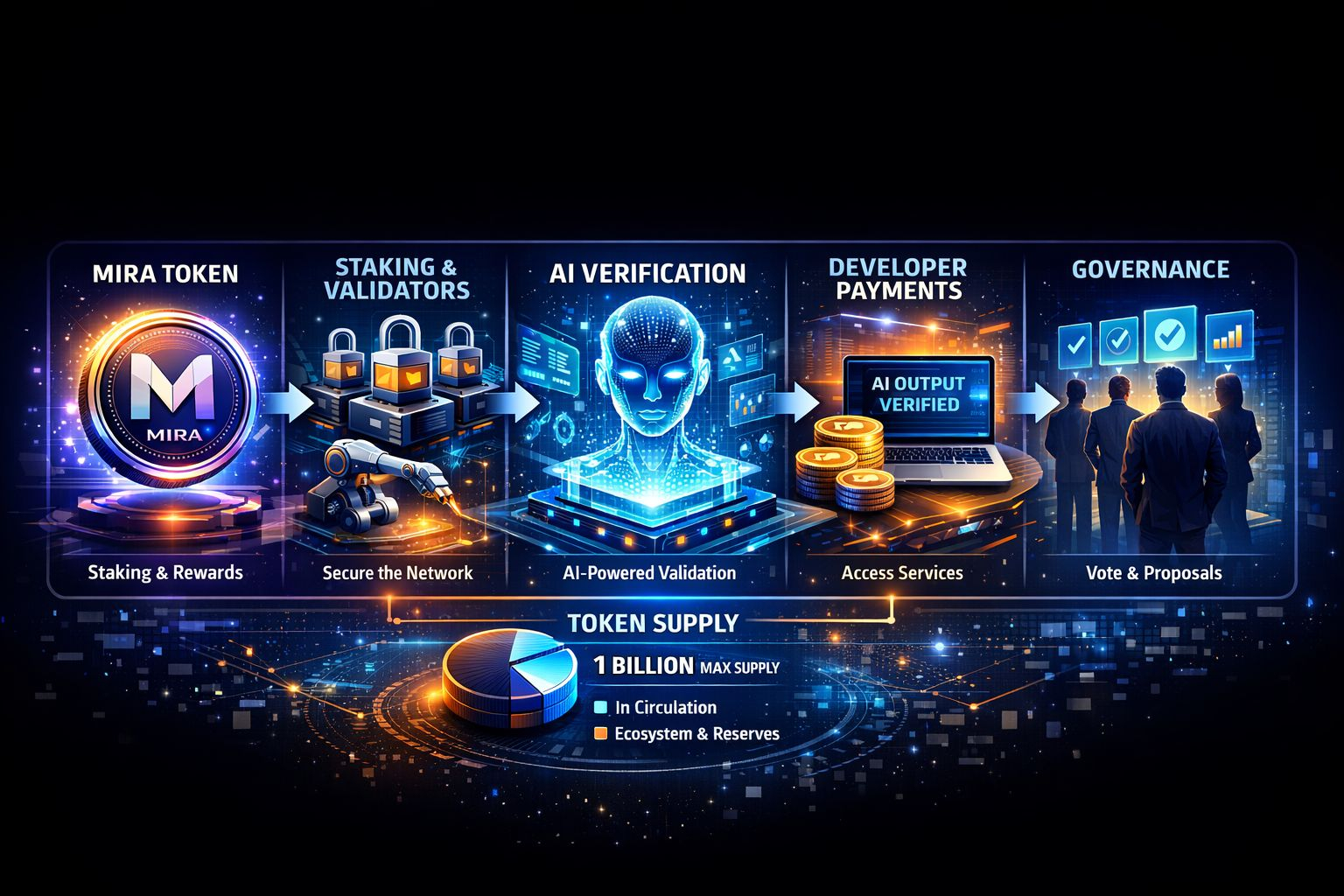
Recent Developments and Ecosystem Growth;
One of the most important recent developments has been the expansion of Mira’s developer infrastructure. The release of an enhanced SDK allows integration with multiple AI models through a unified interface. This enables applications to route queries dynamically while still benefiting from decentralized verification.
Another major improvement involves performance optimization and scaling upgrades. Through architectural refinements and distributed processing improvements, the network has significantly enhanced throughput. These upgrades position Mira to support high-volume enterprise and AI-driven applications.
There are also ongoing preparations for a broader platform upgrade often referred to as Version 2.0. While full technical documentation is still evolving, the focus appears to be on strengthening verification efficiency, improving validator participation mechanisms, and expanding ecosystem usability.
Adoption metrics suggest growing traction. The network has reported substantial user interaction volumes and increasing query activity. This indicates that Mira is moving beyond theory into practical deployment scenarios.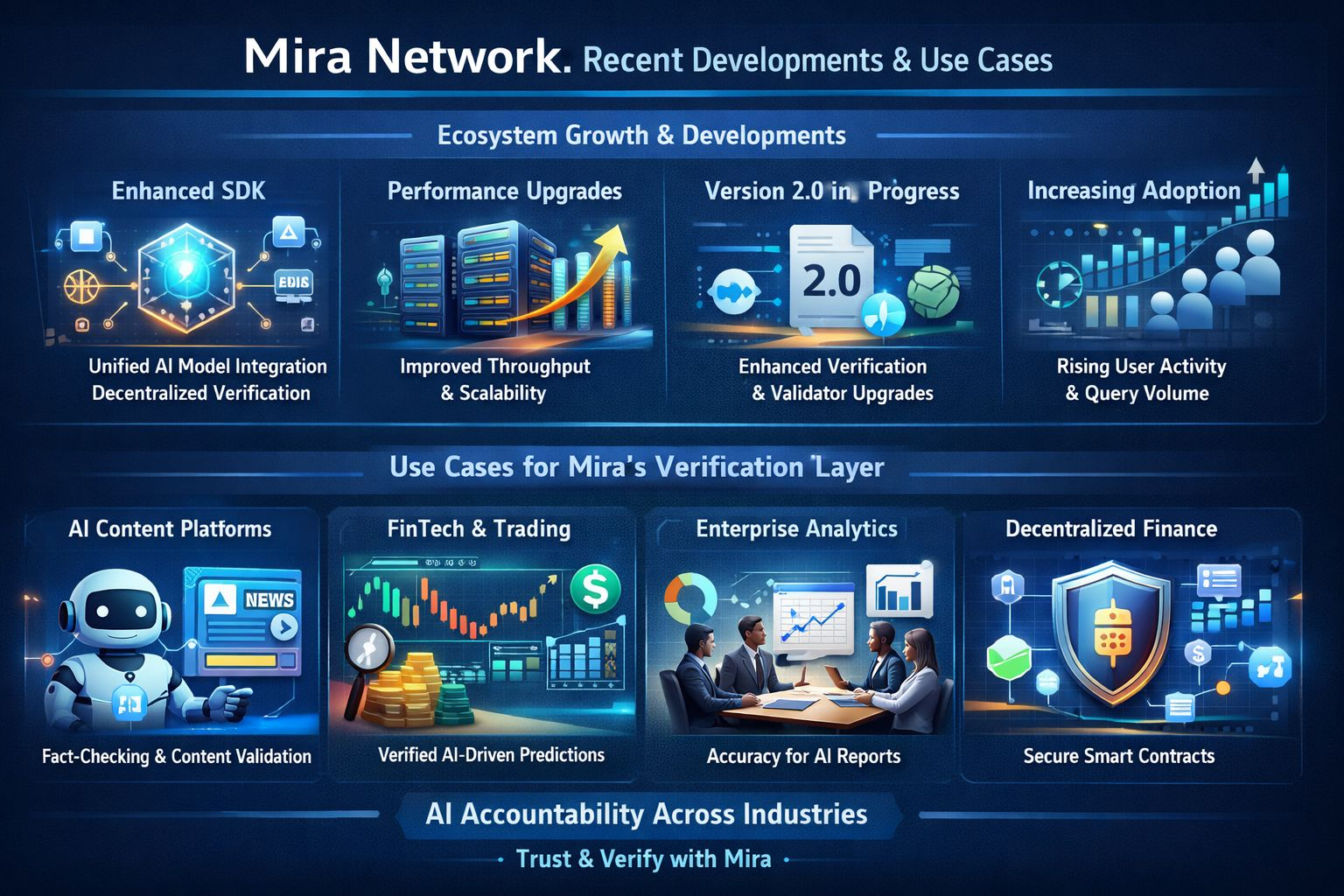
Use Cases: Where Mira Fits in the Real World
Mira’s verification layer has broad potential applications.
In AI-powered content platforms, Mira can validate factual accuracy before information is published or monetized. In financial technology, AI-driven trading models can have their predictions verified before automated execution. In enterprise settings, businesses can ensure that AI-generated reports and analytics meet accuracy thresholds before decision-making.
Decentralized finance platforms can also benefit. Smart contracts that depend on AI-generated risk analysis or forecasting can incorporate Mira’s verification layer to reduce manipulation or faulty inputs.
In essence, any sector that relies on AI outputs but requires accountability can integrate Mira’s trust framework.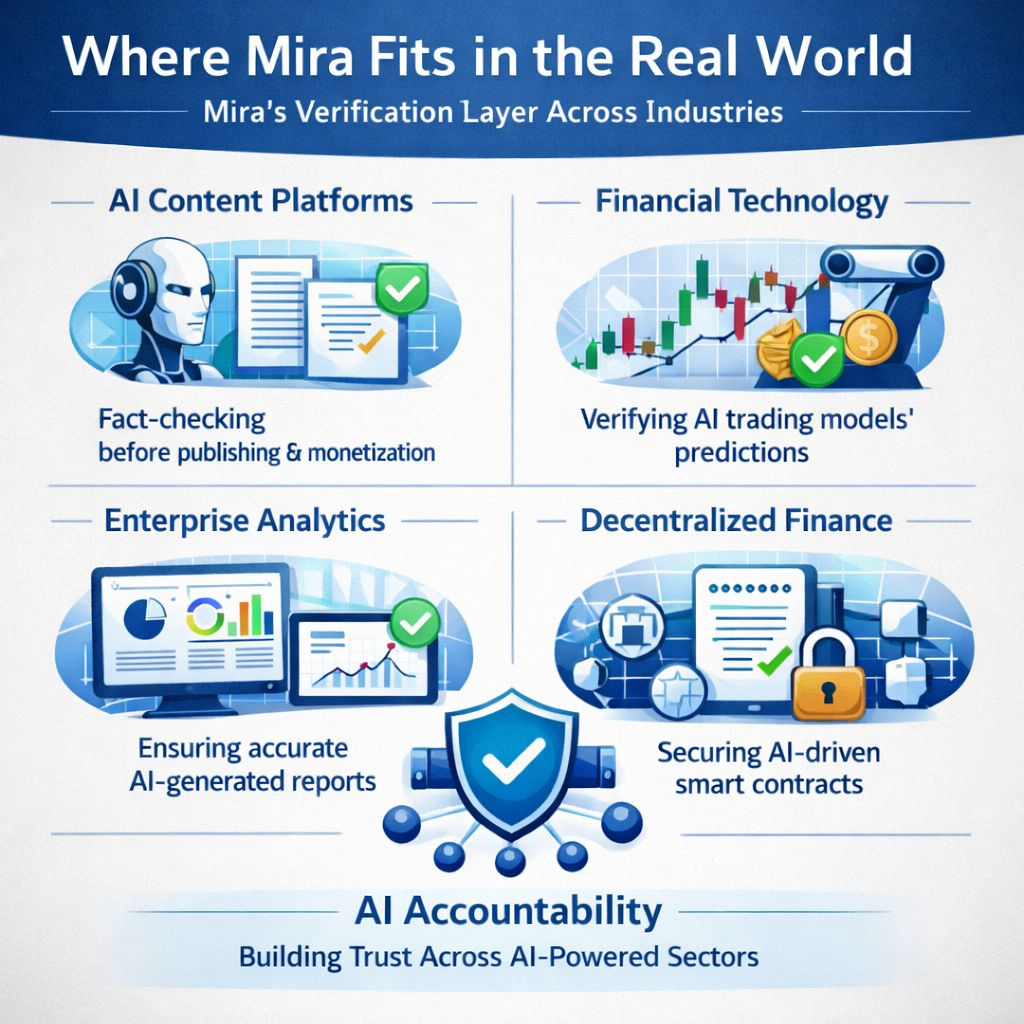
Competitive Positioning:
The AI and blockchain intersection has become highly competitive, with many projects attempting to merge these two transformative technologies. However, most focus either on decentralized AI computation or data marketplaces.
Mira differentiates itself by targeting the trust gap. It does not attempt to replace AI models or build general-purpose computing infrastructure. Instead, it creates a verification environment that sits between AI generation and real-world application.
This specialized positioning gives Mira a clearer value proposition. As regulatory scrutiny increases around AI accountability, protocols that provide auditable verification layers may gain structural importance.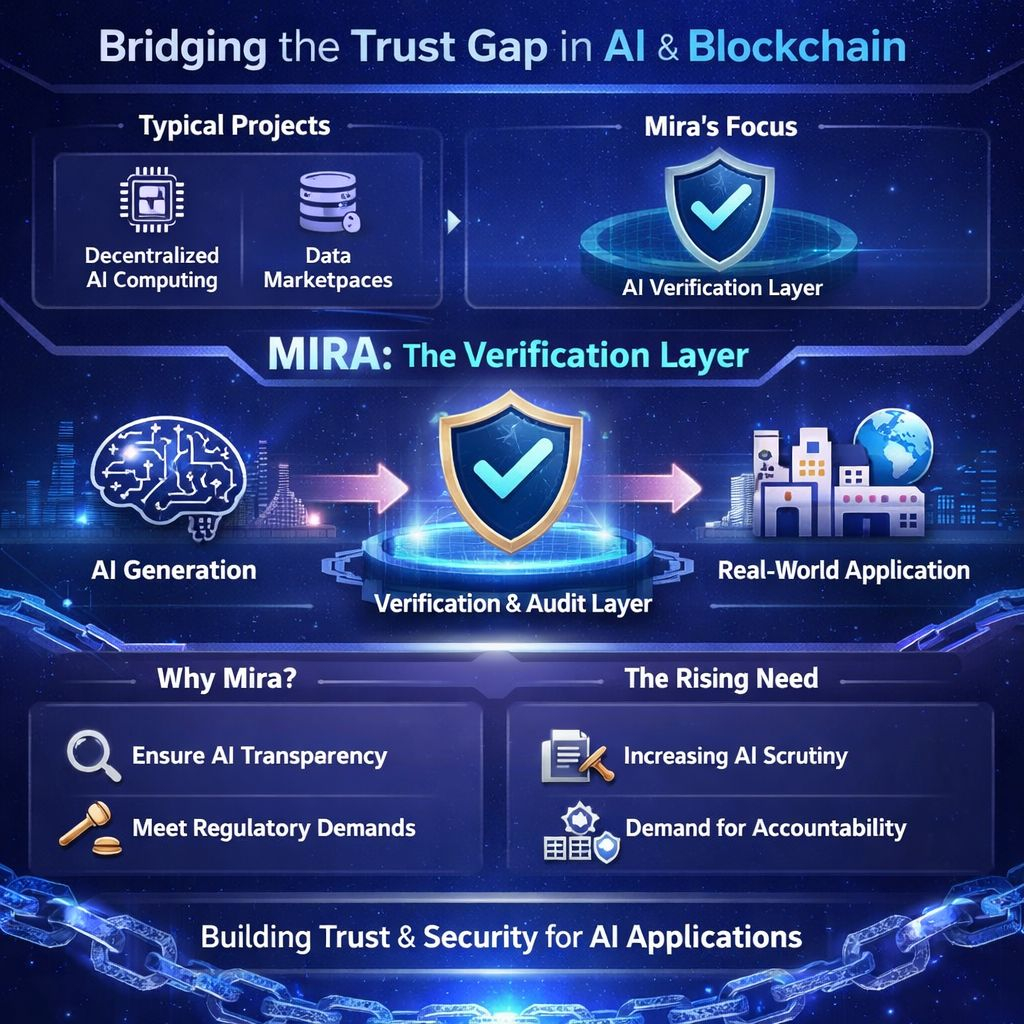
Challenges and Risks:
Despite its promising architecture, Mira operates in a rapidly evolving space.
The AI industry is advancing quickly, and improvements in base model accuracy could reduce perceived need for external verification, although complete elimination of hallucinations remains unlikely.
Regulatory frameworks around both AI and cryptocurrencies are still forming. Changes in compliance requirements could affect network participation or token utility.
Market volatility is another factor. Like all crypto-based assets, MIRA’s market performance is influenced by broader macroeconomic and digital asset trends.
Technical execution remains critical. A verification layer must maintain both decentralization and speed. Any imbalance could impact user adoption.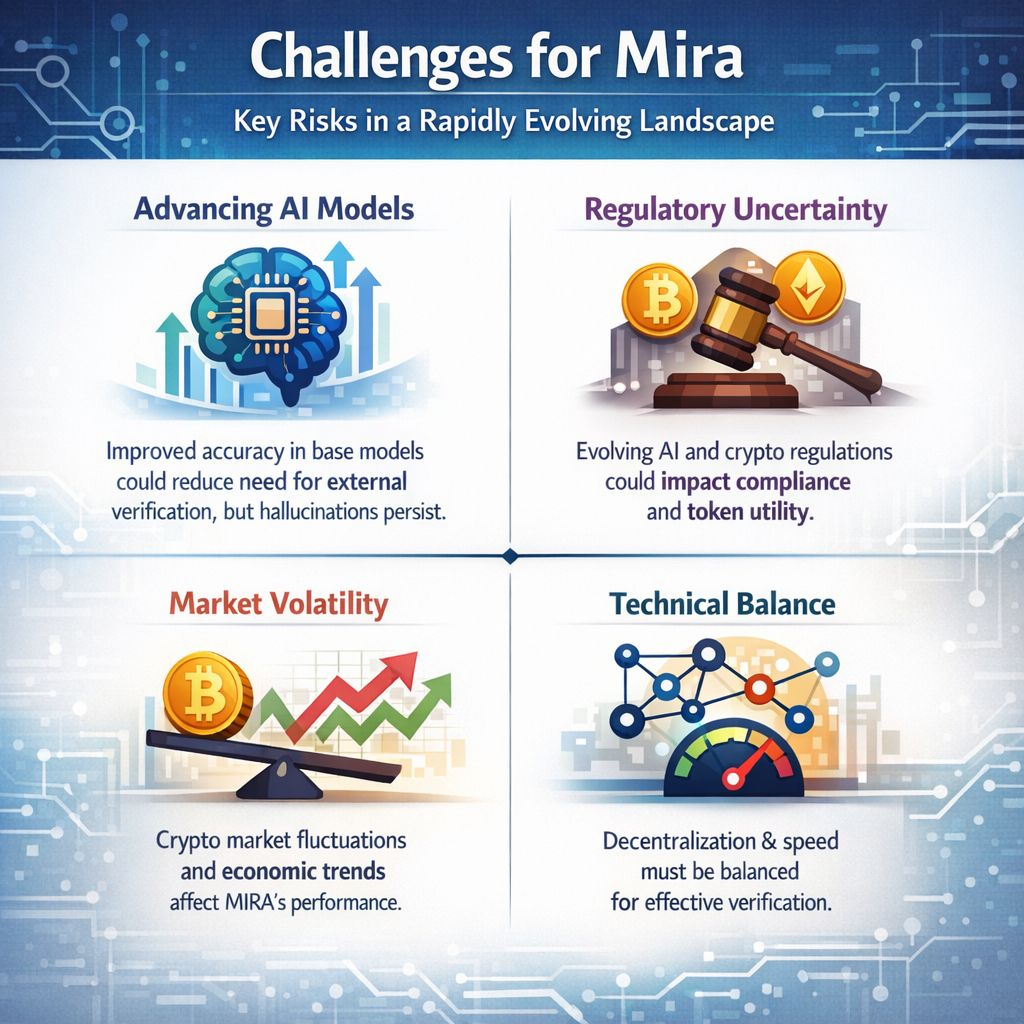
Long-Term Outlook;
As AI becomes increasingly autonomous and integrated into mission-critical systems, verification and accountability will become structural necessities rather than optional features.
Mira Network represents an early attempt to formalize AI trust through decentralized consensus. With its staking-based validation model, scalability improvements, developer-focused tools, and growing adoption metrics, the project is positioning itself as foundational infrastructure rather than speculative technology.
If AI continues expanding into high-stakes industries, the demand for verifiable outputs will likely grow alongside it. In that scenario, Mira’s trust layer approach may become not just relevant but essential.
Mira Network is still in its developmental growth stage, but its direction is clear. It aims to ensure that as AI becomes more powerful, it also becomes more reliable, auditable, and accountable.