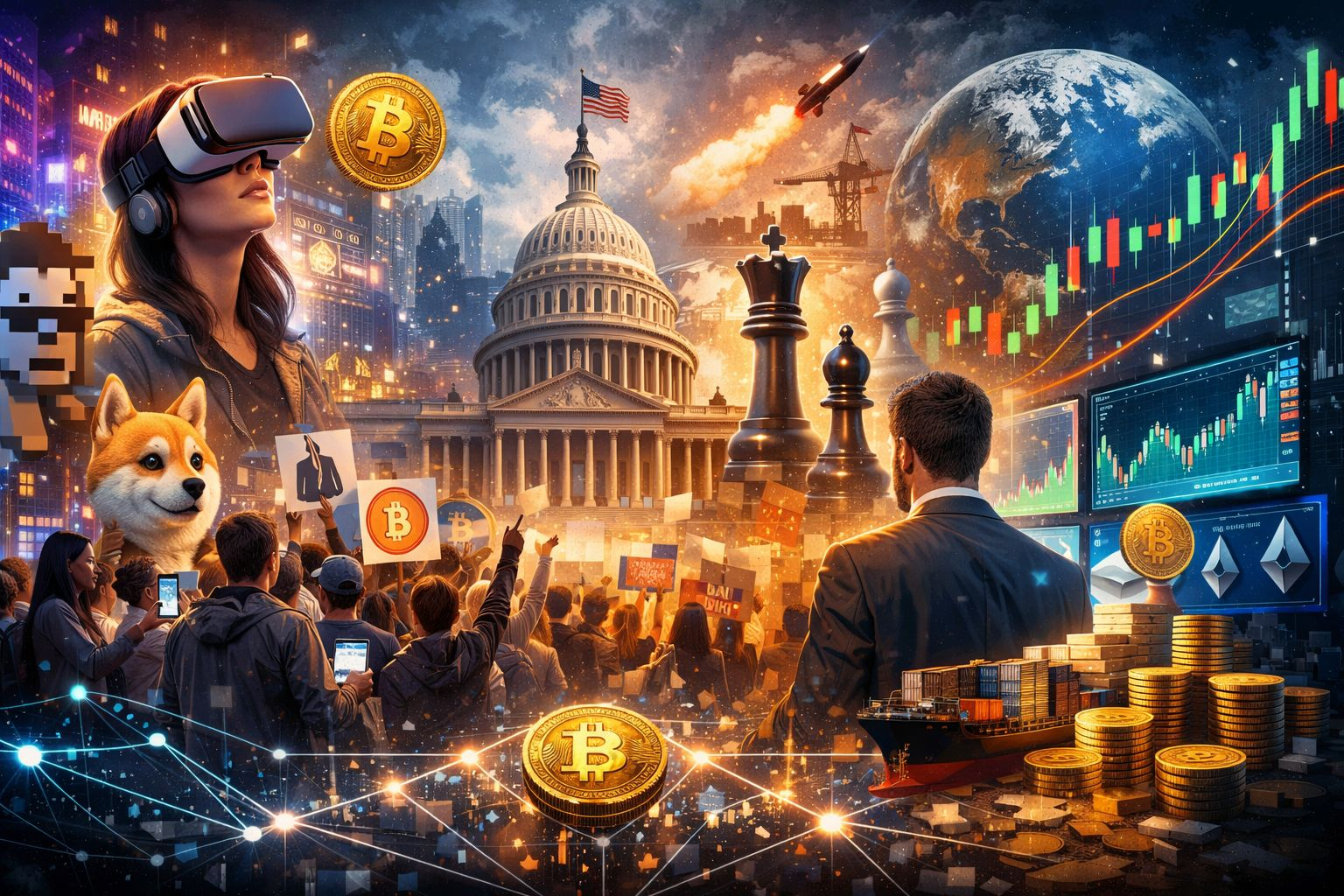
The story of digital assets is often told as a financial revolution. Charts, volatility, market cycles, and speculation dominate the conversation. Yet every so often a situation emerges that reveals something deeper: digital assets are no longer just financial tools. They have quietly become cultural symbols, political instruments, and economic experiments all at the same time. When that happens, the narrative moves far beyond price movements. It becomes a case study about society itself.
At first, most digital assets began as technical ideas. Programmers were experimenting with cryptography, distributed systems, and new forms of online coordination. The early vision was largely economic: a way to move value across the internet without traditional intermediaries. But the moment people started participating at scale, something unexpected happened. Communities formed around these assets. Online groups started treating tokens not just as currency but as identity markers. Owning a token began to signal belonging to a particular philosophy, ideology, or digital tribe.
Culture started shaping the meaning of digital assets in ways that the original technology never predicted. Memes, narratives, and internet communities turned certain tokens into cultural phenomena. Suddenly a project could gain momentum not because of its technical architecture, but because it resonated emotionally with millions of people online. In this environment, value becomes partly technical and partly social. A token can rise not only because of infrastructure innovation, but because it captures the imagination of a community.
Politics entered the picture soon after. Governments, regulators, and policymakers began realizing that digital assets could influence national economies, capital flows, and even political narratives. Some countries embraced them as tools for financial innovation. Others viewed them as threats to monetary sovereignty. Debates over regulation quickly became debates about power. Who controls money? Who decides how financial systems evolve? These questions, once confined to central banks and finance ministries, were suddenly being discussed by millions of people on social media.
The political dimension became especially visible when digital assets began intersecting with national identity or geopolitical tension. A token associated with a country, a movement, or a political ideology can take on symbolic importance far beyond its technical design. In those moments, digital assets stop behaving like simple market instruments. They become signals in a much larger social conversation. Supporters treat them as symbols of progress or resistance, while critics view them as speculative bubbles or systemic risks.
Economics adds another layer to the story. Digital assets are often described as decentralized systems, but in reality they operate within the broader global economy. Capital flows into these markets from venture funds, retail traders, institutional investors, and sometimes even governments. Liquidity, speculation, and macroeconomic conditions all shape how these assets behave. In periods of economic optimism, digital assets can feel like engines of innovation. In times of stress, they can reveal structural weaknesses in how markets function.
What makes these situations fascinating is how quickly the lines between culture, politics, and economics blur. A digital asset may start as a technical experiment, gain cultural traction through internet communities, attract political attention from regulators, and then become a major economic story as capital flows in or out. Each stage reshapes how people interpret the asset’s purpose. What began as code becomes narrative, and narrative can be just as powerful as technology.
The human element is impossible to ignore. Behind every digital asset are communities of believers, skeptics, builders, and traders. People project their hopes, frustrations, and ambitions onto these systems. Some see them as tools for financial freedom. Others see them as speculative playgrounds. Some view them as mechanisms for technological progress, while others see them as cautionary examples of market excess. These competing perspectives coexist, creating an environment where the meaning of an asset can shift rapidly.
History suggests that transformative technologies often follow this pattern. Railroads, the internet, and social media all moved through phases where excitement, speculation, and skepticism existed simultaneously. Digital assets appear to be moving through a similar trajectory. The difference is the speed. Information spreads instantly, capital moves globally, and communities organize online at unprecedented scale. This accelerates both the successes and the failures.
The most interesting part of these case studies is that the outcome is rarely clear in the moment. What looks like a revolutionary breakthrough today may later be remembered as a speculative bubble. Conversely, what appears chaotic or experimental today may eventually form the foundation of entirely new economic systems. The uncertainty is part of the process. Innovation often looks messy while it is happening.
Digital assets therefore represent more than just a technological shift. They are testing new forms of coordination between people, markets, and institutions. They challenge assumptions about ownership, governance, and trust in the digital age. Whether a specific example becomes a celebrated milestone or a warning sign will depend on how the surrounding ecosystem evolves.
What is certain is that these moments reveal something important about our time. Technology no longer develops in isolation. It interacts immediately with culture, politics, and economics. Digital assets sit right at that intersection, where code meets society. Watching how these systems unfold is less like observing a software upgrade and more like observing a social experiment in real time.
And like many experiments of this scale, the final verdict may take years to fully understand.