What caught my attention was not the headline claim, but the deeper assumption. In AI, most teams still behave as if better generation is the main race. Ship a faster model. Add more context. Tune the prompt stack. Hope the output is good enough.I’m not fully convinced that is where the durable value sits anymore.For founders, the harder problem may not be how to make AI say more. It may be how to make other people trust what it says. That is the part Mira seems to be building around. Its whitepaper does not start from “how do we generate smarter text?” It starts from a blunter problem: modern AI is good at plausible output, but still unreliable when error-free behavior actually matters. The abstract frames Mira as a network for verifying AI-generated output through decentralized consensus, not as another model trying to win the generation leaderboard.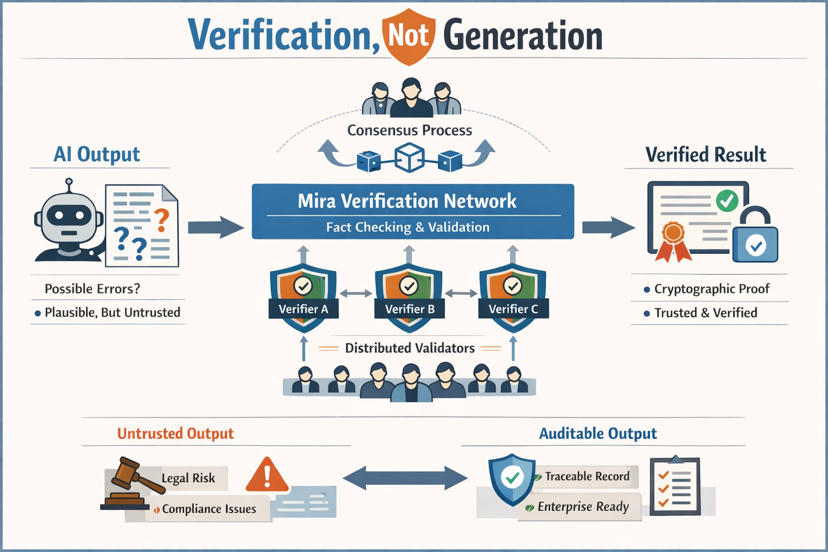 @Mira - Trust Layer of AI $MIRA #Mira That distinction matters more than it first appears.
A lot of AI product strategy today is still generation-first. The assumption is simple: if the model gets stronger, trust will follow. But Mira’s intro makes a different argument. It says current systems face a reliability barrier because hallucinations and bias are hard to minimize at the same time. In that framing, one more jump in model capability does not automatically solve the approval problem. You can still end up with outputs that sound polished, move fast, and fail exactly where enterprises become cautious.That is the practical friction I keep coming back to. Founders often think adoption stalls because buyers are slow, conservative, or political. Sometimes that is true. But often the blocker is simpler: the model may impress the demo team and still fail the approval team.Mira’s thesis, as I read it, is that verification can become its own trust layer. The system takes candidate content, breaks it into independently verifiable claims, distributes those claims across different verifier models, and then returns both an outcome and a cryptographic certificate showing what reached consensus. In other words, it treats AI output less like a final answer and more like untrusted input that needs structured checking before it can be used in a meaningful workflow.
That mechanism is more important than “multiple models” by itself. Just asking several models the same big question is messy. Different models may focus on different parts of the response, interpret the prompt differently, or apply different context windows. Mira explicitly argues that raw content has to be transformed into standardized, verifiable claims so each verifier is answering the same problem from the same angle. That is a more serious architecture than simple voting. It suggests the real product is not model aggregation. It is verification discipline.I think founders should pay attention to that, because enterprise AI usually doesn’t fail at the demo stage. It fails later, when the company has to decide whether it can actually trust the system enough to use it in the real world.It dies in the layer after that.Imagine an enterprise team trying to approve an AI assistant for internal policy reviews, financial reporting drafts, or regulated customer communication. The generation quality may already look good enough. The issue is not whether the model can write a convincing answer. The issue is whether legal, compliance, security, or procurement can defend using that answer at scale. “Looks strong in testing” is not an approval artifact. A traceable verification record is much closer to one.
This is where Mira’s positioning gets sharper. The network is designed to return a certificate recording the verification outcome, including which models reached consensus for each claim. For a founder selling into serious organizations, that changes the conversation. You are no longer pitching only output quality. You are pitching inspectability, accountability, and a cleaner audit trail around machine-generated work.And from a crypto angle, that is probably the most credible part of the story.Crypto is not obviously needed just to make a model generate text. But it is more legible when the job is coordinating economically incentivized verifiers who should not all trust one operator. Mira’s paper leans into that by using a hybrid economic model: operators perform real inference work, but they also stake value and can be penalized for behavior that looks like random guessing or dishonest verification. Customers pay fees for verified output, and those fees are distributed to network participants. That is a clearer crypto-native value loop than many AI-token projects that mostly wrap API access in token language.Still, this is not a clean win. The tradeoff is real.A verification layer can improve trust, but it also adds cost, latency, orchestration complexity, and new governance questions. Mira itself acknowledges that duplication and distributed verification can raise verification costs before later sharding and scale efficiencies kick in. And consensus is not identical to truth. A network of models can reduce random error and surface disagreement, yet still inherit shared blind spots if the model set is not truly diverse enough. The architecture is interesting, but the operating details will matter more.That is why I would not frame Mira as “generation versus verification” in a simplistic way. Generation still matters. No one wants a weak base model wrapped in elegant oversight. But I do think the market may be slowly repricing where value sits. The most important layer may not be the one that produces language. It may be the one that makes that language usable in environments where mistakes carry legal, financial, or operational cost.For founders, that is the uncomfortable shift. If the AI market matures the way cloud security did, trust infrastructure may capture more durable value than another marginal jump in model fluency. The best generator may win attention. The best verification layer may win permission.
That is what I want to see proven next. If verification becomes the real coordination layer for enterprise AI, who captures the moat: the model maker, the workflow owner, or the network that makes outputs trustworthy enough to deploy?@Mira - Trust Layer of AI $MIRA #Mira

Article
Mira: The Harder Moat Is Verification Not Generation

--
Disclaimer: Includes third-party opinions. No advice. Binance AI may be used without guarantee. See T&Cs.