

 Crypto beginners are often attracted to one simple idea. Earning without running expensive hardware. That is where cloud mining usually enters the conversation. But not all cloud mining models are equal. Some are purely hash power rental schemes. Others are built around network participation and validation economics.
When discussing Mira Network, it is important to understand what cloud mining really means within its ecosystem. Mira is not a traditional Bitcoin style mining chain. It operates through AI verification and validator staking. So cloud participation here is about contributing to verification power rather than brute force computation.
Understanding the Concept in Simple Terms
Traditional mining requires physical machines solving cryptographic puzzles. In contrast, Mira Network focuses on validating AI outputs. The network depends on node operators who stake tokens and verify computational results.
Cloud mining in this context means participating in network validation without managing complex server infrastructure yourself. Instead of buying hardware, a beginner can allocate capital into a managed validator service or staking platform that operates nodes on their behalf.
Think of it like investing in a power plant rather than building one in your backyard. You share in the output without managing the machinery.
How Mira Network Participation Works
Mira Network relies on validators who review AI generated outputs. These validators stake tokens and earn rewards when their verification aligns with network consensus. If they validate dishonestly or inaccurately, they face penalties.
For beginners, direct node operation may require technical knowledge. Cloud based participation lowers the barrier by allowing users to delegate tokens to professional operators who run the infrastructure.
The reward structure is based on three variables.
Network usage volume
Validator performance accuracy
Total tokens staked across the network
As more AI outputs require verification, validator rewards can increase. However, as total staked supply rises, individual yield may decrease due to reward distribution dynamics.
Chart Suggestion 1
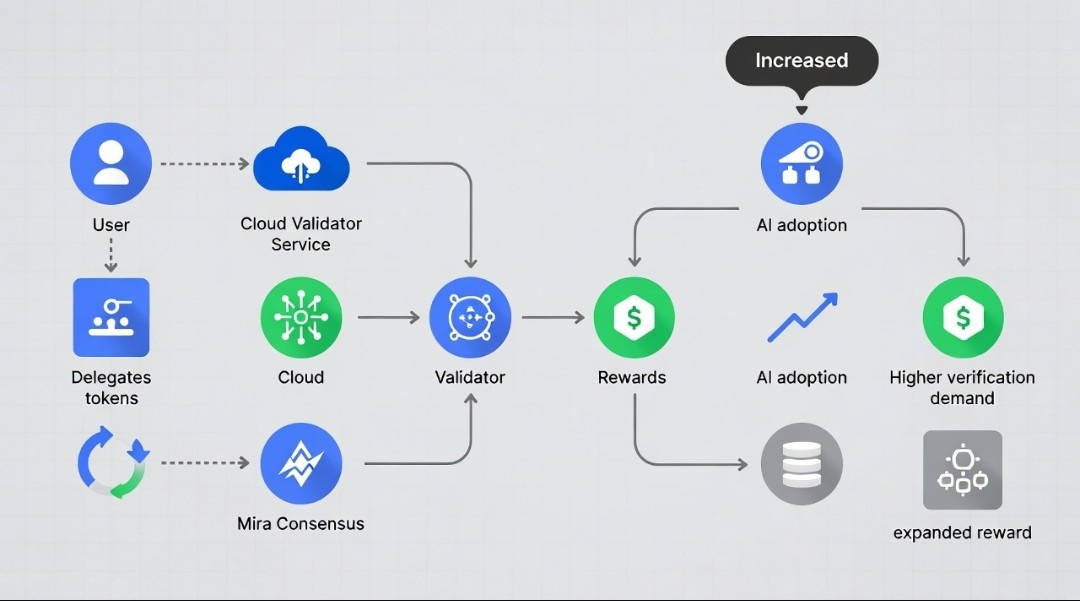
A simple visual showing User Delegates Tokens to Cloud Validator Service leading to Validator Node Participates in Mira Consensus leading to Earned Rewards Distributed Back to User. This clarifies the flow for beginners.
Why This Model Is Different From Classic Mining
In proof of work mining, revenue depends on electricity efficiency and hardware competition. In Mira Network, revenue depends on economic honesty and validation accuracy.
This makes the risk profile different.
You are not exposed to hardware depreciation or energy price spikes. Instead, you are exposed to token economics, validator competence, and network adoption.
In my perspective, this shifts cloud participation from industrial scale infrastructure competition to incentive alignment evaluation. You are choosing trust in an operator’s verification integrity rather than trust in their cooling system.
Risks Beginners Must Understand
Cloud mining always carries counterparty risk. If the validator operator mismanages funds, performs poorly, or fails to maintain uptime, rewards decline.
There is also token price volatility. Even if rewards are consistent, token market value can fluctuate significantly.
Slashing risk is another factor. If a validator behaves incorrectly and is penalized, delegators may experience reduced returns.
In my view, beginners should evaluate validator transparency, staking ratios, uptime history, and governance participation before allocating capital.
Opportunities Within the AI Narrative
The broader AI crypto narrative is expanding. As AI agents integrate with DeFi protocols and enterprise systems, verification demand may grow.
If Mira Network becomes a core middleware layer for AI validation, staking demand could increase. Higher network usage may lead to stronger validator reward dynamics.
For beginners, early participation in infrastructure layers can sometimes provide better long term positioning than chasing speculative tokens with unclear utility.
Chart Suggestion 2
A projected growth illustration showing Rising AI Adoption leading to Increased Verification Demand leading to Higher Validator Activity leading to Reward Distribution Expansion. This highlights the macro thesis behind participation.
Market Structure Considerations
Infrastructure tokens behave differently from hype driven assets. Their value depends on real network activity rather than short term speculation alone.
Key metrics to monitor include
Total value staked
Active validator count
Verification volume growth
Partnership integrations
If these indicators trend upward consistently, the economic base supporting rewards strengthens.
If growth stagnates, yield compression and reduced incentive alignment may follow.
My Personal Perspective
I believe beginners should approach Mira Network cloud participation as exposure to AI verification infrastructure rather than passive income magic.
The strongest advantage of this model is alignment. Validators earn by being correct. Delegators earn by supporting accurate validation. That creates a feedback loop around integrity.
However, sustainability depends on adoption. Without meaningful AI integration demand, staking becomes circular.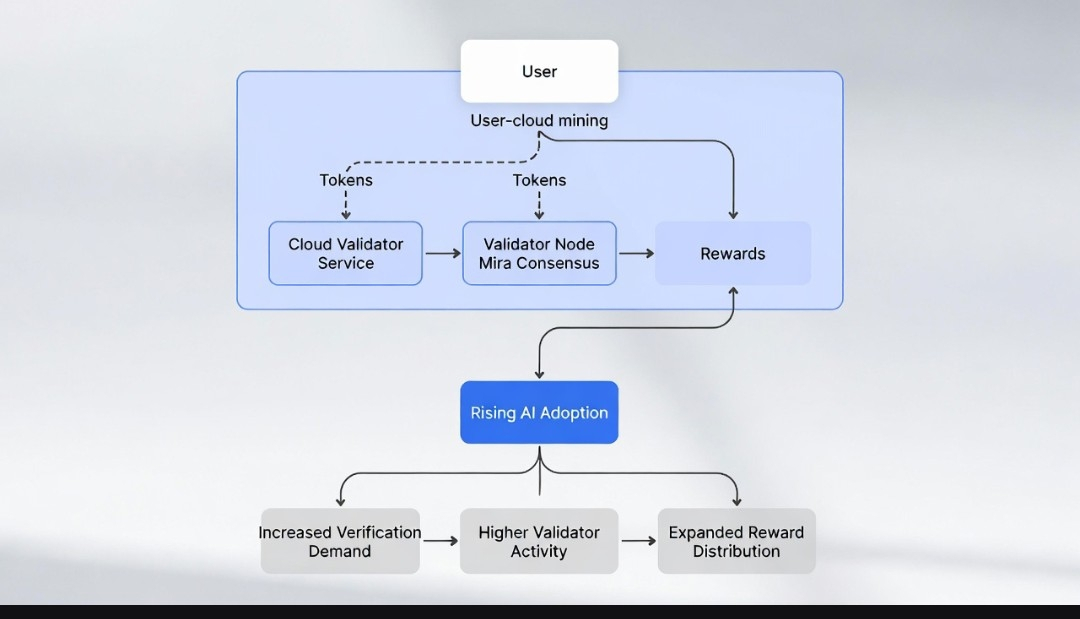
For that reason, I would monitor ecosystem partnerships and real world use cases closely.
Investor Takeaways
Start small and understand validator performance history.
Diversify across multiple validators if possible to reduce operator risk.
Monitor staking ratios and reward adjustments regularly.
View participation as long term infrastructure exposure rather than short term yield farming.
Final Thoughts
Mira Network cloud mining is not about machines solving puzzles. It is about capital securing intelligence.
For beginners, it offers an accessible path into AI driven blockchain infrastructure. But like all crypto opportunities, rewards follow risk and adoption.
If verified AI becomes essential for autonomous finance, networks that secure computational truth may become foundational.
And in that scenario, participating early in validation infrastructure could prove strategically valuable.
@Mira - Trust Layer of AI #Mira $MIRA
