
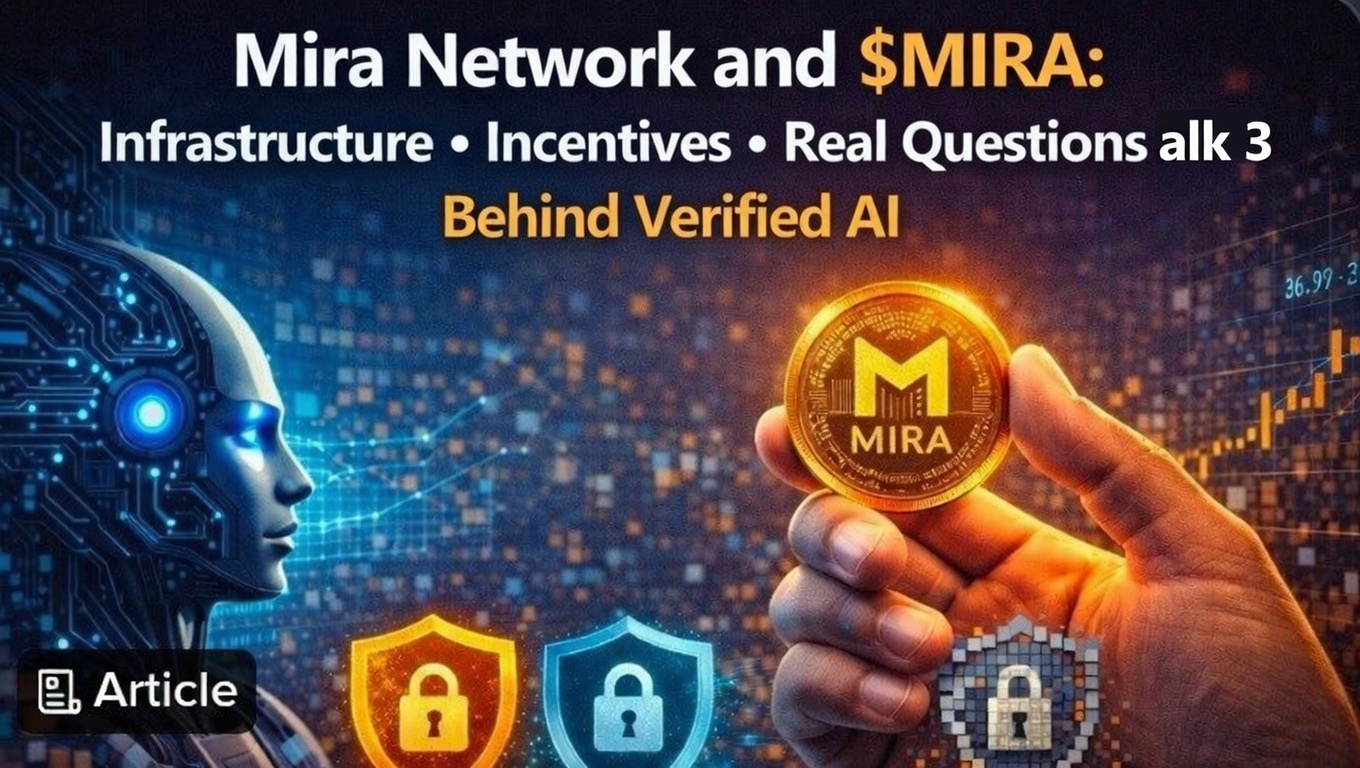
as I dived deeper into the world of Mira Network, what caught my attention was not the sales pitch, per se, but the evident intention to develop a trustworthy layer of infrastructure for AI systems. Indeed, the basic concept, which aligns with the interests of both the blockchain and high-assurance AI communities, is to make AI outputs verifiable, with responses segmented to atomic claims and reaching consensus among verifiers before publishing outputs on the blockchain.
The $MIRA token is at the center of this entire infrastructure stack. It is an ERC-20 token on the Base network with a total supply of 1 billion tokens. It has very practical use cases: staking by validator nodes to achieve consensus, API fees, and governance. In particular, the staking mechanism ensures that there is economic incentive alignment so that nodes are not rewarded to participate in the process, but to correctly verify outputs, with adverse consequences for misbehavior.
Another contract-level analysis, such as examining burn and restoreSupply, also becomes more relevant because it speaks to the degree of flexibility with token governance. Some contracts have this functionality to handle supply management and mitigate inflationary pressures or encourage holders. The degree to which the actual Base-deployed Mira ERC-20 has these management features will impact the overall decentralization and potentially the degree to which the community trusts the token. If the team has these keys, it represents a centralization risk factor. At the time of writing, this doesn’t seem to be well-documented, and it would be worth investigating this directly from the contract or audits.
Regarding the degree to which Mira offers privacy protections, the system inherently breaks down sensitive output fragments into claim fragments among the nodes. Therefore, the entire raw content isn’t visible to a single entity.
Additionally, the neutrality of AI providers will be important. Mira will attempt to reduce the risk of bias in its verification process by aggregating verification results from multiple AI providers in its pool. In this way, verified results can be used across different applications via standard APIs and SDKs without having to redo the verification process.
Mira
There are still many open issues with respect to the economics of participation and decentralization. For instance, how low can the stakes be for participants to remain secure? How will decentralization naturally lead to centralization in the hands of the large participants? These will be important questions that will be answered in the real world.
#Mira @Mira - Trust Layer of AI
