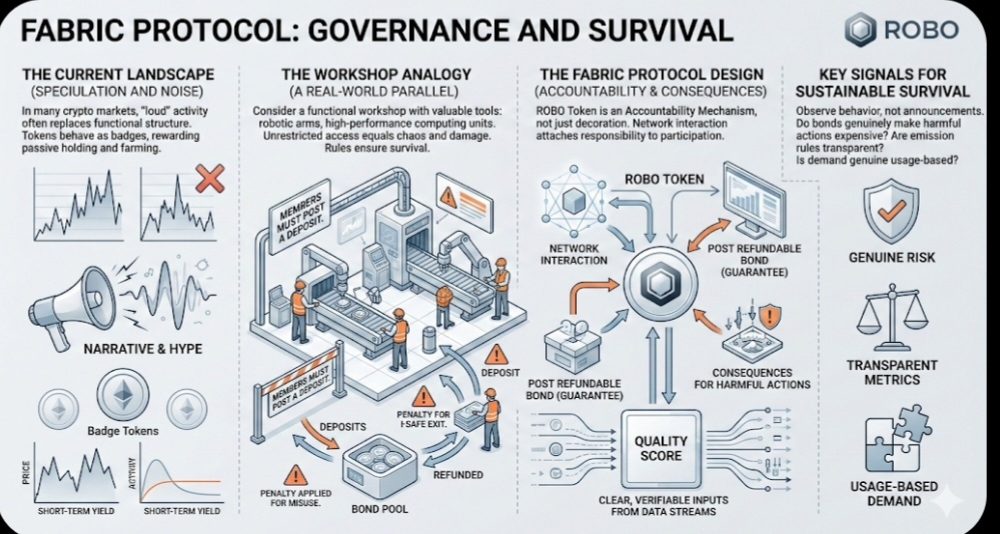
Fabric Protocol becomes interesting the moment you stop looking at it as another token story and start looking at it as a system trying to survive real conditions. In a market where attention often replaces structure, Fabric appears to be experimenting with a different idea: participation should carry responsibility, not just rewards.
If you watch the crypto market from a distance, everything seems fast. Prices move constantly, charts flash, and communities grow noisy almost overnight. But when you spend enough time inside the ecosystem, a pattern becomes clear. Many projects create movement, yet very few create structure.
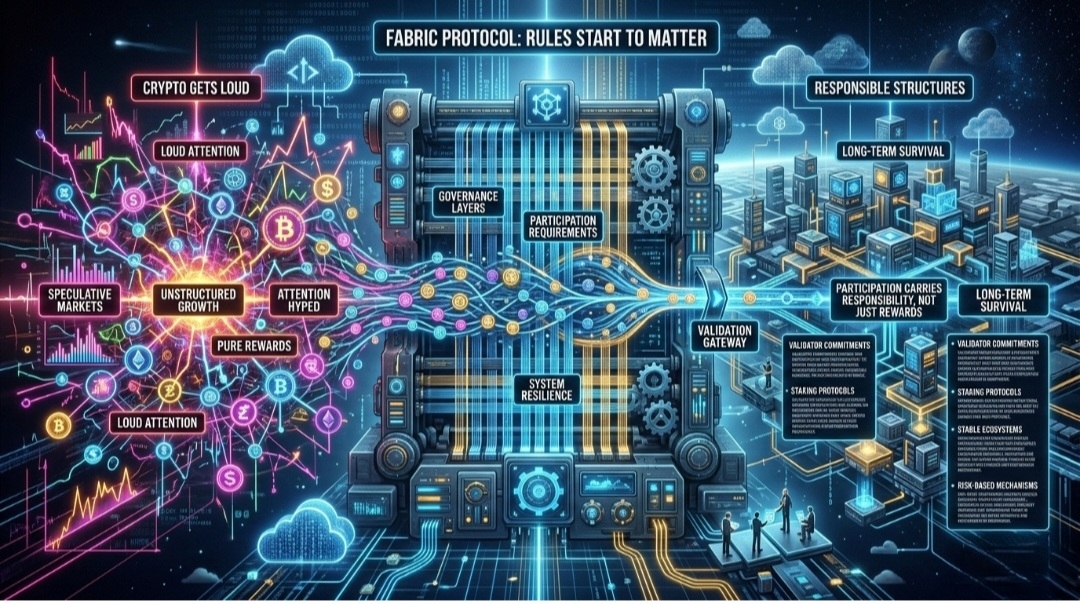
That difference is what made Fabric stand out.
Not because it arrived with dramatic promises.
Not because the token suddenly captured attention.
But because the design quietly circles around a simple principle: systems that last usually attach consequences to participation.
A simple analogy: membership and responsibility
Imagine joining a workshop that contains expensive machines—industrial printers, cutting equipment, robotics tools. If anyone could walk in and start using those machines without restrictions, the workshop would quickly fall apart.
Serious workshops avoid that problem with a simple rule.
Members place a deposit, agree to clear guidelines, and if something is misused, the deposit absorbs the damage.
That deposit is not there to make money.
It exists to make behavior accountable.
Fabric’s design treats the ROBO token in a somewhat similar way. Instead of existing only as something to hold or speculate on, the token becomes a mechanism that attaches responsibility to participation inside the network.
ROBO as accountability, not decoration
In many crypto systems, tokens behave like badges. People hold them, stake them, and receive rewards while the underlying activity remains secondary.
Fabric’s structure suggests a different approach. Participants interacting with certain parts of the network may need to post a bond, essentially a refundable guarantee. If activity is legitimate, the bond remains untouched. If behavior harms the system, penalties can be applied.
The logic is straightforward:
participation should not be a cheap signal.
Of course, whether this works depends on implementation. If bonds are too small, they become just another operational cost for farming. If enforcement becomes vague or subjective, the system risks sliding back into narrative rather than rules.
Emissions: growth or illusion
Crypto has a long history of using emissions to create the appearance of activity. Rewards are distributed, usage spikes temporarily, and dashboards show a healthy network.
Fabric’s theoretical position suggests emissions should respond to real network conditions, not simply to excitement. If the system is underused, emissions should not artificially inflate the picture.
That idea sounds straightforward, but the challenge lies in measurement. The moment a system introduces something like a quality score, the real question becomes whether that score is transparent or adjustable.
If the inputs remain visible and difficult to manipulate, credibility grows.
If the metric becomes vague, it risks turning into a steering wheel rather than a measurement.
Work-linked distribution: contributors or farmers
Fabric also frames token distribution around work performed within the ecosystem.
In theory, this approach could filter out passive speculation and reward people who actively contribute to the network. Many traditional “community allocations” simply create future selling pressure rather than long-term participation.
But markets tend to test any system that holds value.
If “work” can be imitated easily, automated farming quickly scales.
If proof of work requires verification, logs, and consequences, real contributors become easier to identify.
The success of the model depends on how difficult it is to fake participation.
Supply unlocks and delayed pressure
Token vesting introduces another structural reality.
A cliff does not eliminate supply.
It only delays the moment when supply appears.
When those unlocks arrive, markets suddenly face additional circulating tokens. The only sustainable defense is building real demand sinks before that moment arrives.
If demand exists primarily because people hope to hold the token for appreciation, the outcome tends to follow a familiar pattern.
If demand grows from genuine system usage—fees, bonds, coordination mechanisms—then unlock pressure becomes easier to absorb.
Infrastructure patience
Fabric’s roadmap reflects a relatively cautious strategy. Building on existing infrastructure first, while leaving open the possibility of a dedicated chain later, avoids rushing into fragmentation.
Crypto history has repeatedly shown how launching a new chain too early can divide liquidity and increase friction for users.
Sometimes patience is a stronger strategy than speed.
What actually matters
For observers trying to understand Fabric’s direction, the most meaningful signals will likely come from behavior rather than announcements:
Do bonds genuinely make harmful actions expensive?
Do emission rules remain transparent and consistent?
Does work-linked distribution attract real contributors instead of automated farmers?
Does token demand emerge from usage rather than speculation?
Crypto markets often reward loud beginnings.
But the systems that survive usually rely on quiet rules that hold their shape under pressure.
Takeaway: If Fabric keeps its constraints visible and its incentives difficult to manipulate, the long-term value of ROBO will come not from attention, but from the reliability of the system behind it.
#ROBO @Fabric Foundation $ROBO