

Something subtle is happening in the world of artificial intelligence, and most people are only beginning to notice it. For years, the conversation around AI has been dominated by one idea: making models smarter and faster. Every new breakthrough seemed to focus on bigger datasets, more powerful algorithms, and answers that appear almost instantly. But as AI systems become more influential in finance, research, governance, and automated decision-making, another question has quietly moved to the center of the conversation:

Can we actually trust what AI tells us?
This question is becoming more important every day. AI can write reports, analyze markets, summarize complex data, and even guide automated systems that operate without human intervention. But behind the impressive speed and confidence of these responses lies a hidden vulnerability. Most AI outputs today are accepted simply because they look convincing. The language is smooth, the structure is logical, and the answers appear complete. Yet in many cases, there is no clear proof that the information is correct or even based on reliable reasoning.
This is the problem that $MIRA is trying to address.
Instead of joining the race to build the fastest or most powerful model, Mira is focusing on something deeper: verification. In decentralized systems, trust is not built through authority or reputation. It is built through proof. Blockchains verify transactions mathematically. Smart contracts verify that agreements execute exactly as written. Ownership can be proven without relying on a central authority.
But when AI enters this environment, that same level of verification often disappears.
AI answers appear instantly, but the reasoning behind them is hidden inside complex models that most people cannot inspect. The result is a strange contradiction. We rely on these systems more and more, yet we often cannot prove whether their conclusions are correct.
Mira approaches this challenge from a completely different angle.
Rather than treating AI output as a single block of information, Mira breaks it into individual claims. Each statement within an answer becomes its own unit of truth that can be evaluated and verified independently. This process reveals something important: not every part of an AI response carries the same level of certainty.
Some claims may be straightforward and easy to confirm. Others may be more complex or uncertain. By separating them, Mira creates a system where verification can happen in a transparent and measurable way.
But Mira goes even further.
Verification is not just technical — it is economic.
In the Mira system, participants who verify claims can stake value behind their judgment. When someone confirms that a statement is correct, they are not simply clicking an approval button. They are backing that decision with real economic commitment. If the claim later proves incorrect, their stake may be at risk.
This changes the entire psychology of verification.
Instead of casual agreement, verification becomes a serious responsibility. Participants are incentivized to review claims carefully because their decisions carry consequences. Confidence is no longer just a feeling expressed through language; it becomes something that can be measured through economic backing.
This approach creates a new layer between AI generation and final trust.
The AI model generates answers quickly, but verification happens more deliberately. Claims move through a process where they are analyzed, supported, and economically validated before they are fully trusted.
At first glance, this may appear slower than traditional AI systems. But the goal is not to make answers appear faster. The goal is to make them reliable.
In many real-world environments, reliability matters more than speed.
Imagine AI systems helping to execute financial trades, guide medical research, or support governance decisions in decentralized organizations. In those situations, a confident but incorrect answer can cause serious damage. Verification provides a safeguard that ensures decisions are supported by proof rather than assumption.
This idea reflects a broader shift in the AI landscape. For years, progress was measured by how quickly machines could generate information. Now the conversation is beginning to move toward how accurately and transparently that information can be trusted.
In other words, the future of AI may not belong to the models that speak the fastest. It may belong to the systems that can prove their answers.
Mira’s architecture is designed with this future in mind. By combining AI outputs with decentralized verification and economic incentives, it creates a framework where intelligence and accountability evolve together.
For developers, this opens new possibilities. Verified AI outputs can be integrated into applications, smart contracts, and automated systems with greater confidence. Instead of building complicated safeguards around uncertain AI results, developers can rely on a network that verifies claims before they are used.
For users, the benefit is even more personal. Verified intelligence means fewer hidden assumptions and fewer blind leaps of faith. It means systems that show how they reached a conclusion instead of simply presenting one.
And for institutions, verification could become essential. As AI plays a larger role in financial systems, governance processes, and global infrastructure, regulators and organizations will increasingly demand systems that provide transparent proof rather than opaque outputs.
Of course, the journey is just beginning. Infrastructure projects like Mira often grow quietly before their impact becomes widely recognized. Adoption will depend on developer integration, community participation, and the ability to scale verification efficiently.
But the direction of the idea is powerful.
AI has already proven that it can generate knowledge faster than ever before. What comes next is ensuring that this knowledge can be trusted.
In many ways, Mira represents the next step in the evolution of decentralized technology. Blockchain proved that transactions can be verified without trusting a central authority. Now projects like Mira are exploring whether intelligence itself can be verified in the same way.
If that vision succeeds, it could transform how humans interact with AI systems. Instead of trusting answers simply because they appear convincing, we will trust them because they are supported by transparent proof and aligned incentives.
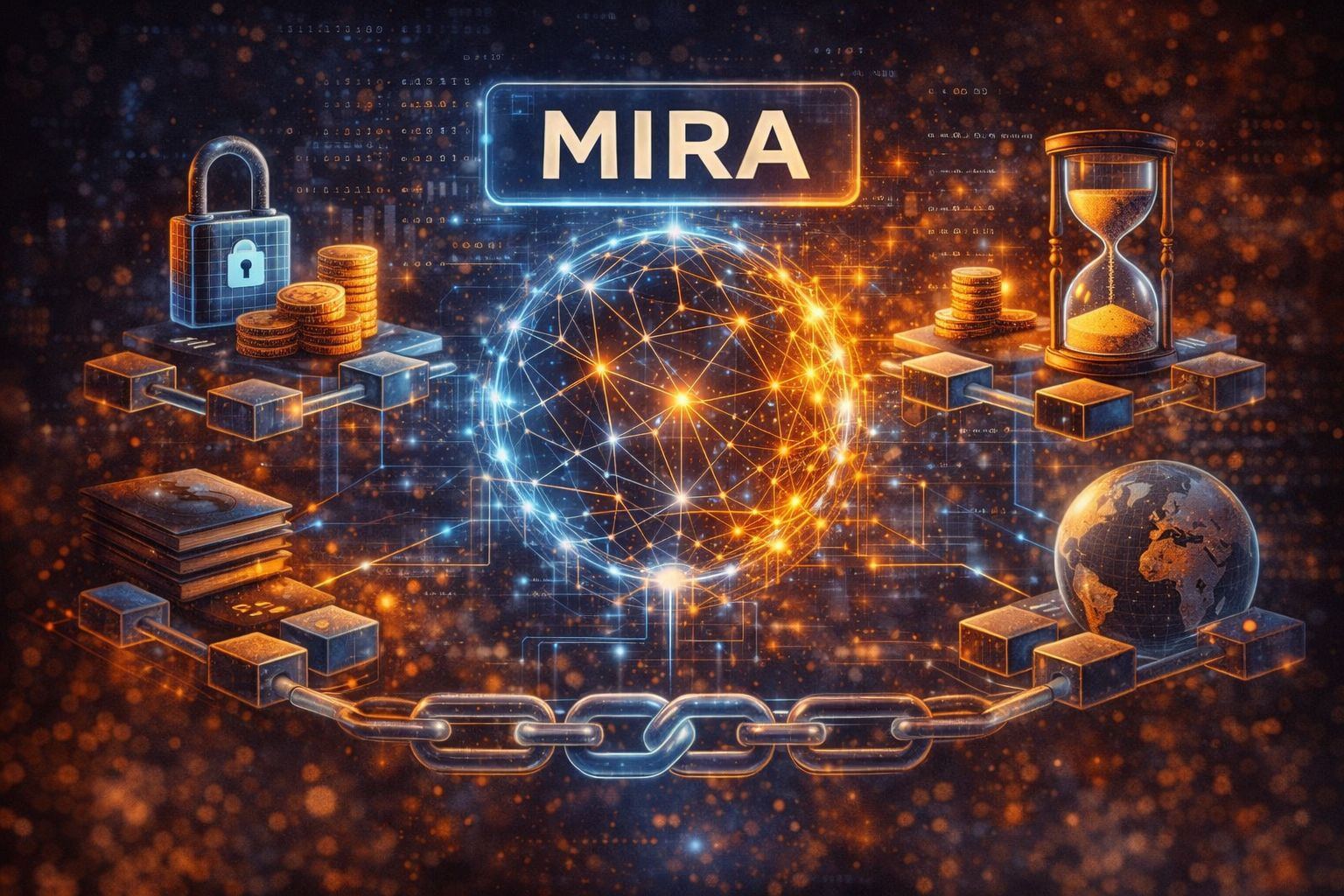
And in a world where machines are becoming increasingly intelligent and autonomous, that shift may be more important than speed itself.
Because in the end, intelligence alone is impressive.
But verifiable intelligence is what turns innovation into infrastructure.
