
Web3 is entering a phase where the usual performance metrics are no longer enough. For years, progress was measured in speed — faster blocks, higher throughput, lower fees. Those metrics mattered when systems were simple and usage was experimental. But as decentralized networks begin coordinating real economic value, autonomous processes, and cross-network logic, a deeper challenge emerges: how do we know systems are actually doing what they claim to do?
At scale, assumptions break. Automation magnifies both efficiency and error. When correctness is assumed rather than proven, small inconsistencies can cascade into systemic failures. This is why trust — not speed — has become the real bottleneck in modern decentralized systems.
From Assumed Correctness to Provable Systems
Most decentralized architectures implicitly assume correctness. Transactions execute, state updates occur, and the system moves forward as long as consensus rules are followed. This works under limited complexity, but composability, automation, and cross-network interactions introduce new failure modes. The more systems depend on one another, the more dangerous unverifiable assumptions become.
A verification-first approach changes this dynamic. Instead of trusting that outcomes are correct, systems require proof. Verification becomes an independent process — one that can be audited, reused, and relied upon by multiple applications simultaneously. This shift transforms trust from a social or economic assumption into a technical guarantee.
Why Verification-First Infrastructure Matters
This is where @Mira - Trust Layer of AI represents a meaningful evolution in Web3 design. #Mira treats verification as core infrastructure rather than a secondary feature. Its architecture emphasizes modularity and correctness, allowing verification to exist independently from execution.
By separating these concerns, systems gain flexibility and resilience. Execution layers can optimize for performance, while verification layers ensure outcomes remain provably correct. This separation reduces hidden trust assumptions and allows systems to scale without silently increasing risk.
Automation Changes the Risk Model
As AI-assisted agents, automated execution, and autonomous coordination become more common, the cost of incorrect verification grows exponentially. Machines do not pause to question outputs — they act on them instantly. In such environments, unverifiable outcomes are not just bugs; they are systemic threats.
Verification-first infrastructure ensures that automation scales progress, not error. It provides guardrails that allow complex systems to interact safely, even under adversarial conditions. This is especially critical when decentralized systems begin managing high-value assets, governance processes, and cross-chain operations.
Modular Systems Need Shared Trust Anchors
The broader Web3 ecosystem is moving toward modular architectures — execution, data availability, settlement, and verification as specialized layers. While this modularity improves scalability and specialization, it only works if verification remains robust and independent.
A shared verification layer reduces duplicated security logic, improves composability, and strengthens system-wide resilience. Instead of every application reinventing its own correctness model, multiple systems can rely on the same provable guarantees. This is how decentralized ecosystems grow without becoming fragile.
Building What Lasts
Projects like $MIRA reflect a long-term mindset. They are not optimized for short-term attention or speculative hype. Instead, they focus on building the underlying rails future decentralized systems will rely on. These are the systems that tend to matter most — often quietly — when infrastructure is stressed, attacked, or scaled beyond initial expectations.
In a maturing Web3 landscape, flashy performance claims are easy to make. Durable trust is not. Verification-first design is not just a technical choice; it is a strategic necessity for any system that aims to survive real-world complexity.
The Path Forward
Web3 does not fail because it lacks speed. It fails when trust cannot keep up with scale. Verification-first infrastructure addresses this gap by making correctness explicit, auditable, and independent. It allows decentralized systems to grow without sacrificing integrity.
As the ecosystem evolves, the networks that endure will not be the loudest or fastest — they will be the ones that can prove they are correct. In that sense, verification is no longer optional. It is the foundation of every scalable, resilient, and trustworthy decentralized system. 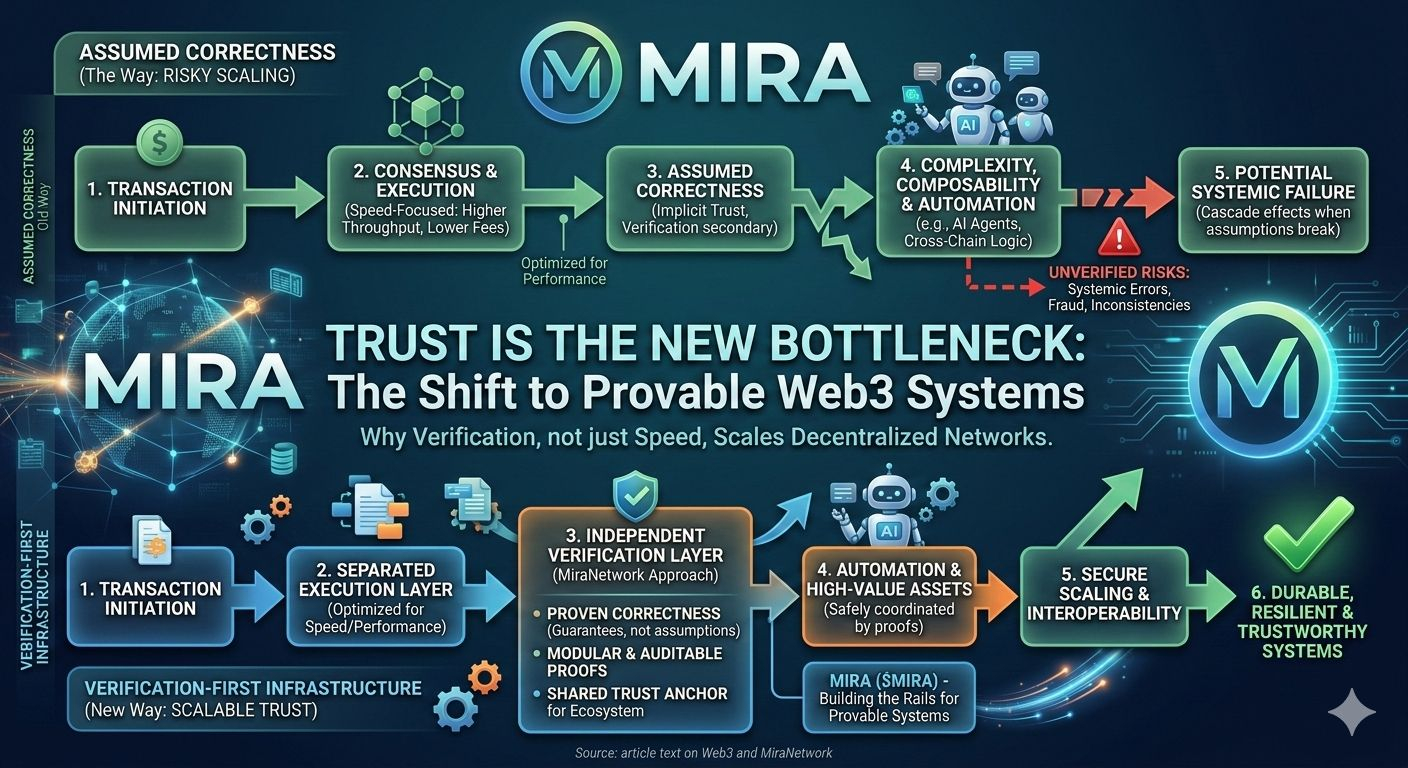


#XCryptoBanMistake #USCitizensMiddleEastEvacuation #GoldSilverOilSurge #AIBinance