

A few months ago, I found myself testing different AI tools for research and content validation. The answers were fast. Confident. Polished. But one question kept bothering me: Who verifies the verifier?
That tension between speed and certainty is exactly where MIRA steps in. Not as another AI model competing for attention, but as a verification layer built for a world increasingly powered by machine intelligence.
The Problem MIRA Is Actually Solving
We are entering a phase where AI outputs influence financial decisions, trading strategies, governance votes, even smart contract execution. Yet most systems still rely on centralized validation or blind trust in model outputs.
That’s a fragile foundation.
The project account @mira_network positions MIRA as a decentralized verification network designed specifically to validate AI-generated outputs and computational results. Instead of trusting a single model or server, verification is distributed across independent nodes. This shift may sound subtle, but structurally it changes everything.
In simple terms:
AI generates.
MIRA verifies.
The network reaches consensus.
And that separation of roles matters.
Verification as Infrastructure, Not a Feature
One reason I find MIRA compelling is that it treats verification as infrastructure, not an add-on. Many AI-blockchain hybrids focus on compute marketplaces or data monetization. MIRA narrows its lens to something more fundamental: ensuring integrity.
The protocol introduces a decentralized verification mechanism where independent validators check AI inferences or computational results. If outputs don’t match across nodes, discrepancies are flagged. Over time, this builds a reliability layer on top of AI systems.
This is especially important in high-stakes use cases:
On-chain AI trading signals
Risk modeling for DeFi protocols
AI-powered governance simulations
Automated compliance monitoring
In each case, a wrong output isn’t just inconvenient — it’s expensive.
How MIRA’s Architecture Changes the Game
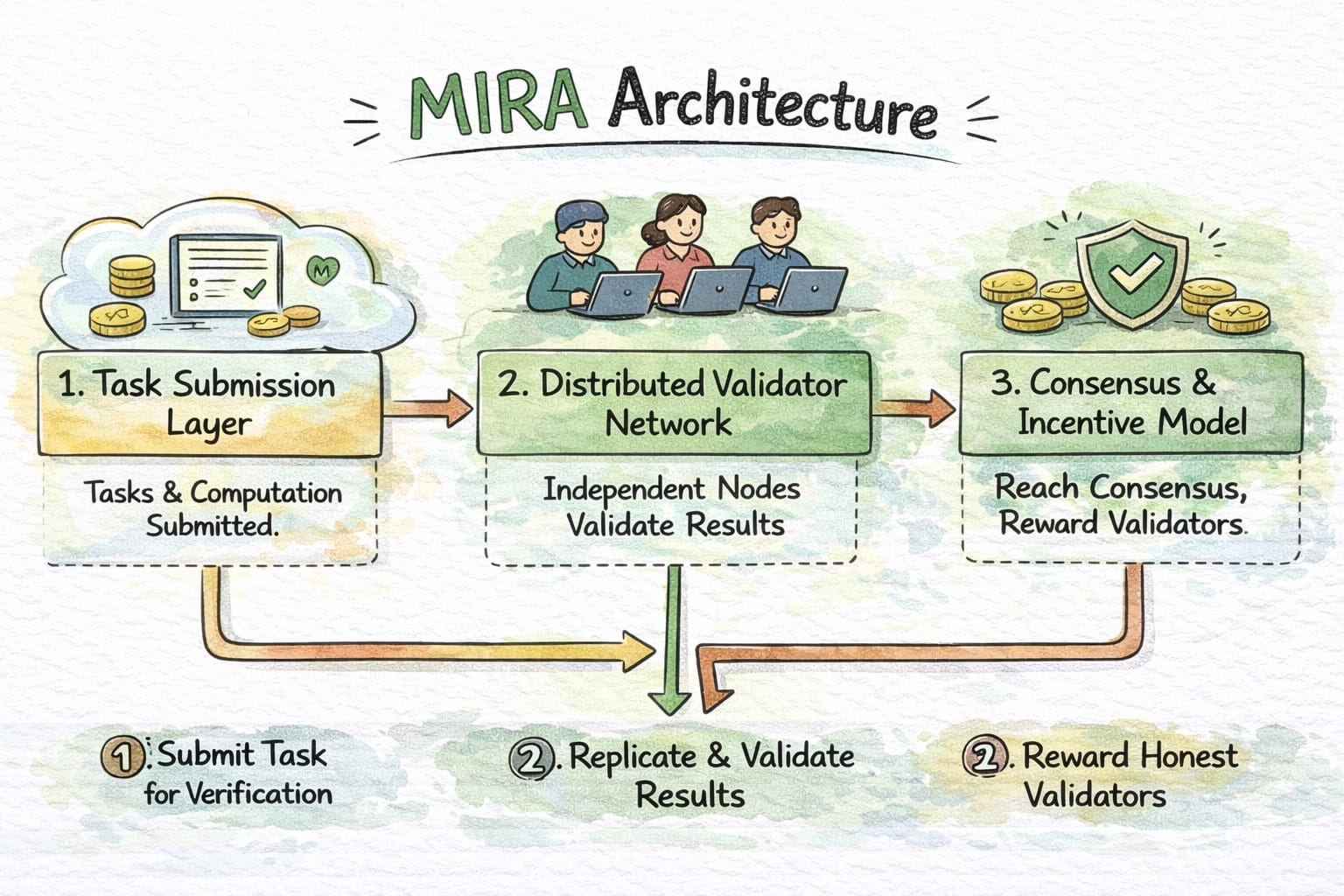
From a structural standpoint, MIRA integrates three important components:
1. Task Submission Layer – Where AI-generated results or computational tasks are submitted for verification.
2. Distributed Validator Network – Independent nodes replicate and validate the results.
3. Consensus & Incentive Model – Validators are rewarded in MIRA token for accurate verification and penalized for dishonest behavior.
This design aligns economic incentives with truthfulness. It mirrors the security philosophy of blockchain itself but applies it to AI output verification.
In my opinion, this is where MIRA differentiates itself most clearly. It doesn’t attempt to replace AI providers. Instead, it acts as a neutral verification rail that can sit beneath multiple AI systems.
That interoperability gives it long-term relevance.
Real Use Cases That Go Beyond Theory
What makes MIRA more than a concept is how it integrates into practical workflows.
Imagine a decentralized finance protocol using AI to assess loan risk in real time. The AI suggests collateral ratios. If those outputs are wrong or manipulated, the protocol’s stability is threatened. By routing those AI outputs through MIRA’s verification network, the protocol gains an additional security checkpoint.
Or consider DAO governance. If AI tools summarize proposals and simulate outcomes, those summaries can influence voter behavior. A decentralized verification layer ensures those simulations weren’t biased or corrupted.
Even outside DeFi, think about AI-generated research data submitted to blockchain-based marketplaces. Buyers need confidence in the computation. MIRA provides that confidence without relying on a single trusted party.
The Role of MIRA in the Ecosystem
The MIRA token is not just a transactional unit; it underpins the incentive structure of the network.
Validators stake MIRA to participate in verification. Accurate verification earns rewards. Malicious behavior risks slashing. This creates an economic gravity around honest participation.
From a network design perspective, staking accomplishes two things:
It deters low-quality or malicious validators.
It creates long-term alignment between token holders and network integrity.
Personally, I see this as critical. Verification without economic alignment quickly collapses into reputation-based trust. MIRA avoids that trap by embedding incentives directly into its architecture.
Why Timing Matters
The rise of large language models and AI agents has accelerated faster than governance frameworks can adapt. Enterprises are deploying AI into financial and operational systems without a decentralized audit layer.
This is why I think MIRA’s timing is strategic.
We’re moving from experimentation to automation. As soon as AI outputs start triggering smart contracts automatically, verification becomes mandatory rather than optional.
In that future, decentralized verification networks won’t be niche they will be foundational.
Recent Momentum and Ecosystem Growth
Looking at the broader activity around @mira_network, the focus remains consistent: expanding validator participation, improving verification efficiency, and strengthening integration pathways with other blockchain ecosystems.
The emphasis isn’t on hype announcements but on network robustness. That approach may seem quiet compared to louder AI narratives, but infrastructure projects often grow this way steadily and structurally.
The real signal is in developer engagement and validator onboarding, not marketing volume.
My Personal Take
If I step back from technical layers and look at MIRA conceptually, I see it as a bridge between two trust models:
AI trust (probabilistic, statistical, fast)
Blockchain trust (deterministic, consensus-based, secure)
MIRA connects them.
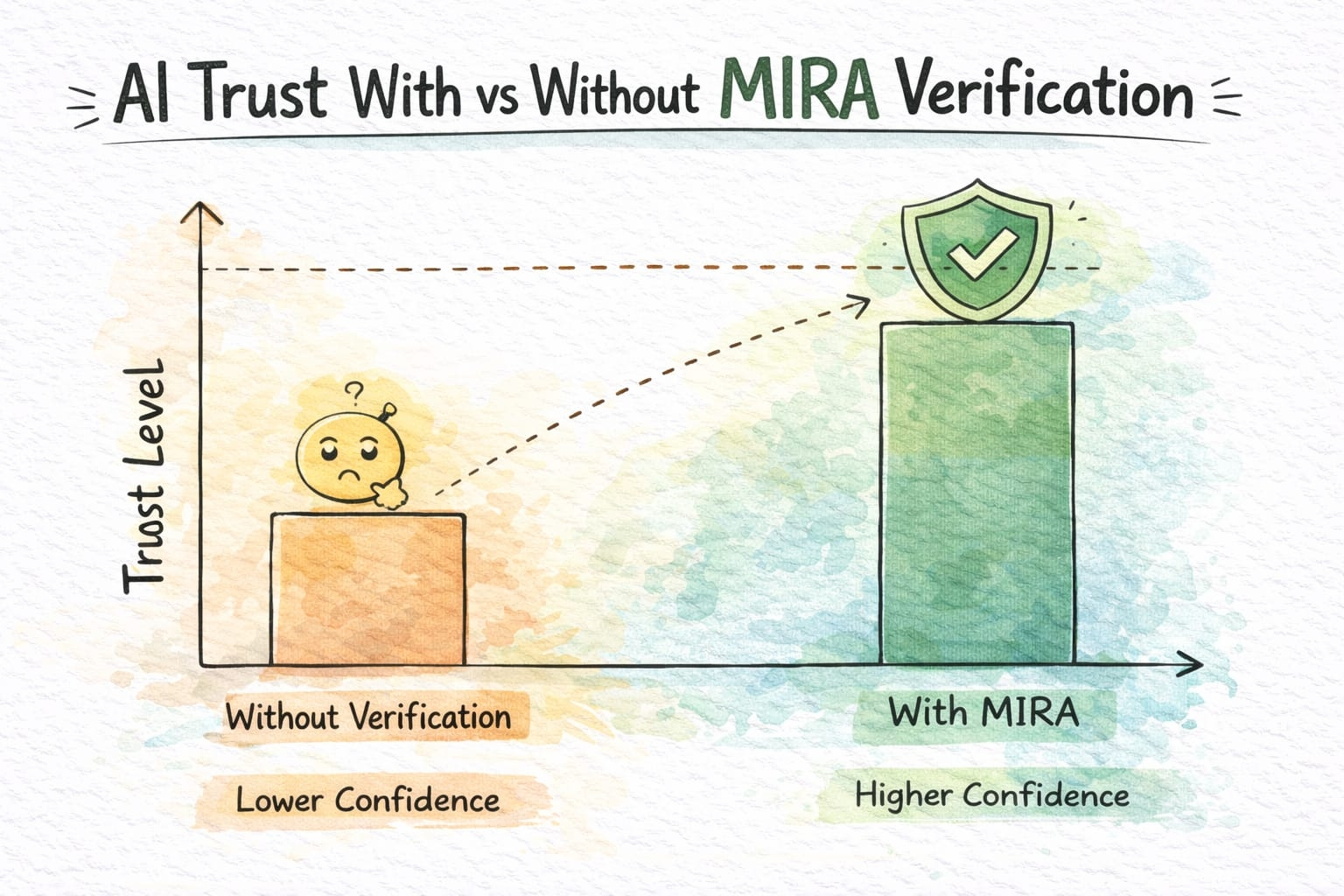
And that bridge matters because AI systems are inherently probabilistic. They generate the most likely answer, not necessarily the correct one. Blockchain, on the other hand, demands deterministic outcomes.
Without verification, combining the two is risky.
With verification, it becomes powerful.
The Broader Implication
What MIRA is building isn’t flashy. It’s foundational.
In the early days of the internet, encryption protocols weren’t exciting. But without them, e-commerce wouldn’t exist. I believe decentralized AI verification plays a similar role for Web3’s AI era.
The long-term success of AI integrated blockchains depends less on model sophistication and more on output integrity.
That’s where Mira stands.
Not as the loudest project in the room.
But potentially as one of the most necessary.
And in infrastructure, necessity always outlasts noise.
@Mira - Trust Layer of AI #Mira $MIRA
