There is a strange moment many people experience the first time they spend real time with artificial intelligence. At first it feels impressive, almost magical. You ask a question, sometimes a complicated one, and within seconds the machine responds with an answer that sounds confident, thoughtful, and organized. It feels like the system truly understands what you asked. But after a while, something subtle begins to appear. Occasionally the answer contains a small mistake. Sometimes it references something that doesn’t exist, or it mixes facts together in a way that sounds believable but isn’t completely accurate. The strange part is that the system delivers these mistakes with the same confidence it uses for correct information. It doesn’t hesitate, and it doesn’t warn you that it might be wrong. For many people, that realization becomes the moment they start to question something deeper about artificial intelligence. If these systems are going to guide decisions, write research, assist doctors, help manage financial systems, or even control autonomous machines in the future, then one question quietly becomes unavoidable: how do we know when AI is telling the truth?
Artificial intelligence today is powerful, but it operates in a way that is very different from human understanding. These models do not actually “know” facts in the traditional sense. Instead, they analyze enormous amounts of data and learn patterns in language and information. When you ask a question, the system predicts what the most likely answer should look like based on those patterns. Most of the time that prediction works surprisingly well, which is why AI feels so useful. But sometimes the prediction drifts away from reality. Researchers often call these moments hallucinations, but the word doesn’t really capture the full picture. The machine is not imagining things in a creative sense; it is simply filling gaps in knowledge with what statistically seems plausible. For everyday conversations that might not feel dangerous. But once artificial intelligence begins influencing real-world decisions, the cost of small inaccuracies becomes much larger.
This quiet problem has been growing as AI becomes more integrated into daily life. Businesses are beginning to rely on AI systems to analyze data and produce insights. Developers are building autonomous agents that can complete tasks without constant human supervision. Researchers are using AI to summarize complex scientific papers. Even machines in warehouses, factories, and logistics networks are beginning to operate with increasing levels of automation. As this shift continues, the reliability of information becomes more important than ever. If a machine is making decisions based on information that might occasionally be incorrect, the consequences can ripple outward in ways that are difficult to control. This is where a project like Mira Network begins to make sense, not as another AI model trying to be smarter than the rest, but as a different kind of infrastructure entirely.
The idea behind Mira starts from a simple observation. Instead of expecting one artificial intelligence system to be perfectly reliable, what if many independent systems could work together to check each other’s work? Humans have relied on this principle for centuries. Scientific discoveries are rarely accepted immediately; they are reviewed, debated, tested, and replicated by other researchers. Journalists verify information by confirming sources through multiple channels. Even everyday conversations often involve people comparing perspectives before agreeing on what is true. Mira attempts to bring that same process of verification into the world of artificial intelligence.
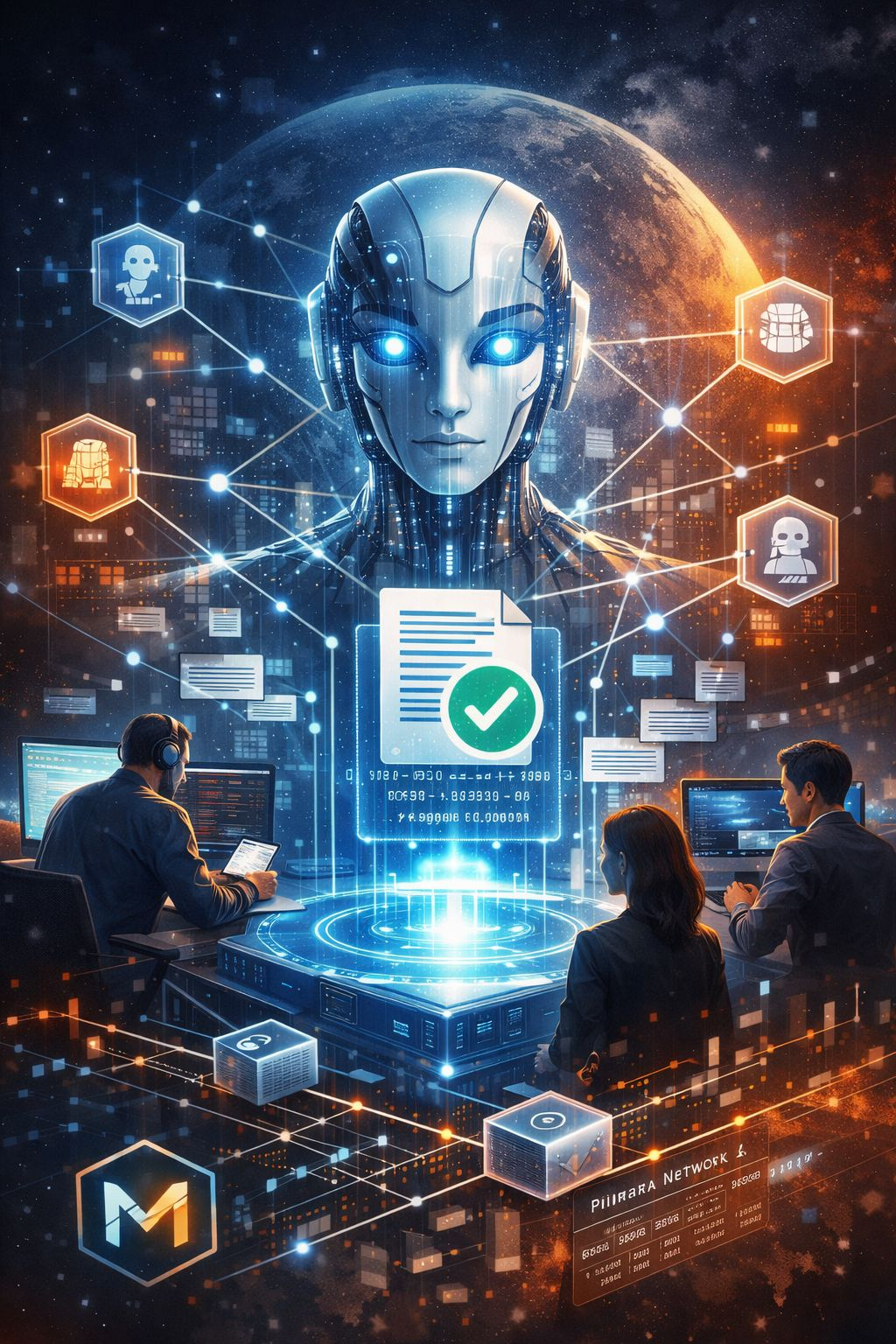
When an AI produces an answer inside the Mira ecosystem, the system does something interesting. Rather than accepting the response as a single piece of information, it breaks the answer into smaller statements that can be evaluated individually. Each claim becomes something that can be checked. These claims are then distributed across a network of independent AI models and verification nodes. Each participant examines the statement and decides whether it appears accurate, uncertain, or incorrect based on its own knowledge and reasoning. Instead of relying on one system’s judgment, the network gathers many opinions and gradually forms a consensus about the reliability of the information.
What makes this approach powerful is that mistakes often reveal themselves when multiple perspectives are involved. A hallucination produced by one model might not convince others. Bias present in one dataset may be balanced by knowledge from another. Through this process, the network filters information in a way that feels similar to how communities of experts examine complex ideas. The final result is not just an answer generated by a machine, but an answer that has been examined and validated through a decentralized process.
Blockchain technology plays a role here because it provides a structure for recording and verifying these decisions without relying on a central authority. Once a claim has been evaluated by the network and consensus is reached, the result can be recorded in a transparent and tamper-resistant system. This means the verification process itself becomes visible and auditable. Anyone using the information can see that it passed through a network of independent validators rather than coming from a single source. In effect, the response becomes more than text on a screen. It becomes a piece of information with a traceable history of validation.
Economic incentives help keep the system functioning honestly. Participants in the network stake tokens in order to take part in the verification process. If they consistently provide reliable evaluations that align with accurate consensus, they are rewarded. If their assessments repeatedly prove to be misleading or incorrect, the system can penalize them. This structure creates an environment where accuracy becomes valuable. Instead of trusting individuals or organizations purely on reputation, the network encourages trustworthy behavior through economic design.
What makes this vision particularly interesting is how it changes the way we think about artificial intelligence itself. For years, most conversations about AI have focused on making models bigger, faster, and more powerful. The race has often been about who can build the smartest system. Mira approaches the challenge from another angle entirely. It suggests that intelligence alone may not be the most important quality. What matters just as much is whether that intelligence can be verified and trusted.
As AI continues to evolve, the world will likely see more systems operating with a high level of autonomy. Software agents may negotiate digital contracts, manage supply chains, analyze legal documents, or assist with complex medical research. In those situations, humans may not have time to manually verify every piece of information the machine produces. A decentralized verification layer could become an invisible safety net beneath these systems, quietly ensuring that important claims have been examined by multiple independent validators before decisions are made.
If that idea becomes reality, the way people interact with artificial intelligence could change in a subtle but important way. Instead of asking whether an AI answer sounds convincing, users might begin asking whether the answer has been verified. Responses could arrive with digital proof showing that many independent systems evaluated the information and reached agreement about its accuracy. In other words, the machine would not simply provide knowledge; it would demonstrate why that knowledge deserves to be trusted.
At its heart, Mira Network reflects a very human understanding of knowledge. No individual mind, human or artificial, is perfect. But when independent thinkers examine the same idea from different angles, their combined perspective often moves closer to truth. By building a decentralized network where artificial intelligence systems constantly verify each other, Mira attempts to transform AI from something that occasionally guesses into something that gradually earns credibility.
The future of artificial intelligence will not depend only on how advanced the technology becomes. It will depend on whether people feel comfortable trusting it in situations that truly matter. Systems that can prove the reliability of their information may ultimately become more valuable than systems that simply generate impressive answers. Mira’s long-term vision rests on that belief. In a world increasingly shaped by intelligent machines, trust may become the most important layer of all.
@Mira - Trust Layer of AI #Mira $MIRA