
In the rapidly evolving world of artificial intelligence, a fundamental shift is underway. Traditional AI platforms think ChatGPT, Grok, Claude, or Google’s Gemini rely on centralized models controlled by a handful of tech giants. These systems are incredibly powerful, capable of generating human like text, code, images, and more. Yet they come with persistent flaws: hallucinations (fabricating facts), biases from training data, lack of transparency in decision-making, and vulnerability to single points of failure or manipulation. Enter Mira Network, a blockchain powered protocol that flips the script by harnessing collective intelligence through decentralized verification. This approach doesn’t just compete with centralized models it aims to make AI fundamentally more reliable and trustworthy.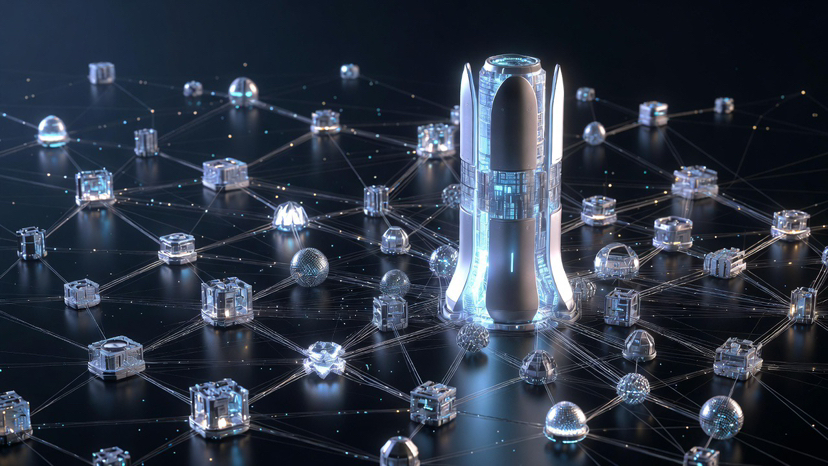
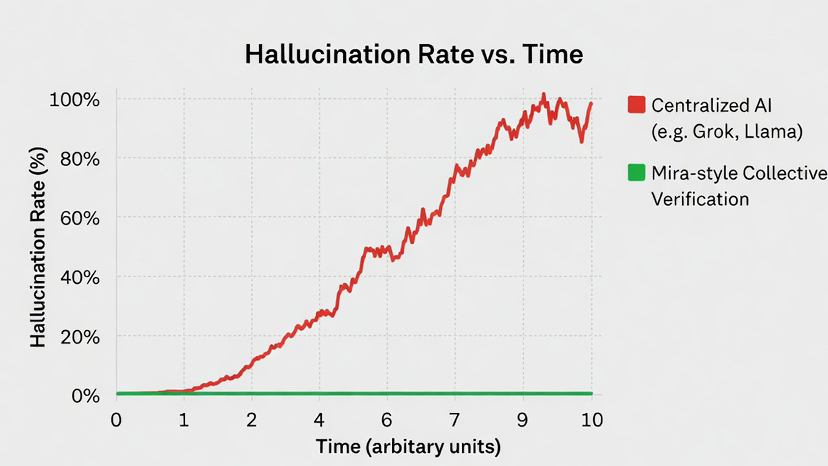
At its core, Mira Network acts as a “trust layer” for AI. Rather than depending on one monolithic model, Mira breaks down AI outputs into smaller, verifiable claims and distributes them across a decentralized network of diverse AI models (nodes). These nodes cross verify each claim using consensus mechanisms inspired by blockchain tech, often achieving verification accuracy around 96% or higher in reported benchmarks. This collective wisdom drastically reduces errors, with some sources noting reductions in hallucinations from ~30% in single models to as low as 5% or below. The network uses crypto-economic incentives staking, rewards, and penalties to ensure honest participation, making manipulation economically unviable.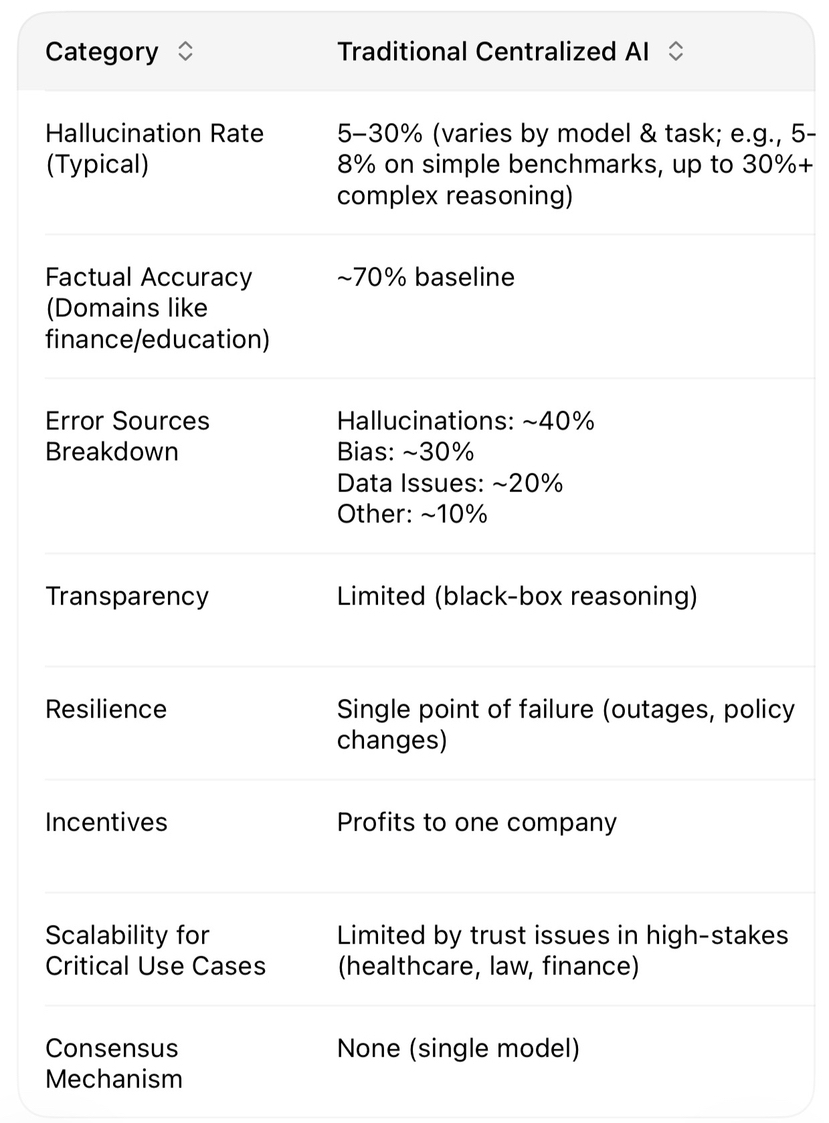
Traditional centralized AI, by contrast, operates in a black-box manner. A single company trains and deploys the model, controls the data, and decides updates. While this allows for rapid scaling and optimization, it creates risks: unchecked biases, opaque reasoning, and potential for misinformation in high stakes fields like finance, healthcare, law, or education. If the central model hallucinates in a critical application say, advising on medical treatment or financial trades the consequences can be severe. There’s no built-in mechanism for external validation beyond the company’s internal checks.
Mira’s decentralized model addresses these issues head-on. By leveraging multiple independent models (from different providers and architectures), it taps into diverse perspectives, much like how a group of experts reviewing a report catches errors a single person might miss. Blockchain ensures the verification process is transparent, immutable, and trustless no single entity can alter results without consensus. This is particularly powerful for autonomous AI agents, which need near-perfect reliability to handle real world decisions without human oversight.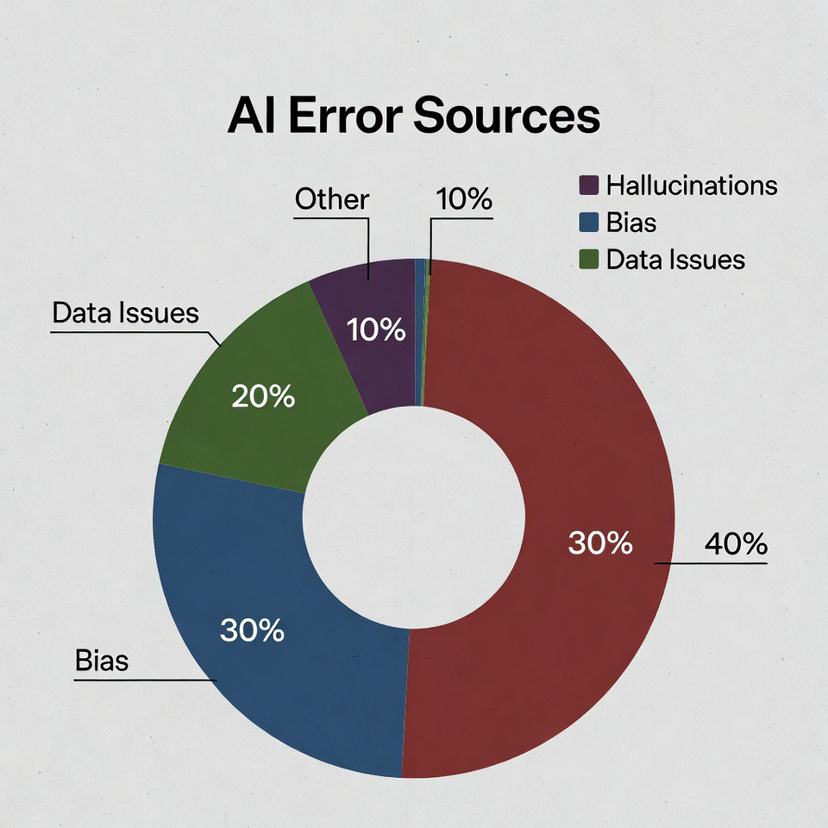
To illustrate the differences, consider this comparison:
• Reliability and Error Reduction — Centralized models often suffer from 10-30% hallucination rates in complex queries. Mira’s collective verification slashes this dramatically, targeting sub -1% error rates through multi-model consensus.
• Transparency — Traditional platforms offer limited insight into why an output was generated. Mira provides on-chain proofs and traceable verification steps.
• Resilience — Centralized systems have single points of failure (e.g., server outages or company policy changes). Decentralized networks distribute compute and verification, enhancing uptime and resistance to censorship or attacks.
• Incentives and Fairness — Centralized AI profits flow to one company. Mira uses tokenomics to reward node operators for accurate verifications, democratizing participation.
• Scalability for Critical Use Cases — In DeFi, healthcare, or legal analysis, trust is non-negotiable. Mira enables verifiable AI outputs that can be audited on-chain, unlocking applications where centralized AI falls short.
Beyond technical superiority, Mira’s approach aligns with broader trends toward decentralized intelligence. Blockchain adds immutability and economic security, turning verification into a provable, tamper-resistant process. This isn’t just incremental improvement it’s a paradigm shift from isolated intelligence to collective, verifiable wisdom.
Of course, challenges remain. Decentralized systems can face latency from consensus rounds or higher costs due to incentives. Yet as Mira processes hundreds of millions of tokens daily and integrates with ecosystems like Base, these hurdles are being addressed. The result? AI that isn’t just smarter, but verifiably trustworthy paving the way for autonomous agents in finance, research, and beyond.
In summary, while traditional centralized platforms excel in raw capability, they struggle with trust. Mira Network’s blockchain-based collective intelligence outperforms them by making reliability the foundation, not an afterthought. As AI integrates deeper into society, this decentralized trust layer may prove essential for a safer, more equitable future.