For a long time, using artificial intelligence has felt a bit like having a conversation with someone who is incredibly knowledgeable but sometimes a little too confident. You ask a question, and the answer arrives almost instantly. It sounds structured, thoughtful, and convincing. Often it even feels smarter than anything you could have written yourself. But then there’s that small moment afterward when you pause and think, “I should probably check this.” That tiny hesitation has quietly become part of everyday life for people who use AI regularly. The technology is powerful, but trust still feels incomplete. The answers sound right, yet we still feel responsible for verifying them ourselves.
This strange relationship between confidence and uncertainty is one of the most important challenges in the AI era. Artificial intelligence is very good at generating language, but generation and truth are not exactly the same thing. Most modern AI systems work by predicting patterns in enormous amounts of data. They learn how sentences usually form, how information is structured, and how ideas are typically explained. When you ask a question, the model predicts what the most likely answer should look like. In many cases that prediction ends up being correct. But sometimes the system fills in gaps with guesses that sound just as confident as real facts. The result is something researchers often describe as “hallucination,” but for everyday users it simply means the AI can occasionally present incorrect information in a very convincing way.
For casual questions this is not a disaster. If an AI gives the wrong recommendation for a movie or misremembers a minor detail in a story, nothing serious happens. But the situation becomes different when AI starts assisting with research, financial decisions, business operations, or automated systems that actually trigger actions in the real world. In those environments, even a small mistake can carry consequences. That is where the idea behind Mira Network begins to make sense. Instead of trying to build an AI that magically never makes mistakes, Mira approaches the problem from a different direction. It starts with the assumption that mistakes are inevitable. The real challenge is figuring out how to detect them quickly and prove which parts of an AI response are actually reliable.
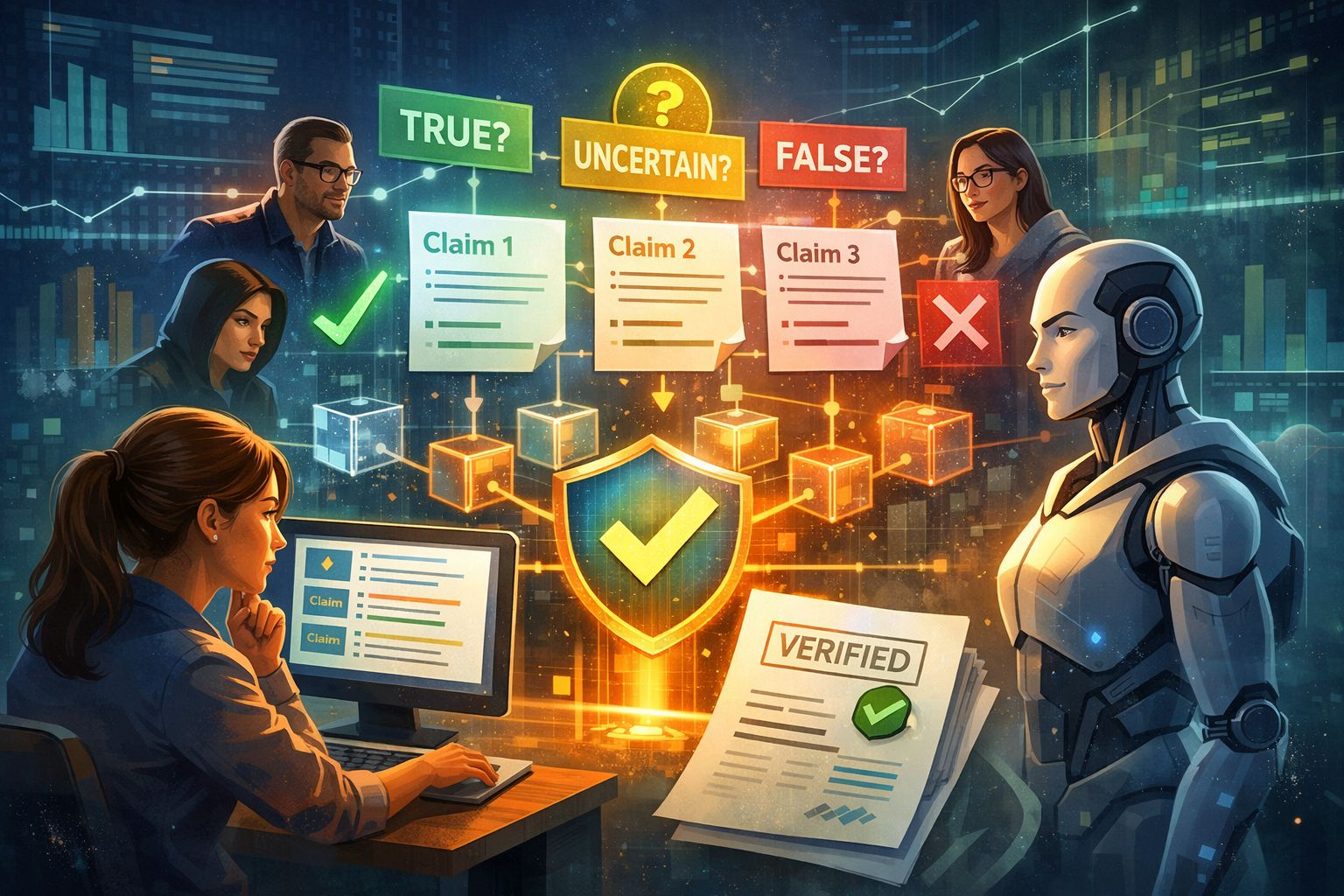
The core idea behind Mira feels surprisingly simple once you hear it. Rather than treating an AI response as one complete piece of text that must be accepted or rejected all at once, Mira breaks that response into smaller pieces. Every paragraph written by an AI usually contains multiple individual claims about the world. It might mention a date, a person, a number, or a cause-and-effect relationship. Instead of verifying the whole paragraph, Mira separates these claims and examines them individually. This small shift changes the entire verification process. In the real world, AI rarely gets everything wrong. More often, one small detail inside an otherwise reasonable explanation is incorrect. By isolating those details, it becomes much easier to evaluate accuracy.
Once the claims are separated, they are sent into a verification network where multiple independent evaluators analyze them. Some of these evaluators can be AI systems trained to check information, while others can be participants who contribute to the verification process. Each claim receives independent assessments, and the results are combined to determine whether the statement appears correct, uncertain, or incorrect. Instead of trusting a single model’s opinion, the network gathers multiple perspectives and produces a result that reflects collective analysis. The outcome can then be recorded in a way that makes the verification process transparent and traceable.
What makes this system particularly interesting is that it does not rely on a single organization controlling the verification process. Mira is designed as a decentralized network, which means that the responsibility for checking claims is distributed across many participants rather than concentrated in one place. This approach helps reduce bias and increases resilience. If verification were controlled by a single authority, that authority could potentially influence results or become a bottleneck for the entire system. By spreading the process across independent participants, Mira attempts to create a more balanced environment where accuracy emerges from collective evaluation rather than centralized control.
Of course, a network like this only works if participants behave honestly, and that is where incentives come into play. People contributing to the verification process are expected to have something at stake. Participants who consistently evaluate claims accurately can earn rewards for their work, while those who behave carelessly or dishonestly risk losing their stake in the system. This economic structure encourages careful verification because accuracy becomes the most beneficial strategy for everyone involved. It transforms verification from a volunteer effort into a structured ecosystem where reliability is directly connected to incentives.
Another important aspect of the system involves privacy. Verification networks could easily become problematic if every participant had access to the full content of every request. Sensitive data might circulate unnecessarily, creating risks for users and organizations. Mira attempts to address this by distributing smaller fragments of information across the network. Individual participants may only see the specific claims they are responsible for verifying rather than the entire context of the original input. This fragmentation helps reduce the chances that any single participant can reconstruct private information while still allowing the network to perform its verification role effectively.
Thinking about the future of artificial intelligence makes this kind of infrastructure feel increasingly relevant. Today most people interact with AI through conversations or simple tasks, but the technology is already moving toward systems that can act more independently. AI agents are beginning to handle scheduling, research assistance, data analysis, and automated workflows across digital platforms. As these systems gain more autonomy, they will start making decisions that directly affect businesses, finances, and daily life. In that world, the reliability of information becomes much more important. A mistaken sentence inside a chat conversation might be harmless, but a mistaken decision made automatically by an AI system could have real consequences.
This is why Mira Network describes itself less as an AI tool and more as a trust layer for AI systems. The goal is to create a structure where AI outputs can be evaluated before they influence important actions. Developers building AI-powered applications could integrate verification into their systems so that generated information passes through a reliability check before being used in real processes. Instead of relying solely on the confidence of the model that produced the answer, applications would have access to an independent verification layer that helps confirm the accuracy of key claims.
The vision is ambitious, and like any new infrastructure it faces real challenges. Verification inevitably requires additional computation, which means the network must remain efficient enough to keep pace with the speed of modern AI systems. Extracting claims from natural language is also a complex task, because language often carries nuance and context that can be difficult to separate cleanly. The system must also handle situations where truth is not absolute but depends on interpretation or evolving information. These are not simple problems, and solving them will require careful development and experimentation over time.
Even so, the direction feels meaningful because it focuses on something fundamental. As AI becomes more integrated into society, trust will become just as important as intelligence. The systems that shape the future will not only need to generate information quickly but also demonstrate that their outputs are dependable. Mira’s approach recognizes that reliability is not something that appears automatically just because a model is powerful. It has to be built into the structure surrounding the model.
If the idea works as intended, the most interesting outcome may be that people eventually stop thinking about it. Users will interact with AI tools just as they do today, asking questions, generating reports, and automating tasks. But behind the scenes, a verification layer will quietly analyze the claims being produced, separating reliable information from uncertain statements. The process will feel invisible, yet it will gradually reshape how people trust the information generated by machines.
In a world where AI will increasingly participate in decision-making, the ability to verify information may become as important as the ability to create it. Mira Network represents one attempt to build that missing layer. Instead of promising a flawless AI that never makes mistakes, it focuses on creating an environment where mistakes can be detected, measured, and corrected before they cause harm. That philosophy feels grounded in reality, because the future of AI will not be defined by perfection. It will be defined by how well we build systems that understand their own limits and give us the tools to trust them responsibly.
@Mira - Trust Layer of AI #Mira $MIRA